The planet would have had the mass of our moon. As Spock says 4% of its mass added to the asteroid belt.There isn't nearly enough mass in the asteroid field to form a planet. There's only enough material there to form a planet about a quarter the size of pluto, and Pluto isn't considered a planet anymore.

-
Welcome! The TrekBBS is the number one place to chat about Star Trek with like-minded fans.
If you are not already a member then please register an account and join in the discussion!
You are using an out of date browser. It may not display this or other websites correctly.
You should upgrade or use an alternative browser.
You should upgrade or use an alternative browser.

Yea. I think with #2 you take that to be less than 4% of the planets mass actually remained in that area and became the asteroid belt that they know of in the future. The other 96% was pieces sent out with extreme velocity and became space debris/asteroids in motion. One large piece becoming a meteorite that ended the dinosaurs on Earth."Less than 4 percent of the planets mass became part of the asteroid belt as we came to know it."
That could go either way.
1. 4 percent of the planet "joined" the preexisting asteroid belt.
Or...
2. 4 percent of the planet became an asteroid belt that continued picking up mass for 65 million years until it eventually came to look like the belt we are familiar with.

Umm, there are IRL.I get what you're saying here, but it would've been better if we had been given a conference room scene where different members of the main cast would argue on the morality of intervening versus not intervening once the reality of the situation is understood. The quandary deserved more than a "hunch."
Again, there's a difference between the characters believing something is true, and it actually being true within setting.
I don't have a problem with stories about the Federation being bigots. There are bigotries in RL, after all.
I do have a problem with a story which implies there are real, biological differences in psychology between different "types" of people, baked into their DNA.


Genetic determinism in Star Trek is bad, because the species are allegorical stand-ins for the diversity of mankind. So if you're arguing that they differ on a fundamental way in terms of behavior or aptitude due to DNA, you're basically telling an allegory about the black/white IQ gap, even if you don't realize it.
It's also bad from a storytelling perspective, as we naturally want stories where people behave in a certain way due to their experiences, not just due to something inherent to them. Like, would DS9 have been better if instead of giving Garak his backstory, they just waved away his behavior by saying "Oh, Cardassians are just biologically predisposed to be distrustful?"
But you also add the dramatic storytelling elements of someone overcoming their predispositions to triumph in the end. For analogy, the sports underdog story isn't very interesting if the main character naturally excels from the beginning.
Well, the entire reason Una and Bashir were facing expulsion was BECAUSE Earth still believes ANY genetically enhanced Humanoid is predisposed to eventually start acting like 'Khan-type' augments of the past. Because of their genetic modification they can't be trusted to follow the principles guiding Star Fleet or the Federation - and thus why they can't serve in any capacity UNLESS they get an 'exemption'.
That's not actually the primary reasoning for the ban. It's to prevent a genetic arms race between parents. If your kid isn't allowed to play chess then you won't want to modify them to be a chess prodigy.

I get what you're saying here, but it would've been better if we had been given a conference room scene where different members of the main cast would argue on the morality of intervening versus not intervening once the reality of the situation is understood. The quandary deserved more than a "hunch."
I guess I don't see it as a moral quandary in the sense that you mean; I see a more personal quandary where Pike was wrong for most of the episode and only admitted it to himself it once he had no other options. I swear I used to know a term for that specific type of catharsis, but it's basically the moment when a character admits they know nothing and gives in to the lesson the story was trying to teach. (I'm thinking here of Jason Nesmith in Galaxy Quest, when he finally admits he's not the Captain.) Those don't come at the end of debate and discussion but rather once all other emotional options are spent.
Of course, in order of that to work, the character has to learn something and spend time growing, or at least contemplating, and the episode didn't do any of that.
(And then you have to ask: well, what kind of lesson was Pike meant to learn? And with this story it sure looks like that lesson might be "sometimes, multiculturalism and tolerance is the wrong approach." And while I think that would be a very, very interesting theme for Trek to tackle, I bet it would be hugely unpopular with most people here.)

Humans are used to ordinary superior ability - smart people, athletes, musical prodigies, and the like. Not so much superheros outside of fiction, or people with higher levels of abilities which they can't be born with.
There's been absolutely nothing onscreen which has shown the augments to be superheroes. Kirk's a normal guy, and bested Khan in a fight! And a lot of the decisions that we see the augments make are as dumb as a box of hammers. Even Julian, aside from some really keen reflexes and being smart, isn't a superhero. And the other augments of his time period (from the "Jack pack") are psychological messes, for various reasons.
I've always interpreted the OG augments as more Gattaca-style genetic engineering. They found the genes which were associated with aptitude at the 99.9% of human ability (both physical and mental) and dropped them into one person, plus eliminating a lot of negative variants for genetic diseases. It's a difference of degree, not one of kind. But the augments were raised to think they were the "next step in Human evolution" so they got a head of steam like modern billionaires. It's not that they somehow implanted evil megalomanic genes as an accident while doing everything else.
Look, I understand what the augments were meant to mean back when Space Seed was done. Nazism wasn't long in the past, and anything smacking of it was a great way to horrify an audience. Not to mention the idea of humanity being "replaced" (by the next stage in our own evolution or machines) is a staple of sci-fi. But if the Trekkian ethos can be boiled down to anything, it's "no monsters, just people." Some of those people make awful individual decisions, but it's not because any race is created evil. Indeed, embracing that is Nazi shit.
So there had been a 'theory' for awhile that the asteroid belt between Mars and Jupiter was a destroyed planet and Ceres was the largest remaining chunk of said planet. That idea has been over the past couple of decades really pushed aside and the belief is that the asteroid belt is leftover material that could have become a planet, but Jupiter's gravity kept it forming.
So then this episode is confirming that pushed aside theory, while at the same time seeming to indicate in the centuries of space travel and exploration the Federation scientists in Sol system never said the asteroid belt was a destroyed planet? Or they did and none of the crew were ever exposed to this teaching?
I get peeved when characters who should have knowledge, don't seem to have the knowledge because the writer wants the audience to go along for the ride. Perhaps let the audience feel like they are' smart' and know what's up (c'mon. We're 65 million years in the past. Oh gee, what big event happened 65 million years in the past)
We've directly imaged plenty of asteroids, and can see that they are heavily cratered bodies over four billion years old. If the asteroids only formed 65 million years ago, they'd be nearly smooth blobs of solidified magma.
Umm, there are IRL.
I'm sorry, what are you arguing here exactly? What real world ethnicities do you believe are genetically predisposed to certain behavior, that other ethnicities are not?

... if we had been given a conference room scene where different members of the main cast would argue on the morality of intervening versus not intervening once the reality of the situation is understood.
Oh, HELL, no...
Oh, HELL, no...
Even if you're not a fan of how it was done in TNG, in The City on the Edge of Forever, Kirk wouldn't have let Edith Keeler die without Spock arguing that it was the logical thing to do.
Fundamentally, Star Trek is drama, which requires conflict - both between the characters and inside them. Not allowing for the characters hash out their ideological conflicts here makes it much poorer, thematically speaking.

There is a famous real life incident of a Newcastle United soccer.fan headbutting a horse along with a subsequent interview.Finally realized what that scene reminded me of:
La'An only pawn in game of life...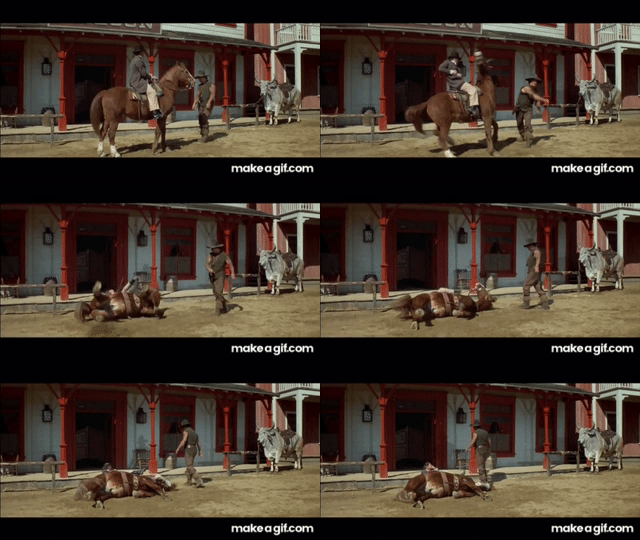
To that sad scene my mind went.

My thoughts went to the multi-armed Green Martians from ERB's Barsoom.Hmmm.... The bug people. Is this also crossing over a bit with Starship Troopers?
Pike isn't Kirk in The City of the Edge of Forever. Pike has been through time travel causality and changes. He's seen the danger of trying to change his own future. He also saw his own romantic partner accept being part of a fixed loop pre-destined thing as well.Even if you're not a fan of how it was done in TNG, in The City on the Edge of Forever, Kirk wouldn't have let Edith Keeler die without Spock arguing that it was the logical thing to do.
Fundamentally, Star Trek is drama, which requires conflict - both between the characters and inside them. Not allowing for the characters hash out their ideological conflicts here makes it much poorer, thematically speaking.
If there's anyone in the Captain's chair who would be able to act unilaterally and accept seeing the destruction of a planet because it meant not changing the future I think it's probably him at this point.

Pick a Universe.. In Dr Who the "Asteroid" was a cyberman space ship, in trek its from a blown up 5th planet.. PICK ONE!
The whole episode felt like sci-fi homages.Hmmm.... The bug people. Is this also crossing over a bit with Starship Troopers?
Cowboy planet is both TOS and Firefly, obviously you have Jurrasic Park, the Martians were very Flash Gordon style matinée characters and of course the bugs launching an attack asteroid is Starship Troopers.

Plus for Trek fans who've been invested in the franchise the insectoids is also a callback to the Xindi-Insectoid threat from the 22nd century.
Complete with the scar in Mars.Plus for Trek fans who've been invested in the franchise the insectoids is also a callback to the Xindi-Insectoid threat from the 22nd century.
How cool would that have been for the Xindi back story though? If they were actually the descendants of a sleeper ship launched from the planet and then 65 mil years later they come back to their home solar system and do the same to Earth that their distant ancestors did to Mars.
Both Earth and Mars have weapons scars. Earth's healed, though, and was filled in, while the one on Mars remains for the rest of time.

True, but there's only so much you can do with a franchise whose entire thing is a guy stalking and killing people. That story will always have a short shelf life.Right they were successful because people were curious. I hated Freddy Vs Jason and still do.... Though I do like Abbott and Costello. But those films were effectively the end of those franchises. Freddy was rebooted but it failed.
Not ethnicities. You were claiming genetics don't influence Phychological makeup and that's not true.I'm sorry, what are you arguing here exactly? What real world ethnicities do you believe are genetically predisposed to certain behavior, that other ethnicities are not?
Examples include Idiot Savants, people with eidetic memory. and some people "on the spectrum" - they all often have a genetic component that causes or contributes.
(And then you have to ask: well, what kind of lesson was Pike meant to learn? And with this story it sure looks like that lesson might be "sometimes, multiculturalism and tolerance is the wrong approach." And while I think that would be a very, very interesting theme for Trek to tackle, I bet it would be hugely unpopular with most people here.)
The Paradox of Tolerance is an overdue subject for Trek to tackle.
I'm sorry, what are you arguing here exactly? What real world ethnicities do you believe are genetically predisposed to certain behavior, that other ethnicities are not?
I'll bite. Twin studies show that approximately 50% of a persons core personality traits are inherited, with the other half being environmental (but of the society at large not necessarily the individual family itself). Now we've only just begun to try and trace what genes affect the 5 big personality traits (Openness, Conscientiousness, Extraversion, Agreeableness, and Neuroticism). But if they are genetic then statistically there has to be differences in ratio in isolated populations, just like there are more redheads in Ireland. But actually tracking that across ethnicity is a minefield no one wants to step into. At best you'll get research into things like distribution of the genes for CRHR1 which controls stress and anxiety hormones, for example.
Similar threads

- Poll
- Replies
- 599
- Views
- 70K

- Poll
- Replies
- 1K
- Views
- 79K

- Poll
- Replies
- 563
- Views
- 54K

- Poll
- Replies
- 561
- Views
- 64K
- Poll
- Replies
- 574
- Views
- 21K
If you are not already a member then please register an account and join in the discussion!