• Welcome! The TrekBBS is the number one place to chat about Star Trek with like-minded fans.
    If you are not already a member then please register an account and join in the discussion!

Star Trek: Strange New Worlds 4x01 - "Valles Marineris"

Rate the episode...


  • Total voters
    121
In the Pale Moonlight doesn't deal with time travel. neither does The Best of Both Worlds, Mirror Mirror, Duet, etc. Now Yesterday's Enterprise is a top tier episode, easily Top 10 TNG, but I wouldn't put it at the #1 spot.

Thinking about it, and assuming you're not including movies, you're probably implying that The City on the Edge of Forever is the"best episode". To me The City on the Edge of Forever is third most overrated Trek episode after The Inner Light, a boring waste of time that is still somehow less bad then the original script but thats a low bar to clear. Its an episode I'll never rewatch unless for some reason I need to make myself simultaneously very annoyed and really bored. I mean I would rewatch it over The Inner Light or that horrible "Captain Sisko is a sci fi writer in the 50s" DS9 episode, but the bar is in the dirt at that point.

I pretty strongly agree with some of your takes here, but I'll note The City on the Edge of Forever is quite different from what this episode is doing.

The City on the Edge of Forever is a character drama like all of the best Trek episodes. It revolves around Kirk's emotional conflict between his love for Edith Keeler and his sense of responsibility to restore the timeline to what it should have been. Kirk is placed in an impossible situation between two awful choices, and he decides to not save Keeler's life because he understands in the end, duty overwhelms love. But it's still a choice - it's his choice to fix the timeline, as we know the bad timeline has already happened due to McCoy's actions.

In contrast, Pike has no real emotional conflict here, because he only realizes the decision before him like 10 seconds before the moment of his (in)action. He doesn't wrestle over anything. And although he feels some sense of duty as a Starfleet captain to stop a genocide (or at least, not allow his own ship's antimatter to be used to cause one), this is a pretty rarified intellectual issue. The bug people are not given any sense of humanity here. We don't have a humanized character to act as a stand in, as we do for the Martians. Pike presumes that maybe it's all a big misunderstanding and they aren't a senseless killing machine, but we're shown nothing to suggest that (hell, we're shown nothing to show them as killing machine either - we just are told). This would all have worked much better if the Commander's people were the ones on the fifth planet, and ended up getting blown up, because then we'd have a sense of dramatic pathos here.

But worst of all, unlike in TOS where they were trying to fix an alternate timelike "back to normal" here we have the strong implication of a causality loop. This completely lets Pike off the hook, because it's not a story of character agency, but "destiny." IRL, I'm actually someone who's very suspicious of the idea free will exists, but in a story focusing on a supposedly heroic captain, it really diminishes the protagonist.
 
10 minutes in and this episode already has horses, dinosaurs, and a shuttle named after Maria Skłodowska Curie - on top of the usual space and technology. Nerdy girl bingo completed. Were I 15 years younger, I would have been ecstatic. But now, I feel like I'm aging out of Star Trek (which I am not).
As always, loved Anson Mount's performance. Martin Quinn was great too.
That said, the first contact situation felt a little too simplistically written for its context. The Martians are an advanced race that has adapted to thrive in hostility and claims to be at war with another race. And while they clearly can determine that the Enterprise and its crew pose no threat, I think them approaching the situation with a lot more caution would have been more logical.
I liked the part about the universal translator not being able to immediately pick up all the nuances of a new language. It felt like a nod to the idea that language learning still matters, even with such an advanced technology. I also enjoyed the glimpse into how the translator works.
Erica's character has gained some depth since "Terrarium," and it is a pleasure to see. Pelia continues to be a delight.
That being said, the main plot of the episode seemed a little far-fetched to me. The concept itself is interesting, but the execution lacked a certain grace and rigor. It felt like the writers tried to cram too many ideas into one episode, making the plot feel overcrowded. But maybe it's just me.
Una's promotion - absolutely lovely. Now I can get my hopes up about seeing her get her own starship by the end of season 5.
Without the promotion, I'd give it 6.5 out of 10, but the last five minutes bumped it to a 7. Also, the CGI gave me vertigo.
 
The weird focus SNW has on genetic determinism is one of the worst aspects of the show thematically.
That's not an SNW thing - it's a STAR TREK Franchise thing whenever they've had a feature film (STII:TWoK) or episode like:

TOS S1 - Space Seed
DS9 S5 - Doctor Bashir I Presume
ENT S4 - Borderland & Cold Station 12 & The Augments
SNW S2 - Ad Astra per Aspera
:shrug:
 
Finally realized what that scene reminded me of:

97YqBh.gif

La'An only pawn in game of life...
Yes - and that scene was great.

La'an did something TOTALLY unexpected and insane (but DEFINITELY in character for her) and yeah, I LOVED that the Dinosaur was also more shocked itself and just ran off.
:guffaw:

Also, this next part is NOT directed at all to the Poster I replied to, just my own statement on what I'm seeing posted in this thread by many:

And yeah, STAR TREK has NEVER been 'Hard' Science Fiction so I don't get all the handwringing about 'scientific accuracy' from some of the Posters in this thread.

The episode was 100% classic STAR TREK.
 
That's not an SNW thing - it's a STAR TREK Franchise thing whenever they've had a feature film (STII:TWoK) or episode like:

TOS S1 - Space Seed
DS9 S5 - Doctor Bashir I Presume
ENT S4 - Borderland & Cold Station 12 & The Augments
SNW S2 - Ad Astra per Aspera
:shrug:
Add in Prodigy and Janeway sticking up for Dal to get into Starfleet Academy, despite his genetic engineering.

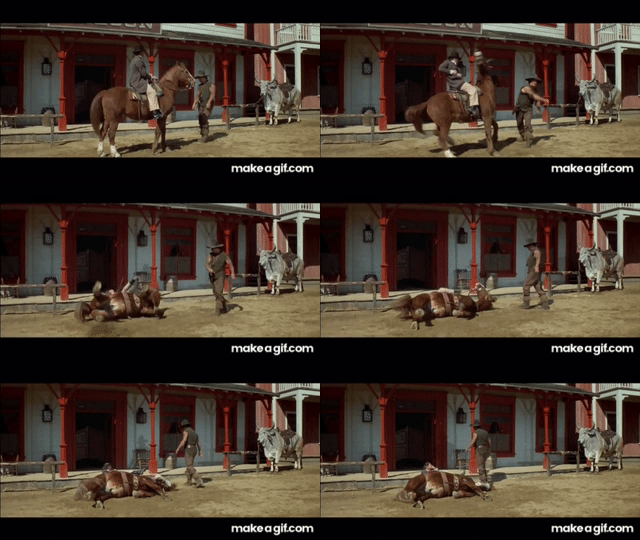
One thing I forgot to mention in my review is I kind of wish the cowboy stuff was it's own episode. We know Pike loves to ride a horse, and apparently Mount has a thing for Horses too. I think if that teaser was made into a 45 minute episode, it would have been a ton of fun. Also, La'an looked amazing in the cowgirl getup.
 
As much as I love Doctor Who, I sincerely hope it ends here. They are two completely different fictional universes, with different histories, alien races, ect.

If they really DO a crossover, for me the show will have completely jumped the shark (if it hasn't already with a few past eps.)
I'd be up for a direct to steaming movie/special that we could endlessly debate the canonicity of, but I'd prefer not to have it as a regular episode of either show.
 
That's not an SNW thing - it's a STAR TREK Franchise thing whenever they've had a feature film (STII:TWoK) or episode like:

TOS S1 - Space Seed
DS9 S5 - Doctor Bashir I Presume
ENT S4 - Borderland & Cold Station 12 & The Augments
SNW S2 - Ad Astra per Aspera
:shrug:
Correct. That's baked in to Star Trek. "Superior ability breeds superior ambition." Why certain characters became ESPers, or even Spock bring made fun of for his human ancestry.
 
That's not an SNW thing - it's a STAR TREK Franchise thing whenever they've had a feature film (STII:TWoK) or episode like:

TOS S1 - Space Seed
DS9 S5 - Doctor Bashir I Presume
ENT S4 - Borderland & Cold Station 12 & The Augments
SNW S2 - Ad Astra per Aspera
:shrug:

I'd really, really disagree that either Dr. Bashir, I Presume or Ad Astra per Aspera were genetically determinist. They were about genetic discrimination against augmented people. Sure, it's established within canon that Augments have superhuman strength/reflexes, etc., but the entire point of both stories is you should judge people as individuals, not based upon their genetic background.

With Space Seed it's a bit up in the air, IMHO. Kirk says "superior ability breeds superior ambition," but I don't know if means he's literally arguing they have a gene for will to power. And the augments in ENT are shown onscreen as being a bunch of idiotic manbabies (probably due to how Arik Soong raised them).

Regardless, Four and a Half Vulcans last season was just awful, because it directly stated that if you give humans Vulcan DNA, they just become these arrogant "logical" pricks. Except for La'an, who somehow became a "Romulan" and started to want to devise harebrained schemes to take over the galaxy. Never mind that Trek has shown in canon that Vulcans are instinctively highly prone to strong emotions, and only cultural practices of repression keep them logical. Or that Romulans and Vulcans are genetically speaking the same people.

Genetic determinism in Star Trek is bad, because the species are allegorical stand-ins for the diversity of mankind. So if you're arguing that they differ on a fundamental way in terms of behavior or aptitude due to DNA, you're basically telling an allegory about the black/white IQ gap, even if you don't realize it.

It's also bad from a storytelling perspective, as we naturally want stories where people behave in a certain way due to their experiences, not just due to something inherent to them. Like, would DS9 have been better if instead of giving Garak his backstory, they just waved away his behavior by saying "Oh, Cardassians are just biologically predisposed to be distrustful?"

Anyway, the show has lost is goodwill for me when it comes to DNA-related stuff, so I really hope that it doesn't go where this was hinting. Though TBH, the advanced screeners suggest my worst fears won't pan out here.
 
Except for La'an, who somehow became a "Romulan" and started to want to devise harebrained schemes to take over the galaxy. Never mind that Trek has shown in canon that Vulcans are instinctively highly prone to strong emotions, and only cultural practices of repression keep them logical. Or that Romulans and Vulcans are genetically speaking the same people.

So does that mean Romulans could be Vulcan Augments from long-ago experimentation?
 
In contrast, Pike has no real emotional conflict here, because he only realizes the decision before him like 10 seconds before the moment of his (in)action. He doesn't wrestle over anything. And although he feels some sense of duty as a Starfleet captain to stop a genocide (or at least, not allow his own ship's antimatter to be used to cause one), this is a pretty rarified intellectual issue. The bug people are not given any sense of humanity here. We don't have a humanized character to act as a stand in, as we do for the Martians. Pike presumes that maybe it's all a big misunderstanding and they aren't a senseless killing machine, but we're shown nothing to suggest that (hell, we're shown nothing to show them as killing machine either - we just are told). This would all have worked much better if the Commander's people were the ones on the fifth planet, and ended up getting blown up, because then we'd have a sense of dramatic pathos here.

I think it's still compelling because Pike spends most of the episode trying to help in the only way he knows how -- by applying the default values of the Federation and hoping they stick. He has a climatic moment of realization where he must decide to go against his own nature and accept his own powerlessness, and that's interesting. It's an idea our culture appears to be wrestling with at the moment, as it's also featured in Backrooms. It's not the same as CotEoF but it's still pretty good.

But worst of all, unlike in TOS where they were trying to fix an alternate timelike "back to normal" here we have the strong implication of a causality loop. This completely lets Pike off the hook, because it's not a story of character agency, but "destiny." IRL, I'm actually someone who's very suspicious of the idea free will exists, but in a story focusing on a supposedly heroic captain, it really diminishes the protagonist.

This is a much more serious issue, imo. I really liked the episode up until the last 10 or so minutes, but the final glad-handing between April and Pike about what happened (plus the inappropriate final "cool" CG shot) soured me. A quieter, sadder ending with Pike upset at his own (inevitable?) actions would have been better.
 
I'd really, really disagree that either Dr. Bashir, I Presume or Ad Astra per Aspera were genetically determinist. They were about genetic discrimination against augmented people. Sure, it's established within canon that Augments have superhuman strength/reflexes, etc., but the entire point of both stories is you should judge people as individuals, not based upon their genetic background.

With Space Seed it's a bit up in the air, IMHO. Kirk says "superior ability breeds superior ambition," but I don't know if means he's literally arguing they have a gene for will to power. And the augments in ENT are shown onscreen as being a bunch of idiotic manbabies (probably due to how Arik Soong raised them).

Regardless, Four and a Half Vulcans last season was just awful, because it directly stated that if you give humans Vulcan DNA, they just become these arrogant "logical" pricks. Except for La'an, who somehow became a "Romulan" and started to want to devise harebrained schemes to take over the galaxy. Never mind that Trek has shown in canon that Vulcans are instinctively highly prone to strong emotions, and only cultural practices of repression keep them logical. Or that Romulans and Vulcans are genetically speaking the same people.

Genetic determinism in Star Trek is bad, because the species are allegorical stand-ins for the diversity of mankind. So if you're arguing that they differ on a fundamental way in terms of behavior or aptitude due to DNA, you're basically telling an allegory about the black/white IQ gap, even if you don't realize it.

It's also bad from a storytelling perspective, as we naturally want stories where people behave in a certain way due to their experiences, not just due to something inherent to them. Like, would DS9 have been better if instead of giving Garak his backstory, they just waved away his behavior by saying "Oh, Cardassians are just biologically predisposed to be distrustful?"

Anyway, the show has lost is goodwill for me when it comes to DNA-related stuff, so I really hope that it doesn't go where this was hinting. Though TBH, the advanced screeners suggest my worst fears won't pan out here.
Well, the entire reason Una and Bashir were facing expulsion was BECAUSE Earth still believes ANY genetically enhanced Humanoid is predisposed to eventually start acting like 'Khan-type' augments of the past. Because of their genetic modification they can't be trusted to follow the principles guiding Star Fleet or the Federation - and thus why they can't serve in any capacity UNLESS they get an 'exemption'.
 
I think it's still compelling because Pike spends most of the episode trying to help in the only way he knows how -- by applying the default values of the Federation and hoping they stick. He has a climatic moment of realization where he must decide to go against his own nature and accept his own powerlessness, and that's interesting. It's an idea our culture appears to be wrestling with at the moment, as it's also featured in Backrooms. It's not the same as CotEoF but it's still pretty good.

I get what you're saying here, but it would've been better if we had been given a conference room scene where different members of the main cast would argue on the morality of intervening versus not intervening once the reality of the situation is understood. The quandary deserved more than a "hunch."

Well, the entire reason Una and Bashir were facing expulsion was BECAUSE Earth still believes ANY genetically enhanced Humanoid is predisposed to eventually start acting like 'Khan-type' augments of the past. Because of their genetic modification they can't be trusted to follow the principles guiding Star Fleet or the Federation - and thus why they can't serve in any capacity UNLESS they get an 'exemption'.

Again, there's a difference between the characters believing something is true, and it actually being true within setting.

I don't have a problem with stories about the Federation being bigots. There are bigotries in RL, after all.

I do have a problem with a story which implies there are real, biological differences in psychology between different "types" of people, baked into their DNA.
 
So there had been a 'theory' for awhile that the asteroid belt between Mars and Jupiter was a destroyed planet and Ceres was the largest remaining chunk of said planet. That idea has been over the past couple of decades really pushed aside and the belief is that the asteroid belt is leftover material that could have become a planet, but Jupiter's gravity kept it forming.

So then this episode is confirming that pushed aside theory, while at the same time seeming to indicate in the centuries of space travel and exploration the Federation scientists in Sol system never said the asteroid belt was a destroyed planet? Or they did and none of the crew were ever exposed to this teaching?

I get peeved when characters who should have knowledge, don't seem to have the knowledge because the writer wants the audience to go along for the ride. Perhaps let the audience feel like they are' smart' and know what's up (c'mon. We're 65 million years in the past. Oh gee, what big event happened 65 million years in the past)
 
it would've been better if we had been given a conference room scene where different members of the main cast would argue on the morality of intervening versus not intervening once the reality of the situation is understood.

Or if you want to keep the split second decision-making, frame it as a closed-door hearing in which everyone testifies using flashbacks.
 
The box office for Freddy v Jason would disagree with you. :shrug:

I thought it was a very entertaining movie and I still go back to it from time to time.

I won't disagree that crossovers are usually the point when franchises run out of ideas. Eg: Frankenstein Meets the Wolfman, House Of Dracula, House of Frankenstein and Abbot and Costello meet Frankenstein etc. But those movies were very successful and looked back on very fondly. As long as the creative stays true to what was established for both franchises and puts them together in an interesting wat, a crossover will work.

Right they were successful because people were curious. I hated Freddy Vs Jason and still do. 😂... Though I do like Abbott and Costello. But those films were effectively the end of those franchises. Freddy was rebooted but it failed.
 
There isn't nearly enough mass in the asteroid field to form a planet. There's only enough material there to form a planet about a quarter the size of pluto, and Pluto isn't considered a planet anymore.
 
If you are not already a member then please register an account and join in the discussion!

Sign up / Register


Back
Top