• Welcome! The TrekBBS is the number one place to chat about Star Trek with like-minded fans.
    If you are not already a member then please register an account and join in the discussion!

The overall Harry Potter Years 1-7 story arc

Rate Years 5-7 of the Harry Potter story arc

  • 5

    Votes: 0 0.0%
  • Years 5-7 kept improving, and went out on a very high note

    Votes: 2 20.0%
  • Years 5-7 kept improving, and went out on a high note

    Votes: 2 20.0%
  • The series maintained consistent quality throughout

    Votes: 2 20.0%
  • Years 5-7 were a bit weaker than Years 1-4, and went out on an okay note

    Votes: 1 10.0%
  • Years 5-7 were much weaker than Years 1-4, and ended badly

    Votes: 3 30.0%

  • Total voters
    10
Well, I'd like it to, but given this is supposed to be a more accurate take on the books, I doubt they'd do much more than what's already there, if they do. Because then there'd be grumblings that it's not accurate to the books. I doubt they'll stray very far.

This thread isn't about the TV series; it's specifically about the story as told in the books and reflected in the movies, so if there's anything about the story you wish the books had done differently, now's the time to discuss it. :)
 
To me the biggest problem is that Voldy is established as an existential threat to wizarding society, and yet it's unclear that any wizards outside of those in the UK even particularly took notice of him.

Were the wizards in the US aware of him? And if so, why didn't they do a damn thing to help?

The idea is that it was just the British Wizards who saw him that way and to everyone else, the "War" was just an internal skirmish and not anything bigger.
 
The idea is that it was just the British Wizards who saw him that way and to everyone else, the "War" was just an internal skirmish and not anything bigger.
I don't recall anything in the books that explicates this. Indeed, given Voldy's ambitions for wizarding kind, I don't know how other wizards could even feel that way. It's not like he was planning to stop with the UK.
 
I don't recall anything in the books that explicates this. Indeed, given Voldy's ambitions for wizarding kind, I don't know how other wizards could even feel that way. It's not like he was planning to stop with the UK.

The Bulgarians Wizards apparently didn't take him seriously, the Bulgarian Wizard who fought for him not only got barely a slap on the wrist but ended up becoming the Headmaster for the Bulgarian school.
 
This thread isn't about the TV series; it's specifically about the story as told in the books and reflected in the movies, so if there's anything about the story you wish the books had done differently, now's the time to discuss it. :)

You're right. My Bad. Somehow I conflated the two threads.
 
Soooooooo, getting back on track... I'm curious if anyone else expected or hoped that other nations' magical societies would play a larger role in the seven-year-story?
Yes, definitely. After the fourth book I expected Durmstrang and Beauxbatons or at least Krum and Fleur to have much bigger roles instead they were reduced to cameos.

I also thought Hogwarts would be ditched as the primary setting for book 5, Harry hadn't actually been safe there since book 1 and by book 4 Voldemort managed to literally kidnap Harry from the grounds so what was the point of keeping up the pretense? It felt like Rowling was expanding the world in book 4 to get away from Hogwarts and explore the wizarding world but then this simply didn't happen. Not even when the trio eventually got away from Hogwarts in book 7, they wandered the countryside a bit but there was not a lot of expanding happening, they visited a bunch of previously established locations and a few private homes.
 
The idea is that it was just the British Wizards who saw him that way and to everyone else, the "War" was just an internal skirmish and not anything bigger.
Hmm, Harry Potter as a commentary on Britain's post-Thatcher decline and reckoning with no longer being the political and cultural center of the world. (See also, Jack Wade's snark to James Bond in GoldenEye.)

No, no, there's no way Rowling intended that reading. It's a clever idea and I like it (if that's what you intended), but, no, Rowling's Britishcentrism in the saga works against it.
 
I also thought Hogwarts would be ditched as the primary setting for book 5, Harry hadn't actually been safe there since book 1 and by book 4 Voldemort managed to literally kidnap Harry from the grounds so what was the point of keeping up the pretense? It felt like Rowling was expanding the world in book 4 to get away from Hogwarts and explore the wizarding world but then this simply didn't happen. Not even when the trio eventually got away from Hogwarts in book 7, they wandered the countryside a bit but there was not a lot of expanding happening, they visited a bunch of previously established locations and a few private homes.
The writer Andrew Rilstone wrote an essay that tackles this -- the differences between the Hogwarts-centric early books and the fuzzier later books -- almost twenty years ago. He ascribes an almost "A-plot/B-plot" dichotomy to it.

Each of the seven Harry Potter books contains two different stories. One story typically concerns some dramatic event from the past. It's often something which will impact on Harry's life and call into question something he believes in: maybe his father wasn't quite the saint he thought him to be; or perhaps Dumbledore secretly fathered a love child with Mary Magdalene. The second story describes how Harry-ron-and-hermione collect a series of clues – fragments of old letters, anecdotes narrated by other characters, and un-convincing plot devices like Tom Riddle's sentient diary and the magic pot that contains the headmaster's memories. Eventually, they have enough MacGuffins to re-construct the back story, at which point Prof. Dumbledore pops up and shows them how it all fits together.

Now, in books 1 and 2, the focus was entirely on the front-story: that is "the adventure of a new-bug at a funny school". We only cared about the identity of the Heir of Slytherin and the location of the Philosopher's Stone in so far as they provided a pretext for Harry to leave the dorm after lights out, sneak into the girls' toilets (sorry, bathrooms) and generally have a thrilling but slightly naughty time. Even Lord Voldemort is primarily a plot device: a bit of doublethink which allows Harry to be excused and even sometimes rewarded for breaking the school rules. ("The dog ate my homework" and "I have a medical condition which means I have to eat chocolates during maths" don't work nearly so well as "I had to do it because otherwise the Dark Lord would have covered all the lands of Middle-Earth in a second darkness.")

In the third and best of the books, the front story and the back story were about equally important. Harry Potter and the Prisoner of Azkaban is a thrilling school story about an escaped murderer possibly hiding out in the school grounds; but when Harry learns the convict's identity, he also discovers some genuinely interesting things about his parents and the origins of Lord Voldemort.

From volume 4 onwards, the focus increasingly shifts to the back-story. It feels as if the story which Rowling wants to tell is not the one about Harry-ron-and-hermione, but the one about Harry's parents and their contemporaries. Harry is simply the lens through which James Potter, Lilly Evans, Tom Riddle and the rest come into focus. In Harry Potter and the Deathly Hallows, the school story has atrophied completely. We learn about the childhood and early career of Prof. Dumbledore. We find out why he was content to remain a school-teacher instead of taking on some job that would have been more appropriate to his talents – Minister for Magic, emissary of the Valar or Anglican Deity. (This is not very interesting.) It is revealed (for the sixteenth or seventeenth time) whether Prof. Snape is a dark wizard pretending to be a good wizard; a good wizard pretending to be a dark wizard; or a dark wizard pretending to be a good wizard pretending to be a dark wizard pretending to be a good wizard. (This is actually rather well done.) Harry-ron-and-hermione's function in all this is to traipse around the countryside collecting two different sets of plot coupons – the "horocruxes" which contain parts of the Dark Lord's soul, and the interesting but largely irrelevant "deathly hallows". J.K is so wrapped up in herself that she can't see why we might think that "A Harry Potter book which is mostly not set at Hogwarts School" is a slightly odd notion.

So, instead of following any conventional narrative structure, the books are built like computer games. Deathly Hallows reads (seriously) like the novelization of a third person quest adventure. Characters decide which location to explore; they visit each room in that location in turn; they pick up clues or solve a puzzle; they sift out which clues are relevant to their quest, what is a red herring, and what is a pointer to some sub-plot or side-quest. When they meet another character, the main thing is to work out what question they need to ask it in order that it will recite the next section of the back story. Harry is linked telepathically to Voldemort; and the occasional flashes where he sees the world through the Dark Lord's eyes feel an awful lot like cut-scenes.

I also think the shift in focus comes about at the point where Rowling will no longer be edited.
 
I also think the shift in focus comes about at the point where Rowling will no longer be edited.

Yes, the first 3 books clearly had an Editor who knew what they were doing. Tightly plotted, no padding, to the point.

Then in Book 4 suddenly the series becomes one of those typical bloated, convoluted self-indulgent series that comes from authors who had no one telling them to get to the point.
 
There's an odd symmetry between the final book of HP and the final book of The Dark Tower in that both involve our protagonists spending vast amounts of time journeying without a great deal really happening to them; journeys that might be perceived as lulls in the narrative by some readers.

To add to that symmetry, for me; I'm pretty sure I began reading the HP books because Stephen King suggested them in On Writing. I liked the first two movies well enough, but not enough to read the books upon which they were based. Prisoner of Azkaban was easily better than the first two films (and perhaps remains the one I consider the best executed overall), but I'm not sure whether I would have started reading the books solely based on the strength of that film. And then I found Goblet of Fire to be a disappointment, so if I hadn't already started the books I might have opted not to at that point.
 
There's an odd symmetry between the final book of HP and the final book of The Dark Tower in that both involve our protagonists spending vast amounts of time journeying without a great deal really happening to them; journeys that might be perceived as lulls in the narrative by some readers.

To add to that symmetry, for me; I'm pretty sure I began reading the HP books because Stephen King suggested them in On Writing. I liked the first two movies well enough, but not enough to read the books upon which they were based. Prisoner of Azkaban was easily better than the first two films (and perhaps remains the one I consider the best executed overall), but I'm not sure whether I would have started reading the books solely based on the strength of that film. And then I found Goblet of Fire to be a disappointment, so if I hadn't already started the books I might have opted not to at that point.

Goblet of Fire is where the major problems all start to manifest. The stories become very contrived, the writing is unnecessarily bloated and loose, whole plotlines go nowhere and the characterizations go very wonky. Poor Ron suffers the most.
 
I also thought Hogwarts would be ditched as the primary setting for book 5, Harry hadn't actually been safe there since book 1 and by book 4 Voldemort managed to literally kidnap Harry from the grounds so what was the point of keeping up the pretense?

How cool would it have been to have Harry and his group of friends moved to a new school elsewhere for their safety? I mean, if you're The Boy Who Lived, special considerations would need to be taken to ensure the kid's safety, even if it means moving him around. Would be a logistical nightmare though.

I don't know if anybody here's read R.F Kuang's Babel, but that is set in an alternate history Oxford where there is magic, with translation at the heart of it, culminating in a message about colonialism and its effect on those under its thumb. It's a brilliant book.
 
Soooooooo, getting back on track... I'm curious if anyone else expected or hoped that other nations' magical societies would play a larger role in the seven-year-story? As I recall, when Deathly Hallows came out, there was a fair amount of grumbling about the extended camping trip that made up a fair amount of the book's narrative and page count. Would anyone else here have preferred a visit to Beauxbatons and/or Dumstrang, or somewhere else, than what we got? Offhand, I can't think of any important new location the last two Years (books or movies) introduced other than the horcrux zombie cave and the grave of Harry's parents, and I'm not sure the latter even qualifies as "important."

To be honest, I was so engrossed with the story that was being told in the last couple books that I didn't
really care about the other schools or magical societies. The books were titled Harry Potter, not the wonderful wizarding world. So focusing on Harry's quest to eliminate Voldemort makes more sense than trailing off into something else.
 
I really wasn't that bothered by the later books, I thought they were at least better than Sorcerer's Stone and Chamber of Secrets.
No its not. Thats an opinion.


Seriously? That is apples and oranges. But if you want to go there, Mcdonalds built their brand in the 50s by delivering good food at a reasonable price in a fraction of the time. If their food sucked, no one would have bothered and they would have went the way of Burger Queen and every other fast food chain that no longer exists.


If you want to believe she is a bad writer, that is your prerogitive. Im not interested in changing anyones opinion. It just isnt based by any measurable that people normally quantify with successful writers.. Bad writers dont sell hundreds of millions of books. Just like bad shows dont score high ratings. One opinion is not the majority.
I don't think I've ever seen anybody actually call the Michael Bay Transformers movies good, but they still managed to make billions of dollars. There are often things other than overall quality that draw people to something. It wasn't a bad show by any stretch, but I still have to wonder if Game of Thrones would have still been as popular if it didn't have all of the graphic sex, nudity, and violence.
Soooooooo, getting back on track... I'm curious if anyone else expected or hoped that other nations' magical societies would play a larger role in the seven-year-story? As I recall, when Deathly Hallows came out, there was a fair amount of grumbling about the extended camping trip that made up a fair amount of the book's narrative and page count. Would anyone else here have preferred a visit to Beauxbatons and/or Dumstrang, or somewhere else, than what we got? Offhand, I can't think of any important new location the last two Years (books or movies) introduced other than the horcrux zombie cave and the grave of Harry's parents, and I'm not sure the latter even qualifies as "important."

As for the location of the final battle... I'm of two minds. On the one hand, I can't help feeling that having it be in Hogwarts was a boring and lazy choice that prevented the overall story from being an epic, because an epic fundamentally involves a long journey to a far-off place, with Mount Doom and the third Death Star being classic examples. What's more, having the ultimate battle of good vs. evil be decided at a children's school feels just plain silly. That said, Hogwarts is the center of the overall story, so I'm not sure where else it could have taken place. (Certainly not the dull and underwhelming underground Ministry of Magic!)

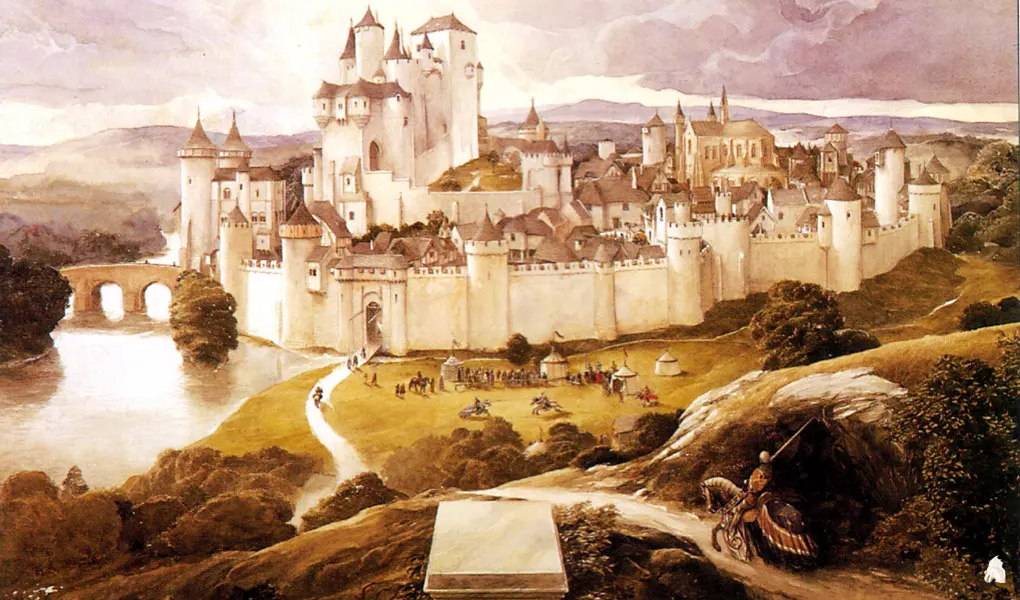
Maybe if the last year or two had built up to Voldy reclaiming, say, the hidden/lost castle of Camelot as the final step in his grand plan, that could have made a fitting site. Heck, doing so could have paid off the in-universe introduction of the historical wizard Merlin, from Harry's first train ride to Hogwarts.

126595-2x.webp


"Camelot" by Alan Lee
No, that would have made it even worse. It would an even bigger distraction and divergence from the story being told that what we got in the Deathly Hollows that we got. The series was also supposed to be about Hogwarts, and the fact that it spent so little time there was of my least favorite parts of Deathly Hollows,
To me the biggest problem is that Voldy is established as an existential threat to wizarding society, and yet it's unclear that any wizards outside of those in the UK even particularly took notice of him.

Were the wizards in the US aware of him? And if so, why didn't they do a damn thing to help?

I don't recall anything in the books that explicates this. Indeed, given Voldy's ambitions for wizarding kind, I don't know how other wizards could even feel that way. It's not like he was planning to stop with the UK.
I could have sworn there were refences at one point to Fleur and Bill Weasly working to get help from the French, and possibly Krum working to get help from Bulgaria.
 
I could have sworn there were refences at one point to Fleur and Bill Weasly working to get help from the French, and possibly Krum working to get help from Bulgaria.
It's certainly possible, but given how the books turned out, that feels a bit like tokenism, since in the end, unless I've seriously forgotten something, neither the French nor the Bulgarians play much, if any, role.
 
This popped up on my feed. Fairly good summary of the different schools and why there's still much material that could be done with, namely the 3 unrevealed schools that practically scream to be made a series about.

To view this content we will need your consent to set third party cookies.
For more detailed information, see our cookies page.
 
there are probley some alternate earths in the multiverse where the harry potter books kept going along with the movies

and there are probley also more alternate earths in the multiverse where the harry potter rebooted into a tv series came out after the final movie of the harry potter anthology
 
No, there probably isn't since the whole point of the series was to follow Harry and his friends 7 years at Hogwarts, so they're always going to stop at book 7.
 
Yes, the first 3 books clearly had an Editor who knew what they were doing. Tightly plotted, no padding, to the point.

Then in Book 4 suddenly the series becomes one of those typical bloated, convoluted self-indulgent series that comes from authors who had no one telling them to get to the point.

Now don’t be inviting ASOIAF and its author into the discussion without a proper invitation and dinner, with extra descriptions of each course served, etc. ;)

Cheers,
-CM-
 
If you are not already a member then please register an account and join in the discussion!

Sign up / Register


Back
Top