INTRODUCTION
I've managed to find six threads on this board about UFO, all of them posted between 2009 and 2014, well past the two-year limit for additional contributions. So, this post is an effort to kick off more discussion, and hopefully, maybe even generate a few new fans.
For those who have no idea what I'm talking about, UFO was a British science-fiction TV show; filming started in late 1969, and it was first broadcast in the UK, Canada and Japan in late 1970, and in the USA two years later. So, it can be considered to be a contemporary of the original series of Star Trek. Twenty-six episodes were made.
It was made by Gerry Anderson, who had previously made many children's TV series featuring puppets and models, the most famous being Thunderbirds. For those unfamiliar with these productions, their style and feel were perfectly parodied in the movie "Team America: World Police". UFO was his first TV production to target an adult audience, with a live cast. This allowed the incorporation of more adult themes in the storylines, such as drug use, moral dilemmas, extra-marital affairs, personal tragedy, etc. It was almost entirely humourless, I can only remember a single bit that was meant to be funny, and that only lasted for a couple of seconds. Oh, and I thought the theme music was great.
The core of the story is that the Earth is under attack from a race of technically superior aliens, who are fighting for their survival. It turns out that they are a dying race who initially came to Earth in order to harvest human organs to transplant into ailing individuals (which was always the weakest part of the story in my view… but you’ve just got to go along with it and enjoy the ride), with the eventual goal of eradicating all human life on Earth and then colonizing the planet before theirs is no longer able to sustain their race. When the authorities realized what was happening, they formed the Supreme Headquarters of the Alien Defence Organization (SHADO for short), to protect the Earth from the attacks which were becoming more frequent. SHADO had two main control centres, one on Earth which was located underneath the Harlington-Straker movie studio in England (don’t ask why… just go with it), and the other on the Moon, called Moonbase, which was the first line of defence against incoming UFO attacks. In order to prevent widespread panic, SHADO operated in complete secrecy, and any leakage of information regarding the attacks was aggressively suppressed. SHADO was led by American ex-military man Commander Ed Straker (though he had political masters who he was regularly in conflict with), who had a civilian alter-ego (of the same name), the chief executive of the movie studio. The alien attacks came in waves of numerous UFOs (UFO always being pronounced you-foe), and although most of them didn’t get past the Moonbase defences, some did make it to Earth, and most episodes delt with one of these incidents. Almost everything is portrayed from a human point of view, we never see inside a UFO, hear the aliens communicate with each other, or see their home planet (except for a few photographs of it from space, which turned out to be useless). UFO is set in 1980, about ten years after production, and though some of the expectations were about right (computer technology using large magnetic tape storage), some were very optimistic (a manned base on the lunar surface, with video-phone links to Earth), and changes in fashion were understandably mis-anticipated (there were not that many mini-skirts still around in 1980, and shirt and ties never died out).
Anderson’s team had ten years’ experience of presenting vehicles on-screen using models, and this was used to very good effect, allowing for a huge number of different vehicles to be portrayed at a fraction of the cost of using full-sized mock-ups. This included the UFOs, spacecrafts, ground-based vehicles (on Earth and the Moon), aircrafts, and submarines, though the cars used were full size.
It’s time for a confession, one of the reasons I was an avid viewer in the early seventies was because I had a massive teenage crush on Lieutenant Gay Ellis (Gabrielle Drake), but funnily enough, only when she was wearing her purple wig and heavy eye make-up. When she was back on Earth, in her “natural” state, she didn’t do anything for me. But I digress …
THE REVIEW
“The Complete Book Of Gerry Anderson's UFO” was written by Chris Bentley and originally published in 2003, a second edition in 2006, and a third in 2016. It appears to have been reprinted in 2017 to coincide with the release of the Blu-ray box set. This review is of the final edition. It is written in UK English; hence, so is this review.
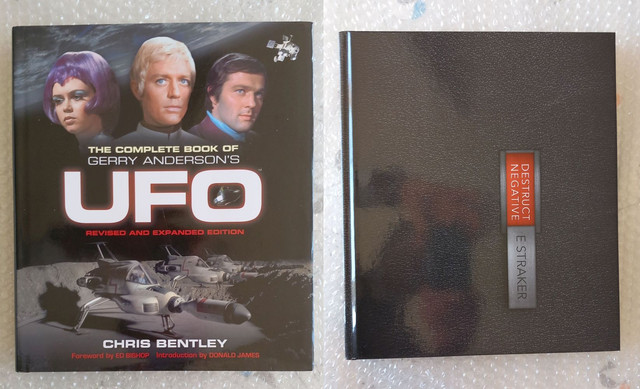
Available in paperback and hardback, it has 200 24x28cm pages, printed on high quality glossy paper. The vast majority of the photographs are in colour, though there are some in black and white. A nice touch is that if you remove the dust jacket from the hardback version, the "naked" book looks like Straker's briefcase from the pilot episode, depicting the slider used to deactivate the destruct mechanism on the back cover.
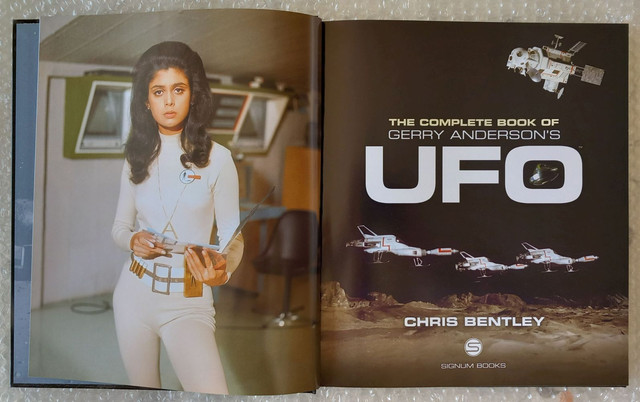
Following a Forward written by Ed Bishop (the star of the show), and an Introduction to the edition, there are a total of 22 chapters, organized as six "reports", namely (I have no idea what CBGAU stands for):
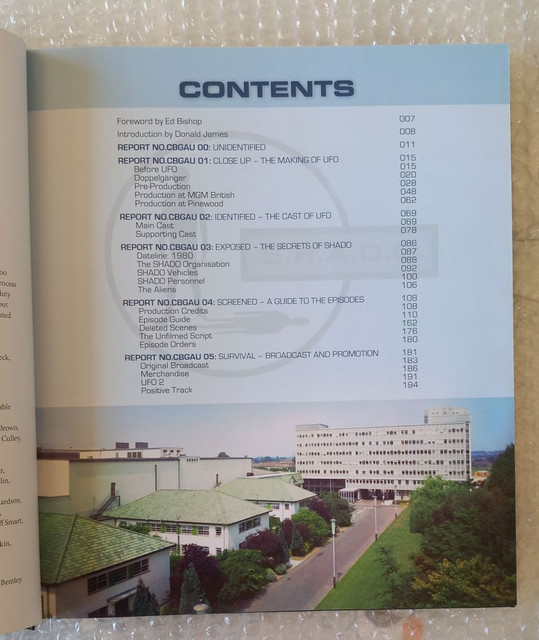
REPORT NO.CBGAU 00: UNIDENTIFIED (5 pages)
Fictional content. Contains a single chapter.
Comprises fifteen newspaper articles, dated from 1878 to 1970, reporting on various UFO sightings, and related military/political issues. Even though they are illustrated with pictures of UFOs from the show, I was not sure if they were genuine or fabricated, until I got to the last one, which describes the UFO attack on the Rolls Royce containing Straker (with his briefcase) and his political masters from the opening episode.
REPORT NO.CBGAU 01: CLOSE UP - THE MAKING OF UFO (54 pages)

Real-world content. Contains five chapters:
Before UFO
A history of the careers of Lew Grade and Gerry Anderson which led to the creation of UFO.
Doppelganger
A detailed examination of “Doppelganger” (a.k.a. “Journey To The Far Side Of The Sun”), a 1968/9 British science fiction movie about a planet discovered by a solar probe that matched the Earth’s orbit around the sun, but was always located directly behind the Sun from Earth’s point of view, hence it had remained undetectable from Earth. A manned mission to explore the newly discovered planet is launched, with very surprising consequences. It starred Ray Thinnes, the star of the American sci-fi TV series “The Invaders”, other well-known cast members being Ian Hendry and Herbert Lom. So, what’s all this got to do with UFO, you may ask. Well, it was written by Gerry and Sylvia Anderson, and although the storylines were unrelated, it can be considered to be a template for UFO, using many of the sets, props, costumes and vehicles that would later appear in UFO. Also, the cast included Ed Bishop, George Sewell, Vladek Sheybal, Norma Ronald, Keith Alexander and Basil Moss who would all go to become regular members of the cast of UFO.
Pre-Production
Twenty pages of detailed descriptions of all the work required before filming was started. This covers things like the scriptwriting, casting, designing and creating the sets, outfits, vehicles, and deciding on the overall look and feel of the end product.
Something I find particularly interesting is the fact that UFO may have been the first live-action TV show to get around the problem of rolling/strobing lines appearing on TV monitors when filmed with a film camera due to the different frame rates used. It was important because there were a huge number of scenes with someone looking at a computer monitor or TV screen. I think they had to arrange those shots so that a cable between the camera and the monitor required to synchronize their operation was not visible in the shot.
Production at MGM British
The first seventeen episodes were filmed at the MGM British studios, and this chapter goes into a lot of detail about many different aspects of the production of these episodes. The studio was shut down in late 1969, bringing twenty years of British film production at the site to an end.
Production at Pinewood
The final nine episodes were filmed at Pinewood studios, with a break in production required to re-build many of the original sets at the new location. This chapter details the production of these later episodes.
REPORT 02: IDENTIFIED - THE CAST OF UFO (17 pages)
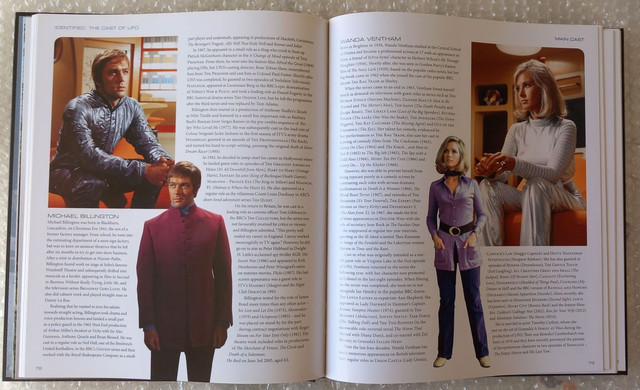
Real-world content. Contains two chapters:
Main Cast
Contains detailed biographies of the ten main cast members. Illustrated with good quality pictures, they provide plenty of personal background information and comprehensive details of other TV shows and movies in which they have appeared. Ed Bishop gets two pages, George Sewell, Michael Billington, Wanda Ventham, Gabrielle Drake and Vladek Sheybal get one page, and Peter Gordeno, Grant Taylor, Dolores Mantez and Harry Baird get half a page.
Supporting Cast
The remaining fifteen cast members who appeared in more than one episode get similar treatment, with Ayshea Brough and Norma Ronald getting a whole page, ten others getting half a page and the final three getting a third of a page.
REPORT NO.CBGAU 03: EXPOSED - THE SECRETS OF SHADO (22 pages)
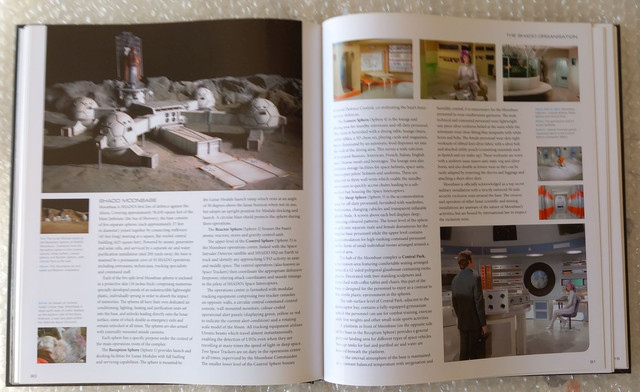
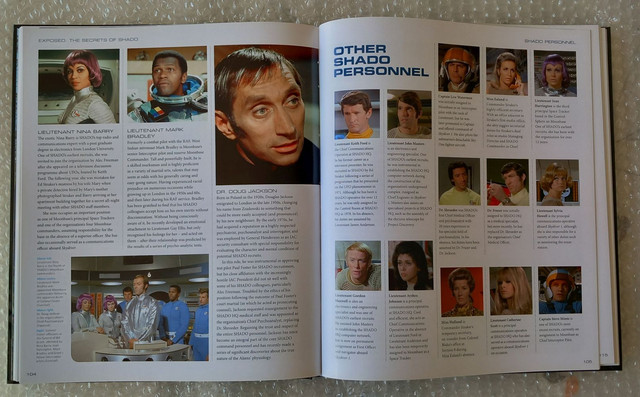
Fictional content. Contains five chapters:
Dateline: 1980
A one-page “history” of events from 1969 up the depicted version of 1980.
The SHADO Organisation
Details of SHADO, mainly concerned with the two main sites, the headquarters beneath the Harlington-Straker Studio, and Moonbase.
SHADO Vehicles
Details, and many photographs, of sixteen types of vehicles used by SHADO. Some appear in many episodes, some in just one or two.
SHADO Personnel
Presented in a similar way to the cast in earlier chapters, this chapter provides background character information for the main SHADO personnel.
The Aliens
A summary of what is known about the aliens; mostly their physiology, technology and telepathic abilities.
REPORT NO.CBGAU 04: SCREENED - A GUIDE TO THE EPISODES (73 pages)
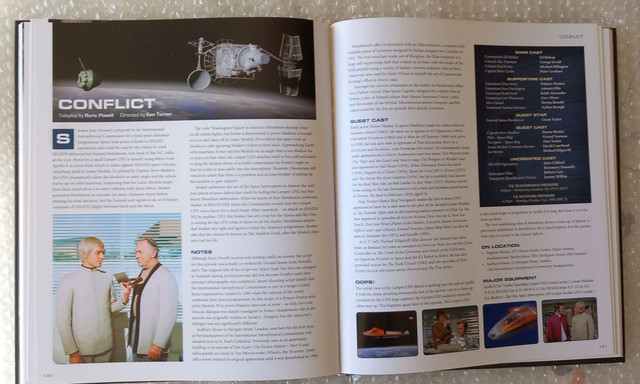
Real-world and fictional content. Contains five chapters:
Production Credits
Two pages of very detailed lists of just about everyone who was involved in the production of the show in any way, to the extent of naming all sixty-eight members of the orchestra.
Episode Guide
Each of the twenty-six episodes gets two pages, containing a number of stills, and seven sections of information, these being:
Detailed scripts of filmed scenes from twelve episodes which didn’t make it to the final cut of the episode, together with photos taken during the filming. The cuts were usually made so as to achieve a required running time for each episode of 47’30”.
The Unfilmed Script
This chapter deals with an episode entitled “The Patriot” which never made it into production. There are three pages detailing the plot, with notes about the evolution of the storyline. The last page contains the scripts for two of the planed scenes.
Episode Orders
A regular subject of discussion amongst UFO fans is in what order the episodes are best viewed. The show was broadcast in different regions of the UK on different dates by the various ITV regional companies, with little consistency between the orders of episode transmission. The only consistency is that the pilot episode “Identified” is shown first, immediately followed by “Exposed” which tells the story of how the Paul Foster character came to join SHADO. The same thing happened in overseas territories where it was up to the broadcaster in what order they would transmit the other episodes. There are only a few “flashback” scenes which only make sense if the scenes being flashed-back to have been seen previously. This jumbling-up of episodes does have a benefit, because the cast changed significantly between the early and late filmed episodes (Ed Bishop was the only one to appear in every episode) this is not obvious when viewing the episodes, it just appears that some characters are in some episodes and not in others.
This chapter lists the transmission orders used in eleven different regions/territories, together with transmission dates for each episode.
REPORT NO.CBGAU 05: SURVIVAL - BROADCAST AND PROMOTION (14 pages)
Real-world content. Contains four chapters:
Original Broadcast
Contains a description of how the show was promoted, to the broadcasters and the public, in the period between completion of production and initial broadcast. It also describes how it was received when broadcast, and what competition it faced from shows on other channels.
Merchandise
Contains descriptions and photographs of all types of UFO merchandising, including books, comics, toys and models, bubble-gum cards, jigsaw puzzles, etc.
UFO 2
This chapter describes events related to the production of the planned second season of UFO. Due to its successes around the world, particularly in the USA, a second season of UFO was commissioned. It was decided that SHADO HQ would move from Earth to a greatly expanded Moonbase, and pre-production commenced with the new sets required for the new primary setting. But… because UFO was broadcast in many American markets immediately before the Saturday evening showings of “All In The Family”, the top-rated show on American television at the time, its viewing figures benefitted from leading into such a popular show, and when “All In The Family” ended its season’s run this benefit disappeared and UFO’s ratings dipped significantly. This threw the money-men into a bit of a panic, and they eventually decided to cancel UFO 2 rather than risk not getting back the large sums of money it would cost to make it. Rather than just junk all the stuff that had already been produced, the sets for the expanded Moonbase became the sets for Moonbase Alpha in what was to become, at the time, the most expensive TV series ever produced – Space 1999 (which in my humble opinion was nowhere near as good as UFO).
There are also descriptions of some miscellaneous matters, such as the release of a 90-minute movie (made up of scenes from three of the episodes) for the Italian market where UFO was very popular, this gave Italian fans the opportunity to see UFO in colour as RAI (the Italian broadcaster) only broadcast in black-and-white before 1977. It also has pictures of three European Super-8mm home movie releases allowing people with the means, to watch on a big screen at home long before home video recorders became available.
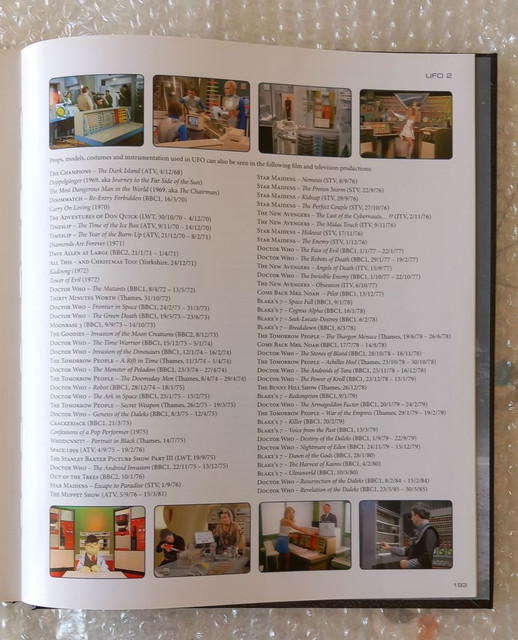
The sets, props and other paraphernalia used in UFO’s production were used in many other TV show episodes and movies; this chapter includes a list of these “appearances”, which includes twenty-one episodes of Doctor Who, and ten episodes of Blake’s 7.
Positive Track
The final chapter is a bit of a hodgepodge of information about UFO related matters since its transmission in the 1970’s. It covers things like the fandom, re-runs, home media releases up to the Blu-ray box-set, etc.
CONNECTIONS TO STAR TREK
I've managed to identify five (well... four and a bit) points of contact between UFO and Star Trek. If anyone can come up with more, then please share.
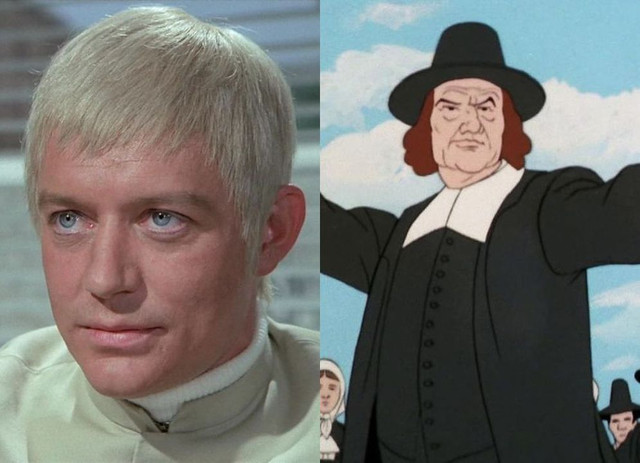
Ed Bishop, who played Commander Ed Straker, provided the voice for the character Asmodeus in the Star Trek: The Animated Series episode "The Magicks of Megas-Tu". Although he was uncredited, you only have to hear his voice to know it's definitely him.
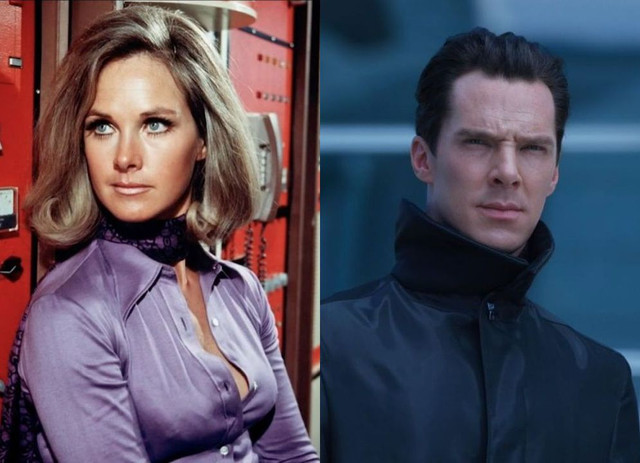
Wanda Ventham, who played Colonel Virginia Lake, is the mother of Benedict Cumberbatch, who played Khan in “Star Trek Into Darkness”.

Stephanie Beacham, who played Sarah Bosanquet in the UFO episode “Destruction”, played the hologram Countess Barthalomew in the Star Trek The Next Generation episode “Ship In A Bottle”.
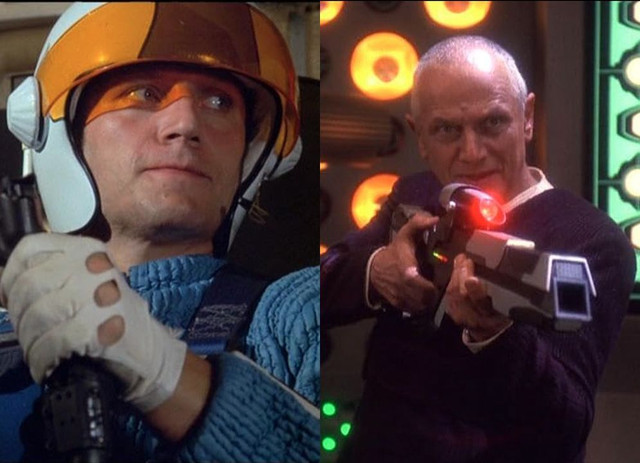
Steven Berkoff, who played Interceptor pilot Steve Minto in a few episodes of UFO, played Hagath the extremely unpleasant arms dealer in the Star Trek Deep Space Nine episode “Business As Usual”.
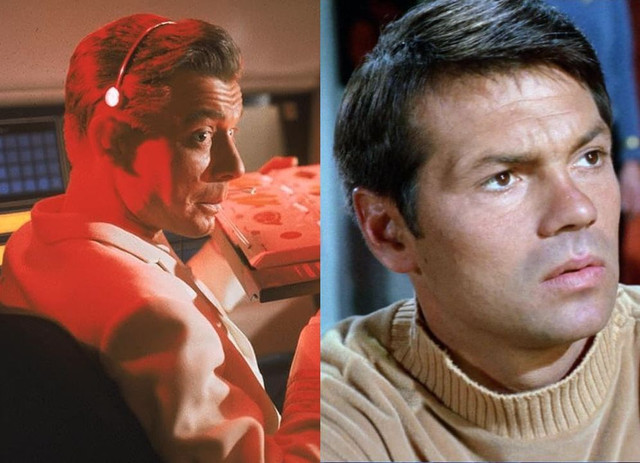
This one's very tentative... Ed Bishop and Gary Lockwood, who played Lt Commander Gary Mitchell in the Star Trek Original Series episode “Where No Man Has Gone Before”, both appeared in “2001: A Space Odyssey”. Bishop played the captain of the Aries-1B Lunar Shuttle; he filmed several scenes, but they were nearly all cut from the final version, leaving just three brief appearances, without any dialog. Lockwood was one of the stars of the movie, playing Frank Poole, the astronaut who HAL kills towards the end of the movie (I’m pretty sure that won’t constitute a spoiler for anyone reading this).
Finally, this is not really a connection, but is worth mentioning. Four episodes into its initial run in three UK ITV regions in 1970, BBC1 launched the first run of the third season of Star Trek. There was a ten-minute overlap of the transmission times. By this time Star Trek had built up a very strong UK viewership, and with no video recorders available at the time, this undoubtably damaged UFO’s viewing figures.
I've managed to find six threads on this board about UFO, all of them posted between 2009 and 2014, well past the two-year limit for additional contributions. So, this post is an effort to kick off more discussion, and hopefully, maybe even generate a few new fans.
For those who have no idea what I'm talking about, UFO was a British science-fiction TV show; filming started in late 1969, and it was first broadcast in the UK, Canada and Japan in late 1970, and in the USA two years later. So, it can be considered to be a contemporary of the original series of Star Trek. Twenty-six episodes were made.
It was made by Gerry Anderson, who had previously made many children's TV series featuring puppets and models, the most famous being Thunderbirds. For those unfamiliar with these productions, their style and feel were perfectly parodied in the movie "Team America: World Police". UFO was his first TV production to target an adult audience, with a live cast. This allowed the incorporation of more adult themes in the storylines, such as drug use, moral dilemmas, extra-marital affairs, personal tragedy, etc. It was almost entirely humourless, I can only remember a single bit that was meant to be funny, and that only lasted for a couple of seconds. Oh, and I thought the theme music was great.
The core of the story is that the Earth is under attack from a race of technically superior aliens, who are fighting for their survival. It turns out that they are a dying race who initially came to Earth in order to harvest human organs to transplant into ailing individuals (which was always the weakest part of the story in my view… but you’ve just got to go along with it and enjoy the ride), with the eventual goal of eradicating all human life on Earth and then colonizing the planet before theirs is no longer able to sustain their race. When the authorities realized what was happening, they formed the Supreme Headquarters of the Alien Defence Organization (SHADO for short), to protect the Earth from the attacks which were becoming more frequent. SHADO had two main control centres, one on Earth which was located underneath the Harlington-Straker movie studio in England (don’t ask why… just go with it), and the other on the Moon, called Moonbase, which was the first line of defence against incoming UFO attacks. In order to prevent widespread panic, SHADO operated in complete secrecy, and any leakage of information regarding the attacks was aggressively suppressed. SHADO was led by American ex-military man Commander Ed Straker (though he had political masters who he was regularly in conflict with), who had a civilian alter-ego (of the same name), the chief executive of the movie studio. The alien attacks came in waves of numerous UFOs (UFO always being pronounced you-foe), and although most of them didn’t get past the Moonbase defences, some did make it to Earth, and most episodes delt with one of these incidents. Almost everything is portrayed from a human point of view, we never see inside a UFO, hear the aliens communicate with each other, or see their home planet (except for a few photographs of it from space, which turned out to be useless). UFO is set in 1980, about ten years after production, and though some of the expectations were about right (computer technology using large magnetic tape storage), some were very optimistic (a manned base on the lunar surface, with video-phone links to Earth), and changes in fashion were understandably mis-anticipated (there were not that many mini-skirts still around in 1980, and shirt and ties never died out).
Anderson’s team had ten years’ experience of presenting vehicles on-screen using models, and this was used to very good effect, allowing for a huge number of different vehicles to be portrayed at a fraction of the cost of using full-sized mock-ups. This included the UFOs, spacecrafts, ground-based vehicles (on Earth and the Moon), aircrafts, and submarines, though the cars used were full size.
It’s time for a confession, one of the reasons I was an avid viewer in the early seventies was because I had a massive teenage crush on Lieutenant Gay Ellis (Gabrielle Drake), but funnily enough, only when she was wearing her purple wig and heavy eye make-up. When she was back on Earth, in her “natural” state, she didn’t do anything for me. But I digress …
THE REVIEW
“The Complete Book Of Gerry Anderson's UFO” was written by Chris Bentley and originally published in 2003, a second edition in 2006, and a third in 2016. It appears to have been reprinted in 2017 to coincide with the release of the Blu-ray box set. This review is of the final edition. It is written in UK English; hence, so is this review.
Available in paperback and hardback, it has 200 24x28cm pages, printed on high quality glossy paper. The vast majority of the photographs are in colour, though there are some in black and white. A nice touch is that if you remove the dust jacket from the hardback version, the "naked" book looks like Straker's briefcase from the pilot episode, depicting the slider used to deactivate the destruct mechanism on the back cover.
Following a Forward written by Ed Bishop (the star of the show), and an Introduction to the edition, there are a total of 22 chapters, organized as six "reports", namely (I have no idea what CBGAU stands for):
REPORT NO.CBGAU 00: UNIDENTIFIED (5 pages)
Fictional content. Contains a single chapter.
Comprises fifteen newspaper articles, dated from 1878 to 1970, reporting on various UFO sightings, and related military/political issues. Even though they are illustrated with pictures of UFOs from the show, I was not sure if they were genuine or fabricated, until I got to the last one, which describes the UFO attack on the Rolls Royce containing Straker (with his briefcase) and his political masters from the opening episode.
REPORT NO.CBGAU 01: CLOSE UP - THE MAKING OF UFO (54 pages)
Real-world content. Contains five chapters:
Before UFO
A history of the careers of Lew Grade and Gerry Anderson which led to the creation of UFO.
Doppelganger
A detailed examination of “Doppelganger” (a.k.a. “Journey To The Far Side Of The Sun”), a 1968/9 British science fiction movie about a planet discovered by a solar probe that matched the Earth’s orbit around the sun, but was always located directly behind the Sun from Earth’s point of view, hence it had remained undetectable from Earth. A manned mission to explore the newly discovered planet is launched, with very surprising consequences. It starred Ray Thinnes, the star of the American sci-fi TV series “The Invaders”, other well-known cast members being Ian Hendry and Herbert Lom. So, what’s all this got to do with UFO, you may ask. Well, it was written by Gerry and Sylvia Anderson, and although the storylines were unrelated, it can be considered to be a template for UFO, using many of the sets, props, costumes and vehicles that would later appear in UFO. Also, the cast included Ed Bishop, George Sewell, Vladek Sheybal, Norma Ronald, Keith Alexander and Basil Moss who would all go to become regular members of the cast of UFO.
Pre-Production
Twenty pages of detailed descriptions of all the work required before filming was started. This covers things like the scriptwriting, casting, designing and creating the sets, outfits, vehicles, and deciding on the overall look and feel of the end product.
Something I find particularly interesting is the fact that UFO may have been the first live-action TV show to get around the problem of rolling/strobing lines appearing on TV monitors when filmed with a film camera due to the different frame rates used. It was important because there were a huge number of scenes with someone looking at a computer monitor or TV screen. I think they had to arrange those shots so that a cable between the camera and the monitor required to synchronize their operation was not visible in the shot.
Production at MGM British
The first seventeen episodes were filmed at the MGM British studios, and this chapter goes into a lot of detail about many different aspects of the production of these episodes. The studio was shut down in late 1969, bringing twenty years of British film production at the site to an end.
Production at Pinewood
The final nine episodes were filmed at Pinewood studios, with a break in production required to re-build many of the original sets at the new location. This chapter details the production of these later episodes.
REPORT 02: IDENTIFIED - THE CAST OF UFO (17 pages)
Real-world content. Contains two chapters:
Main Cast
Contains detailed biographies of the ten main cast members. Illustrated with good quality pictures, they provide plenty of personal background information and comprehensive details of other TV shows and movies in which they have appeared. Ed Bishop gets two pages, George Sewell, Michael Billington, Wanda Ventham, Gabrielle Drake and Vladek Sheybal get one page, and Peter Gordeno, Grant Taylor, Dolores Mantez and Harry Baird get half a page.
Supporting Cast
The remaining fifteen cast members who appeared in more than one episode get similar treatment, with Ayshea Brough and Norma Ronald getting a whole page, ten others getting half a page and the final three getting a third of a page.
REPORT NO.CBGAU 03: EXPOSED - THE SECRETS OF SHADO (22 pages)
Fictional content. Contains five chapters:
Dateline: 1980
A one-page “history” of events from 1969 up the depicted version of 1980.
The SHADO Organisation
Details of SHADO, mainly concerned with the two main sites, the headquarters beneath the Harlington-Straker Studio, and Moonbase.
SHADO Vehicles
Details, and many photographs, of sixteen types of vehicles used by SHADO. Some appear in many episodes, some in just one or two.
SHADO Personnel
Presented in a similar way to the cast in earlier chapters, this chapter provides background character information for the main SHADO personnel.
The Aliens
A summary of what is known about the aliens; mostly their physiology, technology and telepathic abilities.
REPORT NO.CBGAU 04: SCREENED - A GUIDE TO THE EPISODES (73 pages)
Real-world and fictional content. Contains five chapters:
Production Credits
Two pages of very detailed lists of just about everyone who was involved in the production of the show in any way, to the extent of naming all sixty-eight members of the orchestra.
Episode Guide
Each of the twenty-six episodes gets two pages, containing a number of stills, and seven sections of information, these being:
- A synopsis of the episode’s storyline, including how it ends, which is unlikely to constitute a spoiler for anyone who bought the book.
- Some miscellaneous notes covering things like changes from the original script, deleted scenes, re-use of sets/props from earlier episodes, or other shows.
- Some quite detailed information about the lives and careers of guest cast, i.e. actors/actresses who appeared in the episode but not in any other,
- A description of any errors/bloopers to look out for in the episode.
- A list of all the filming locations that appear in the episode.
- A list of all the SHADO vehicles and equipment which feature in the episode.
- A full cast list for the episode, including cast who were not included in the onscreen credits.
Detailed scripts of filmed scenes from twelve episodes which didn’t make it to the final cut of the episode, together with photos taken during the filming. The cuts were usually made so as to achieve a required running time for each episode of 47’30”.
The Unfilmed Script
This chapter deals with an episode entitled “The Patriot” which never made it into production. There are three pages detailing the plot, with notes about the evolution of the storyline. The last page contains the scripts for two of the planed scenes.
Episode Orders
A regular subject of discussion amongst UFO fans is in what order the episodes are best viewed. The show was broadcast in different regions of the UK on different dates by the various ITV regional companies, with little consistency between the orders of episode transmission. The only consistency is that the pilot episode “Identified” is shown first, immediately followed by “Exposed” which tells the story of how the Paul Foster character came to join SHADO. The same thing happened in overseas territories where it was up to the broadcaster in what order they would transmit the other episodes. There are only a few “flashback” scenes which only make sense if the scenes being flashed-back to have been seen previously. This jumbling-up of episodes does have a benefit, because the cast changed significantly between the early and late filmed episodes (Ed Bishop was the only one to appear in every episode) this is not obvious when viewing the episodes, it just appears that some characters are in some episodes and not in others.
This chapter lists the transmission orders used in eleven different regions/territories, together with transmission dates for each episode.
REPORT NO.CBGAU 05: SURVIVAL - BROADCAST AND PROMOTION (14 pages)
Real-world content. Contains four chapters:
Original Broadcast
Contains a description of how the show was promoted, to the broadcasters and the public, in the period between completion of production and initial broadcast. It also describes how it was received when broadcast, and what competition it faced from shows on other channels.
Merchandise
Contains descriptions and photographs of all types of UFO merchandising, including books, comics, toys and models, bubble-gum cards, jigsaw puzzles, etc.
UFO 2
This chapter describes events related to the production of the planned second season of UFO. Due to its successes around the world, particularly in the USA, a second season of UFO was commissioned. It was decided that SHADO HQ would move from Earth to a greatly expanded Moonbase, and pre-production commenced with the new sets required for the new primary setting. But… because UFO was broadcast in many American markets immediately before the Saturday evening showings of “All In The Family”, the top-rated show on American television at the time, its viewing figures benefitted from leading into such a popular show, and when “All In The Family” ended its season’s run this benefit disappeared and UFO’s ratings dipped significantly. This threw the money-men into a bit of a panic, and they eventually decided to cancel UFO 2 rather than risk not getting back the large sums of money it would cost to make it. Rather than just junk all the stuff that had already been produced, the sets for the expanded Moonbase became the sets for Moonbase Alpha in what was to become, at the time, the most expensive TV series ever produced – Space 1999 (which in my humble opinion was nowhere near as good as UFO).
There are also descriptions of some miscellaneous matters, such as the release of a 90-minute movie (made up of scenes from three of the episodes) for the Italian market where UFO was very popular, this gave Italian fans the opportunity to see UFO in colour as RAI (the Italian broadcaster) only broadcast in black-and-white before 1977. It also has pictures of three European Super-8mm home movie releases allowing people with the means, to watch on a big screen at home long before home video recorders became available.
The sets, props and other paraphernalia used in UFO’s production were used in many other TV show episodes and movies; this chapter includes a list of these “appearances”, which includes twenty-one episodes of Doctor Who, and ten episodes of Blake’s 7.
Positive Track
The final chapter is a bit of a hodgepodge of information about UFO related matters since its transmission in the 1970’s. It covers things like the fandom, re-runs, home media releases up to the Blu-ray box-set, etc.
CONNECTIONS TO STAR TREK
I've managed to identify five (well... four and a bit) points of contact between UFO and Star Trek. If anyone can come up with more, then please share.
Ed Bishop, who played Commander Ed Straker, provided the voice for the character Asmodeus in the Star Trek: The Animated Series episode "The Magicks of Megas-Tu". Although he was uncredited, you only have to hear his voice to know it's definitely him.
Wanda Ventham, who played Colonel Virginia Lake, is the mother of Benedict Cumberbatch, who played Khan in “Star Trek Into Darkness”.
Stephanie Beacham, who played Sarah Bosanquet in the UFO episode “Destruction”, played the hologram Countess Barthalomew in the Star Trek The Next Generation episode “Ship In A Bottle”.
Steven Berkoff, who played Interceptor pilot Steve Minto in a few episodes of UFO, played Hagath the extremely unpleasant arms dealer in the Star Trek Deep Space Nine episode “Business As Usual”.
This one's very tentative... Ed Bishop and Gary Lockwood, who played Lt Commander Gary Mitchell in the Star Trek Original Series episode “Where No Man Has Gone Before”, both appeared in “2001: A Space Odyssey”. Bishop played the captain of the Aries-1B Lunar Shuttle; he filmed several scenes, but they were nearly all cut from the final version, leaving just three brief appearances, without any dialog. Lockwood was one of the stars of the movie, playing Frank Poole, the astronaut who HAL kills towards the end of the movie (I’m pretty sure that won’t constitute a spoiler for anyone reading this).
Finally, this is not really a connection, but is worth mentioning. Four episodes into its initial run in three UK ITV regions in 1970, BBC1 launched the first run of the third season of Star Trek. There was a ten-minute overlap of the transmission times. By this time Star Trek had built up a very strong UK viewership, and with no video recorders available at the time, this undoubtably damaged UFO’s viewing figures.
Last edited: