• Welcome! The TrekBBS is the number one place to chat about Star Trek with like-minded fans.
    If you are not already a member then please register an account and join in the discussion!

Strange New Worlds' showrunners advise fans to write to Skydance and Paramount if they're interested in a "Year One" Kirk sequel series

Does it? We still use flat black touchscreens routinely. What seems antiquated about it to you?
Aside from being a touchscreen, it's basically the same thing as a 1980s/1990s computer. IE, you want to magnify an image, you have to type in commands to do it, or maybe issue a verbal command in order to make things futuristic. In modern touchscreens we can actually use our hands to magnify an image. Hell, we can slide images to the left to move to the next one, which LCARS apparently isn't capable of. LCARS really is a dinosaur compared to modern computers, yet fandom insists it's the pinnacle of computer advancement, as indicated by all the crying over its absence in Picard S1 and the cheering over its return in S3.
 
No one hates the TOS look, we just recognize that modern audiences are not going to accept a 1960s aesthetic as advanced cutting edge technology. Which is another thing to consider, Star Trek always says the technology employed on its ships is always the newest most advanced tech available. Nobody in modern audiences is going to look at the TOS aesthetic and think that's what cutting edge technology is going to look like three hundred years from now. A series made in the 2020s is not going to get away with replicating that look and be taken seriously as being futuristic.

And before anyone starts with modern Star Wars productions replicating the 1970s aesthetic of A New Hope, they can get away with that due to a combination of the technology seen in Star Wars is stated within the narrative to be old and outdated, and Star Wars is set in a fantasy world giving them a bit more freedom to make things look however they wish. Star Trek tries to claim it's the future of our world with technology which evolved from what we have. We can't expect technology which looks bulkier and clumsier than what we currently have.

Hell, even the vaunted LCARS from the 24th century looks laughably antiquated compared to modern computers. I'm pretty sure the only reason Picard S3 got away with a faithfully recreated Enterprise D bridge was because they made it a plot point that it was outdated technology. I guarantee we see a new TV series set during TNG's TV run, the look will be updated to make it more believably futuristic for modern A
No one hates the TOS look, we just recognize that modern audiences are not going to accept a 1960s aesthetic as advanced cutting edge technology. Which is another thing to consider, Star Trek always says the technology employed on its ships is always the newest most advanced tech available. Nobody in modern audiences is going to look at the TOS aesthetic and think that's what cutting edge technology is going to look like three hundred years from now. A series made in the 2020s is not going to get away with replicating that look and be taken seriously as being futuristic.

And before anyone starts with modern Star Wars productions replicating the 1970s aesthetic of A New Hope, they can get away with that due to a combination of the technology seen in Star Wars is stated within the narrative to be old and outdated, and Star Wars is set in a fantasy world giving them a bit more freedom to make things look however they wish. Star Trek tries to claim it's the future of our world with technology which evolved from what we have. We can't expect technology which looks bulkier and clumsier than what we currently have.

Hell, even the vaunted LCARS from the 24th century looks laughably antiquated compared to modern computers. I'm pretty sure the only reason Picard S3 got away with a faithfully recreated Enterprise D bridge was because they made it a plot point that it was outdated technology. I guarantee we see a new TV series set during TNG's TV run, the look will be updated to make it more believably futuristic for modern sensibilities.


They could have keot the bridge and the same size. The corridors and the sickbay the same size. Could have done updates on the materials used. Instead of dull walls made out of drywall they could have used shiny plastic compounds material. The large screens above the bridge workstations could have been animated with modern computer graphics. The wrinkly blinky panels could have had more animated computer readoutx.
readout and touchscreen usage. So not sure why modern audiences would not accept that . So far whatever they are currently doing isnt bringing in new or long time viewers. Lots of youtube channels get much more views than kurtzman trek. I still maintain story is much more important than making sure the sets are "updated". Also the current sets look like modern day news or game show(I believe Ray mentioned game shows) sets. The s
ets for sfa do not look futuristic at all.
 
Last edited:
And before anyone starts with modern Star Wars productions replicating the 1970s aesthetic of A New Hope, they can get away with that due to a combination of the technology seen in Star Wars is stated within the narrative to be old and outdated, and Star Wars is set in a fantasy world giving them a bit more freedom to make things look however they wish. Star Trek tries to claim it's the future of our world with technology which evolved from what we have. We can't expect technology which looks bulkier and clumsier than what we currently have.
Star Wars can get away with it because it isn't our world. It isn't connected to our world, it has no touchstones to our world. It's freaking World Wars 2 and Vietnam in space with laser swords. It isn't actually part of our world.

Star Trek doesn't have that claim. It has the opposite, actually.

If people want to start calling Star Trek a fantasy world unconnected to our world then the TOS argument might hold up. But, given that Roddenberry updated it the moment he could with TMP, I'd say no. And, no, I don't buy the "it was explained in the film" line. That time frame is too short and doesn't explain the Klingons at all. And, I don't buy the whole "Well, Gene always wanted Klingons to look that way" either. He had more money to play with and decide to change things. Because change is a fundamental aspect of Star Trek.
 
Mike Okuda himself has reminded folks - in response to recent much-deserved online praise for his work - that LCARS is graphic design that effectively suggests an operating system. It was not planned outbor tested for use to perform real functions.

The characters in 80s and 90s Trek continued to interact with the ship's computer essentially as they had in the 1960s. That is how the scripts were written.
 
Last edited:
Aside from being a touchscreen, it's basically the same thing as a 1980s/1990s computer. IE, you want to magnify an image, you have to type in commands to do it, or maybe issue a verbal command in order to make things futuristic. In modern touchscreens we can actually use our hands to magnify an image. Hell, we can slide images to the left to move to the next one, which LCARS apparently isn't capable of. LCARS really is a dinosaur compared to modern computers, yet fandom insists it's the pinnacle of computer advancement, as indicated by all the crying over its absence in Picard S1 and the cheering over its return in S3.

It would be simple enough to build visually exact replicas of TNG consoles with modern touchscreens installed and direct the actors to slide or expand images with their hands. There's nothing in the basic design of the technology that would prohibit that; it's just a matter of execution. What we're seeing is not reality, but a simulation of it, and that simulation can be refined as it goes -- like how the TNG/DS9/ENT recreations of the TOS sets replaced the wrinkly space poster "screens" in the bridge with actual video screens.

For that matter, recall that "The Last Outpost" in TNG season 1 showed the observation lounge table projecting a 3D midair holographic display of the sort that the modern shows routinely depict. So we know the tech was supposed to have that more "modern" capability even if it wasn't often shown. (Although personally I hate the floating midair hologram trope, because what is emitting or reflecting the light in empty air? That would only be possible with some kind of small suspended particles acting as a screen.)

Anyway, just because touchscreen capability exists doesn't mean it has to be used all the time. My current laptop has touchscreen capability, but I still mostly use its keyboard. You don't have to move your arms as much to type in keyboard commands as to do the Minority Report thing of shuffling images with big hand gestures, so it's probably more efficient.
 
It would be simple enough to build visually exact replicas of TNG consoles with modern touchscreens installed and direct the actors to slide or expand images with their hands.
And yet, they didn't. That's not how the tech was shown to work.

There's nothing in the basic design of the technology that would prohibit that; it's just a matter of execution. What we're seeing is not reality, but a simulation of it.

I prefer the term "fiction" to "simulation."

There is nothing in the "basic design" of the, uh, visual layout of the "control interface" of a 1955 Muntz console television that would prohibit it from working as you describe the LCARS.

See those big ol' bakelite knobs? They're touchless sensors like the antennae on a theremin. Or maybe trackballs.

1773754809746.png

But of course it couldn't work that way - and LCARS didn't work at all. The way they pretended to use it was identical to any push-button-and-video-monitor home computer interface of the 1980s.

They did pretend to have a voice interface, of course, which makes it as advanced as what we do now with our phones. That was cool, just as cool as it was in the 1960s series.

No mouse, but Mike included a circular graphic element on the flat user console elements that can be read, and probably was intended, as a simple trackpad:

1773754711346.png


Nothing about its appearance suggests that it would be used to interact with anything other than a two dimensional display.


That you can extrapolate (here, I prefer "make up") more elaborate ways for LCARS to have worked that better suit your expectations is not the same as their having existed or, in most instances, been intended to be represented, by the initial graphic designs of the 1980s television series in the show's establishing seasons.

 
Last edited:
Fix had a great film career as a character actor, though. Lotta westerns.
Superb in THE BAD SEED. He reminded me of my '80s orchestra teacher.....who would berate you for dirty fingernails or interrupting him while talking to privileged adults. A perfect prequel to WHIPLASH.:cool:
 
Possibly an aside, but I was just yesterday discussing the GUI I did for a couple of strategic space combat games from the early 90s, and the idea was initially to make something LCARS-like, but it quickly became apparent that there was no functional design to the design, which is what Mike confirms. I had to figure out how to make a coherent control scheme with a similar look (discussed in this article I did for Computer Gaming World; page 1 page2, page 3, back in the day, and stuffily rewritten by their editor), and by the second game, the design lost a lot of the LCARS feel just for the sake of practicality.

From the first game's mission builders…
bafkreidzu52ikavdpq5b75du6i4vwmin5yc373ws2ahpnxcehdiwpp6ade
 
Possibly an aside, but I was just yesterday discussing the GUI I did for a couple of strategic space combat games from the early 90s...
While looking up the game on MobyGames I noticed you're credited as an artist on Pool of Radiance. If that's the case - thanks for your work! I adored that game as a kid.
 
there's something nostalgic about that limited colour pallet
The game had to work in 4 color CGA and 16 color EGA, so the overall palette was influenced by those constraints.

While looking up the game on MobyGames I noticed you're credited as an artist on Pool of Radiance. If that's the case - thanks for your work! I adored that game as a kid.
I did work on the C64 version a tad. Did some of the monster images. I looked at screenshots, but I can't remember which specific ones I touched.
 
Last edited:
That's amazing, I had no idea anyone here had worked on those classic games.

I actually just wrote about Pool of Radiance for my game blog, though I looked at the PC version not the C64 game. I've been reading issues of CGW for research, so that article's familiar as well.

It's like I opened Pandora's DOSBox and now wherever I go online I can't escape. Even in the Strange New Worlds sequel series thread!
 
I started in games in late 1987. I worked in that field on and off (mostly on) till 2013, and then did a contract game thing in 2018. A pretty thorough list of games I was involved with is on this page of my website (link).

Right now, I'm hanging with a buddy who worked at Atari in the late 70s until Warner split it up and sold it off in 1984, and worked in the game biz until a year or two ago when he finally quit from Sony. We were just discussing a proposed low-cost console they prototyped at Atari in 1983, just as the video game crash was underway.

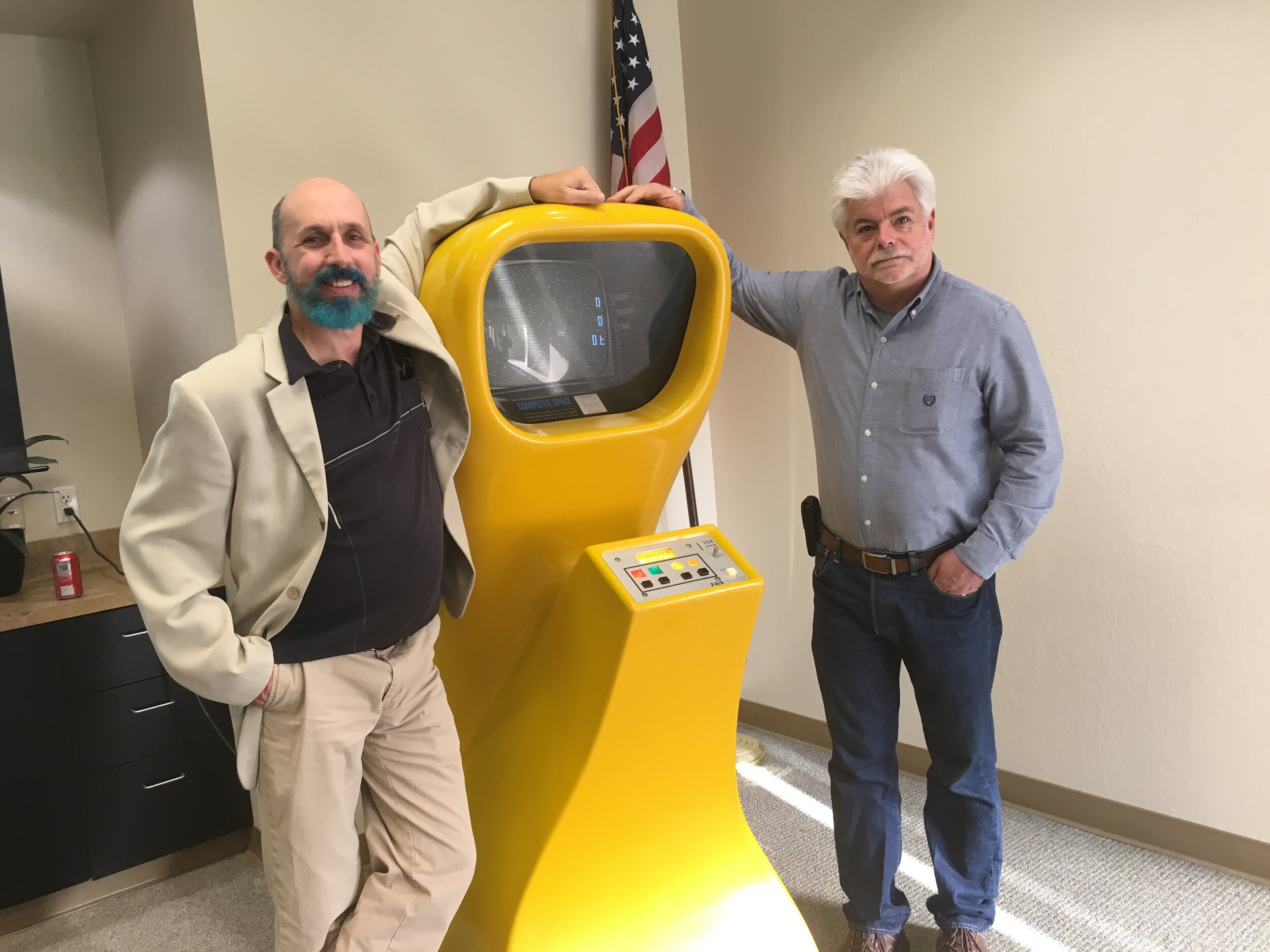
This is us at an event in 2016 with what is probably the #1 unit of the first arcade video game ever produced (Computer Space, which predated Pong), which he has in his collection.

Computer+Space+MM+%26+Jessop.JPG
 
It would be simple enough to build visually exact replicas of TNG consoles with modern touchscreens installed and direct the actors to slide or expand images with their hands.
I have a vague memory of an early interview with someone from Discovery saying that some of the consoles on the Discovery set were touch screens with reactive elements.
 
Last edited:
I have a vague memory of an early interview with someone from Discovery saying that some of the consoles on the Discovery set were touch screens with reactive elements.

Back in 1996, I was a part-time tour guide at the touring Star Trek Federation Science exhibit when it came to the Cincinnati Museum Center at Union Terminal (aka the Hall of Justice from last year's Superman movie). Its exhibits were designed to look like 24th-century Starfleet consoles, and many of them had interactive touch screens installed. All the CRT video screens required keeping the exhibit hall fairly dark, and between that and the constant TNG-era sound effects and looping Majel Barrett computer announcements, I found it an uncomfortable setting to be in for long stretches of time.
 
I started in games in late 1987. I worked in that field on and off (mostly on) till 2013, and then did a contract game thing in 2018. A pretty thorough list of games I was involved with is on this page of my website (link).

Right now, I'm hanging with a buddy who worked at Atari in the late 70s until Warner split it up and sold it off in 1984, and worked in the game biz until a year or two ago when he finally quit from Sony. We were just discussing a proposed low-cost console they prototyped at Atari in 1983, just as the video game crash was underway.

This is us at an event in 2016 with what is probably the #1 unit of the first arcade video game ever produced (Computer Space, which predated Pong), which he has in his collection.

Computer+Space+MM+%26+Jessop.JPG

Thanks for all your hard work on these games. I've played and enjoyed quite a few. I've even written a bit (for my job) about Ecco the Dolphin's future prospects as a franchise.
 
If you are not already a member then please register an account and join in the discussion!

Sign up / Register


Back
Top