• Welcome! The TrekBBS is the number one place to chat about Star Trek with like-minded fans.
    If you are not already a member then please register an account and join in the discussion!

Delta Quadrant Species and Their Hats

BCyphered

Ensign
Newbie
I know I'm not alone in feeling like the Delta Quadrant species introduced in Voyager were (with some exceptions!) less memorable than those in TOS, TNG or DS9. I've been thinking about why that is, and I have two main conclusions.

There are WAY too many Delta Quadrant species.
Per Memory Alpha, the following have been introduced or mentioned:

21 Gamma Quadrant species
49 Beta Quadrant governments and homeworlds (there's no Beta species list on MA)
81 Alpha Quadrant governments and homeworlds (same)
...153 Delta Quadrant species introduced or mentioned (plus the Borg and the Vau N'akat, who weren't introduced in Voyager)

That is... an insane number of species for one show. That's 7.4x as many as the Gamma Quadrant species on DS9, in the same number of seasons! It's an average of about one new species intro'ed or mentioned every 1.07 episodes.

I think the writers were spreading themselves thin. So, we've got a "quantity over quality" problem, along with a "breadth over depth" problem — because species tended to recur less frequently than on other shows. Of the species that recurred, few appeared that much — except for the Borg! Here are some of the most common recurring species, per Memory Alpha:
  • The Borg: 23 listed appearances (though some are holograms, alternate realities, flashbacks, etc.)
  • Kazon: 15 appearances
  • Talaxians (besides Neelix), Vidiians and Hirogen: 9 episodes
  • Species 8472: 4 episodes
  • Ocampa (besides Kes), Malon and Overlookers: 3 episodes
For comparison, the Vorta appeared 33 times in Deep Space Nine. And the Cardassians appeared nine times in TNG alone!

So, that's one problem. Another, I think, has to do with the Delta Quadrant species' hats.

Their hats are too small.
There's a thing that Trek does a lot, which TV Tropes calls a Planet of Hats: "A planet [or species] whose inhabitants all share a single defining characteristic." The classic Trek species fall into this, as do the Delta Quadrant species... but I'd argue that the Deltans' hats are a bit different.

Vulcans are "logic." Romulans are "intrigue." Cardassians are "for the good of the state." Klingons are "violence" (as much as they wish their hat was "honor!"). Changelings are "order." Jem'hadar are "soldiers." Vorta are "bureaucrats." Orions are "organized crimals." The Borg are "conformists." The Ferengi are "capitalists."

Meanwhile, in the Delta Quadrant, we have "organ thieves" (Vidiians), "L.A. gang members" (Kazon), "The Most Dangerous Game hunters" (Hirogen), "mad doctors" (Srivani), "science-worshipers" (Voth), "polluting industrialists" (Malon)... These are much smaller hats to work with! There's a lot less you can do with a science-worshiper than with a bureaucrat.

Admittedly, the Romulans reputedly started as Proud Warriors. Klingons started as the USSR. Orions were "seducers." Cardassians were "bullies." Ferengi were supposed to be scary pirates! These species' initial hats didn't work or were too confining. I'd argue that it's only because they were able to grow over multiple appearances that they found sustainable hats that let them turn into classics.

*Voyager*, with a new species every 1.07 episodes, didn't make time for that. The hats these species started with are, by and large, the ones they kept. Whether they worked or not.

Anyway, those are my thoughts. Very curious what other people think!
 
A lot of the Voyager species are one-episode, one-note antagonists. It's easy for them to blur together under the hat of, "Another species Our Heroes had to fight/negotiate their way past who never showed up again."

Frankly I'd say the Kazon and Vidiians showed up more often than they probably should have, and I think most would agree the former (vastly) overstayed their welcome.

I will say that while I may not remember the name of a species, despite not having watched VOY in years...possibly over a decade...if you give me a plot synopsis I'll generally at least remember them as, "oh yeah, those aliens who did that..."
 
A lot of the Voyager species are one-episode, one-note antagonists. It's easy for them to blur together under the hat of, "Another species Our Heroes had to fight/negotiate their way past who never showed up again."

Frankly I'd say the Kazon and Vidiians showed up more often than they probably should have, and I think most would agree the former (vastly) overstayed their welcome.

I will say that while I may not remember the name of a species, despite not having watched VOY in years...possibly over a decade...if you give me a plot synopsis I'll generally at least remember them as, "oh yeah, those aliens who did that..."
Hard agreed about the Kazon. I liked the Vidiians initially, but I don't feel like the writers did as much with them (as far as exploring story possibilities for their set-up goes) as I would have liked.

The one-episode thing is definitely true (the "breadth over depth" aspect I mentioned)... though I feel like some of the one-off species were weirdly among the most distinctive and memorable species of the show. The Krenim, the Voth, the Vaadwaur, the Srivani — these are some of the species I think of when I think "Delta Quadrant aliens," even though they only really appeared in one episode each. And the Srivani weren't even named in "Scientific Method!"

Meanwhile, of the recurring species, I don't feel like Voyager produced one on the scale of the Cardassians (9 TNG episodes), Ferengi (14 episodes) or Borg (6 episodes) on TNG, or the Founders, Vorta, Jem'hadar or Breen on DS9. Not a classic among them, on Voyager! The closest is, what? Maybe the Hirogen? (I do like the Hirogen.)

Maybe the writers just screwed it up too much trying to make the Kazon happen for a couple years, and then went in the other direction after that? Learned the wrong lesson? I dunno.
 
I was asking why people think the species were overall less memorable, though. The reason why there were so many is pretty obvious! :)
My response still applies :) They kept passing through while the other shows stayed in the same area for the most part. The D barely went into deep space.
 
Aww, and here I thought this was going to be a thread about costume design.

"science-worshipers" (Voth)

Oh, just the opposite. The Voth were anti-science fundamentalists and authoritarians, except for Professor Gegen, who was Galileo standing up to the Inquisition.

Although when I featured the Voth in a couple of my prose tie-in stories, I modeled them on Imperial China -- the most ancient and powerful culture in the region, secure in their dominance and prosperity and thus insular and conservative, expecting others to offer tribute to them and respect their superiority rather than being open to outside ideas, but who could be generous and obliging as long as you swallowed your pride and paid lip service to their dominance.


Admittedly, the Romulans reputedly started as Proud Warriors.

Well, blatantly as Space Romans.


Klingons started as the USSR.

More like "Space Mongols" crossed with Communist China. Basically the Yellow Peril trope transposed to sci-fi. (James Blish's "Errand of Mercy" adaptation describes them as being "of Oriental stock," implying that that's how they were described in the script.) Although the season 2 Klingon stories did tend to be Cold War allegories.


Orions were "seducers."

The women, yes, but "Journey to Babel" and "The Pirates of Orion" established them as mainly pirates, or rather, as an aggressor state whose government maintained deniability by insisting its spies and military ships were pirates acting independently. Although Enterprise and Lower Decks ended up taking the pretense literally and embracing the pirate angle.


Cardassians were "bullies."

Now, they were blatantly based on Soviets and on totalitarian, Orwellian regimes in general.


Ferengi were supposed to be scary pirates!

More like "Yankee traders," a satire of capitalism. They presented themselves as scary, but it turned out to be a deception perpetrated by comically dwarfish beings (sort of borrowing from Balok in "The Corbomite Maneuver"). It's been argued that they reflect anti-Semitic stereotypes, though a lot of Jewish actors have apparently been okay with playing Ferengi.


Maybe the writers just screwed it up too much trying to make the Kazon happen for a couple years, and then went in the other direction after that? Learned the wrong lesson? I dunno.

To an extent. I remember the producers saying that the problem with the Kazon/Seska story arc they attempted in season 2 was that it was too plot-driven rather than character-driven, coming from outside the ship rather than generated internally from the characters, so it was not only more superficial that way but harder to sustain over time as the ship progressed through the quadrant. So after that, they tried to focus on character-based story arcs like Seven of Nine's character growth and the Paris-Torres relationship.

The D barely went into deep space.

Which defeated the whole purpose of the Galaxy Class, which was designed to accommodate families because it was meant to be in deep space for up to 15 years at a time and had to be completely self-sufficient. The whole premise of "Encounter at Farpoint" was that the Enterprise was starting its mission at the farthest point charted by the Federation and would be breaking new ground from then on, but then they threw that out immediately by following it up by an episode about answering another Starfleet ship's distress call and then an episode about delivering medicine to a Federation planet.
 
Last edited:
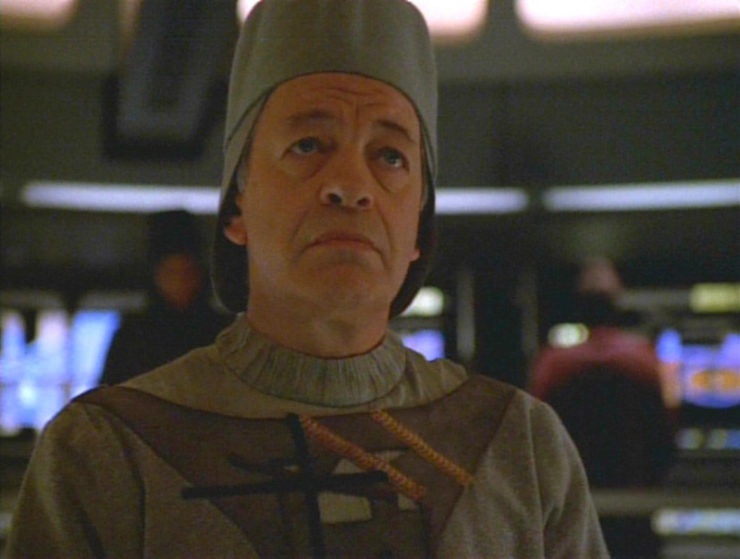
Trek-Voyager-Displaced04-740x559.jpg
 
Anyway, I think the original post is stacking the deck a little by throwing in some one-shot Voyager guest species like the Voth and Srivani along with the recurring ones. I mean, there were plenty of one-shot Planets of Hats in TOS -- it's basically the trope namer. Aside from things like the gangster planet and the Roman planet, you had species like the Halkans, who were pacifists; the Argelians, who were both pacifists and Orientalist-coded hedonists; the Tholians, who were punctual and prickly; the Scalosians, who lived at superspeed; etc. Not every Trek species is meant to be an ongoing presence -- although it's true that some species started out as one-shots but worked out well enough to become major, like Klingons, Cardassians, and Bajorans.
 
A lot of the Voyager species are one-episode, one-note antagonists. It's easy for them to blur together under the hat of, "Another species Our Heroes had to fight/negotiate their way past who never showed up again."

Frankly I'd say the Kazon and Vidiians showed up more often than they probably should have, and I think most would agree the former (vastly) overstayed their welcome.

I will say that while I may not remember the name of a species, despite not having watched VOY in years...possibly over a decade...if you give me a plot synopsis I'll generally at least remember them as, "oh yeah, those aliens who did that..."

VOY's inherent problem (and the reason why it ultimately didn't matter that they were in the Delta Quadrant as opposed to the Alpha) is that it followed the exact same formula as TNG. Aliens/Planets of the week, rather than any kind of meaningful distinction between that area of space and the one we saw for seven years on the Enterprise-D.

What I judge they should have done was to just drop the whole 'we need to get back to Earth by flying aimlessly through space' nonsense (because the audience already knows that this will never happen until the show is over), just stay in one place, and forge alliances with the locals to form their own Delta Quadrant version of the Federation. But UPN wanted an episodic show where the status quo of the initial premise never changed.
 
Last edited:
It offered a goal to aim towards. Like a show about someone trying to find a particular criminal, or a cure for a disease. If they had stayed in one place, it'd be compared to DS9 rather than TNG. Plus, nobody wanted to give up on their families and lives back home...until the crew of DIS did via time travel by choice, IIRC.
 
It offered a goal to aim towards. Like a show about someone trying to find a particular criminal, or a cure for a disease. If they had stayed in one place, it'd be compared to DS9 rather than TNG. Plus, nobody wanted to give up on their families and lives back home...until the crew of DIS did via time travel by choice, IIRC.

It was a goal that the audience knew would never be attained. That is the inherent flaw in that scenario, and doesn't make for good writing. That kind of thing worked for a situation comedy like Gilligan's Island, but it didn't work for a Star Trek series.
 
I know I'm not alone in feeling like the Delta Quadrant species introduced in Voyager were (with some exceptions!) less memorable than those in TOS, TNG or DS9. I've been thinking about why that is, and I have two main conclusions.

There are WAY too many Delta Quadrant species.
Per Memory Alpha, the following have been introduced or mentioned:

21 Gamma Quadrant species
49 Beta Quadrant governments and homeworlds (there's no Beta species list on MA)
81 Alpha Quadrant governments and homeworlds (same)
...153 Delta Quadrant species introduced or mentioned (plus the Borg and the Vau N'akat, who weren't introduced in Voyager)

That is... an insane number of species for one show. That's 7.4x as many as the Gamma Quadrant species on DS9, in the same number of seasons! It's an average of about one new species intro'ed or mentioned every 1.07 episodes.

I think the writers were spreading themselves thin. So, we've got a "quantity over quality" problem, along with a "breadth over depth" problem — because species tended to recur less frequently than on other shows. Of the species that recurred, few appeared that much — except for the Borg! Here are some of the most common recurring species, per Memory Alpha:
  • The Borg: 23 listed appearances (though some are holograms, alternate realities, flashbacks, etc.)
  • Kazon: 15 appearances
  • Talaxians (besides Neelix), Vidiians and Hirogen: 9 episodes
  • Species 8472: 4 episodes
  • Ocampa (besides Kes), Malon and Overlookers: 3 episodes
For comparison, the Vorta appeared 33 times in Deep Space Nine. And the Cardassians appeared nine times in TNG alone!

So, that's one problem. Another, I think, has to do with the Delta Quadrant species' hats.

Their hats are too small.
There's a thing that Trek does a lot, which TV Tropes calls a Planet of Hats: "A planet [or species] whose inhabitants all share a single defining characteristic." The classic Trek species fall into this, as do the Delta Quadrant species... but I'd argue that the Deltans' hats are a bit different.

Vulcans are "logic." Romulans are "intrigue." Cardassians are "for the good of the state." Klingons are "violence" (as much as they wish their hat was "honor!"). Changelings are "order." Jem'hadar are "soldiers." Vorta are "bureaucrats." Orions are "organized crimals." The Borg are "conformists." The Ferengi are "capitalists."

Meanwhile, in the Delta Quadrant, we have "organ thieves" (Vidiians), "L.A. gang members" (Kazon), "The Most Dangerous Game hunters" (Hirogen), "mad doctors" (Srivani), "science-worshipers" (Voth), "polluting industrialists" (Malon)... These are much smaller hats to work with! There's a lot less you can do with a science-worshiper than with a bureaucrat.

Admittedly, the Romulans reputedly started as Proud Warriors. Klingons started as the USSR. Orions were "seducers." Cardassians were "bullies." Ferengi were supposed to be scary pirates! These species' initial hats didn't work or were too confining. I'd argue that it's only because they were able to grow over multiple appearances that they found sustainable hats that let them turn into classics.

*Voyager*, with a new species every 1.07 episodes, didn't make time for that. The hats these species started with are, by and large, the ones they kept. Whether they worked or not.

Anyway, those are my thoughts. Very curious what other people think!
You do have some interesting points here, things I've been thinking about myself.

The problem here was that the series was built on the premise about a ship which was lost in the Delta Quadrant, on the other side of the galaxy and the mission was to find the way back to Earth.

Since the trip was about to take many, many years unless they found a shortcut, the encounters they did have with other races had to be brief.

Personally I really liked the premise of the show. A ship lost in the Delta Quadrant without any support from Starfleet and Federation Headquarters with a crew who had to rely on themeselves to achieve the goal to come home.

But the cost for such a premise was the "small hats".

One of the reasons why I think that Season 2 was the best and most exciting of the series was just the fact that we did at least have som continuity in the constant encounters with the Vidiians and especially the Kazon. There were more interaction with them than with other species and therefore we did learn to know them a bit better than the other species in the Delta Quadrant.

Unfortunately, VOY started to lose ground in season 3 after leaving the Kazon and the Vidiians behind them. It was sort of "what do we do now?" in the writing which meant that there were more bum episodes in season 3 than it had been in seasons 1 and 2, although season 3 was still watchable with some really great episodes, such as Future's End, Warlord, Darkling, Fair Trade, Remember etc.

But there was also another problem which contributed to the issues you are mentioning.

I get the impression that Berman and his gang couldn't really handle VOY. They had done a great job with TNG, a sereis which continued to build, expand and develope what we had seen in TOS.

But VOY had a different premise and while Berman's crew had been excellent when it came to coming up with new, interesting species, new ideas and such in TNG, it actually looked like they were going through the motions with VOY, at least after season 2 but even before that.

I don't know if they were burned out after TNG and simply couldn't come up with ideas or if they simply didn't care because much of the writing for VOY was downright sloppy.

I just have to mention the shuttle and torpedo problem, how they messed up the Ocampa and Chakotay's background and how lost they did seem to be in season 3 and onwards when they no longer had the Kazon and Vidiians for the VOY crew to interact with.

It got worse later on when they started to focus on only three members of the crew while the other characters were shoved in the background and when they brought in the Borg and holograms of TNG characters. Was it because they had run out of ideas or did they simply stop to care?

They could come up with some spectacular ideas for some species or some scenario and when it didn't work, they didn't try to fix the problem, like with the Ocampa one-child syndrome or the waste of shuttles and torpedoes. Instead it was like "oh never mind, the viewers won't notice it". but the point was that the viewers did notice!

It became sort of "let us give the people what we think that they want", sort of "lets bring in a sexy babe, the viewers love sexy babes" or "let us bring in the Borg, the viewers love the Borg" or "let us bring in TNG characters, the viewers love TNG".

And at the end it was just like "lets get this over as soon as possible", I mean, they couldn't even come up with a decent end episode with a real homecoming for the crew!

No wonder why the species they encountered during the journey became so shallow when those in charge just rushed through everything!

Since VOY became my favorite series in 1998 and due to the fact that I 've finally got th watch the whole of DS9 around 2010 and onwards, I've done some realunches of both series and that have lead to some comparision.

When I still find DS9 full of good storytelling, good interaction between the characters, many unexpected twists and turns along the way and an interesting winding story from the first epipsode to the last, the VOY episodes, even in my beloved seasons 1,2 and 3 seems a bit shallow and "empty" when it comes to storytelling. There are a few episodes which I find almost as good as the best episodes of DS9. But there are not many.

But VOY still have a certain charm. The characters were great and the premise for the show excellent which still makes it fun to watch from time to time. Not to mention that the VOY novels from that era are highly readable and some of those books are much better than the TV episodes.
 
One thing to bear in mind (and the Kazon and Vidiians being so cohesive and wide spread is a hole in this theory) is that the presence of the Borg throughout the Delta Quadrant will have prevented races developing widespread territories and therefore being present for more of the journey.

Instead we get lots of small patches where races are mostly contained to a single star system (some exceptions of course) and so that also means fewer interplanetary disputes that might trim the numbers a bit
 
One thing to bear in mind (and the Kazon and Vidiians being so cohesive and wide spread is a hole in this theory) is that the presence of the Borg throughout the Delta Quadrant will have prevented races developing widespread territories and therefore being present for more of the journey.

Instead we get lots of small patches where races are mostly contained to a single star system (some exceptions of course) and so that also means fewer interplanetary disputes that might trim the numbers a bit

I don't think there's any need for that, given that Voyager was trying to travel in a straight line at best possible speed. Texas, for instance, is a really big state with a lot of different cities and towns in it, so someone who wanted to explore it could spend months getting to know all its communities; but if you were just driving through it on the way to California, say, you could be through it in a matter of hours.

So it's not unreasonable to assume that various civilizations could have moderately large territories with dozens of worlds, but Voyager just passed through them briefly before moving on. After all, space is mostly, well, empty space, so the ship could easily spend weeks in an interstellar nation's territory without ever actually approaching one of its member worlds or shipping lanes, and thus have an uneventful passage with no encounters with the species in question (except maybe for whatever border patrol ships they had to get permission from to pass through).

The only problem is when the reverse happened -- when they jumped forward 20,000 light years with the Borg transwarp coil, but still ran into the Malon again in "Juggernaut," long after they should've left Malon territory far, far behind. That just made no sense at all.

Also, the Borg didn't have a presence in most of the territory Voyager passed through. They weren't encountered until midway through season 3, and only intermittently thereafter.

Anyway, the Kazon were hardly cohesive; the idea was that they were a nomadic people, which makes it natural that they'd be spread out over a wide territory (which is true even more so for the Hirogen, given how much more ancient they are). The only reason Voyager kept encountering Culluh and the Nistrim is that they were actively pursuing Voyager. As for the Vidiians, their agents presumably had to travel widely through space to harvest organs, so the territory in which their agents operated could well have been far larger than the size of their nation, in the same way that Starfleet vessels explore the frontier far beyond the borders of Federation space (a concept that the writers of modern Trek shows seem to have forgotten).
 
I don't think there's any need for that, given that Voyager was trying to travel in a straight line at best possible speed. Texas, for instance, is a really big state with a lot of different cities and towns in it, so someone who wanted to explore it could spend months getting to know all its communities; but if you were just driving through it on the way to California, say, you could be through it in a matter of hours.

So it's not unreasonable to assume that various civilizations could have moderately large territories with dozens of worlds, but Voyager just passed through them briefly before moving on. After all, space is mostly, well, empty space, so the ship could easily spend weeks in an interstellar nation's territory without ever actually approaching one of its member worlds or shipping lanes, and thus have an uneventful passage with no encounters with the species in question (except maybe for whatever border patrol ships they had to get permission from to pass through).

The only problem is when the reverse happened -- when they jumped forward 20,000 light years with the Borg transwarp coil, but still ran into the Malon again in "Juggernaut," long after they should've left Malon territory far, far behind. That just made no sense at all.

Also, the Borg didn't have a presence in most of the territory Voyager passed through. They weren't encountered until midway through season 3, and only intermittently thereafter.

Anyway, the Kazon were hardly cohesive; the idea was that they were a nomadic people, which makes it natural that they'd be spread out over a wide territory (which is true even more so for the Hirogen, given how much more ancient they are). The only reason Voyager kept encountering Culluh and the Nistrim is that they were actively pursuing Voyager. As for the Vidiians, their agents presumably had to travel widely through space to harvest organs, so the territory in which their agents operated could well have been far larger than the size of their nation, in the same way that Starfleet vessels explore the frontier far beyond the borders of Federation space (a concept that the writers of modern Trek shows seem to have forgotten).
None of those points are mutually exclusive to mine - similar to how races in Pegasus did to avoid the Wraith, keeping a low profile and not being technologically relevant goes a hell of a way to staying off Borg radar.

You obviously have medium races such as the Hirogen and Devore with a decent sized territory but it just seems logical to me that the Borg (who yes have a core systems are but are also clearly pretty active in the bottom half of the quadrant) would find ways to limit races growing to a point of being a threat - we saw a few races who the Borg went after to stop them crossing the threshold to being a threat.

I'm not good enough on maps to say for certain but I think most is doing some heavy lifting considering they turn up first around the late-mid season 3 and are consistently present from there on out.
 
None of those points are mutually exclusive to mine - similar to how races in Pegasus did to avoid the Wraith, keeping a low profile and not being technologically relevant goes a hell of a way to staying off Borg radar.

My point is that it's an oversimplification to assume the Borg had a presence in all of the Delta Quadrant. It was only certain portions of it, so in much of the territory Voyager passed through, there's no reason to evoke the Borg as a factor.

There's a tendency to think of the Trek "Quadrants" as monolithic places, e.g. how many people assume the Dominion controlled all the Gamma Quadrant even though explorers through the wormhole didn't start hearing about them for more than a year and didn't encounter them directly until nearly two years into the series. I'm just offering the reminder that an entire 25% of the galaxy is a huge, huge territory, inconceivably vast in itself, so we should resist the urge to think of a quadrant as even remotely uniform as a geographical or astropolitical entity. When thinking about space, it's always important to keep the immensity of it in mind.

And that's what I'm saying -- that even an interstellar nation that controls a vast territory on the scale of a humanoid being is still just a tiny speck on the scale of a galactic quadrant. If you look at the galaxy map in Star Charts, the sphere encompassing the entire Federation and all its neighboring empires is just a big dot. If an alien ship were passing through Federation space as fast as possible on the way to its faraway home, it could pass through the entire UFP and be on its way elsewhere within a matter of weeks or less, probably. So many of those "small" territories that Voyager passed through in one episode and never saw again could actually have been interstellar nations comparable in size to, say, the Romulan Empire or Cardassian Union, or even the Federation. Small is relative.
 
My point is that it's an oversimplification to assume the Borg had a presence in all of the Delta Quadrant. It was only certain portions of it, so in much of the territory Voyager passed through, there's no reason to evoke the Borg as a factor.

There's a tendency to think of the Trek "Quadrants" as monolithic places, e.g. how many people assume the Dominion controlled all the Gamma Quadrant even though explorers through the wormhole didn't start hearing about them for more than a year and didn't encounter them directly until nearly two years into the series. I'm just offering the reminder that an entire 25% of the galaxy is a huge, huge territory, inconceivably vast in itself, so we should resist the urge to think of a quadrant as even remotely uniform as a geographical or astropolitical entity. When thinking about space, it's always important to keep the immensity of it in mind.

And that's what I'm saying -- that even an interstellar nation that controls a vast territory on the scale of a humanoid being is still just a tiny speck on the scale of a galactic quadrant. If you look at the galaxy map in Star Charts, the sphere encompassing the entire Federation and all its neighboring empires is just a big dot. If an alien ship were passing through Federation space as fast as possible on the way to its faraway home, it could pass through the entire UFP and be on its way elsewhere within a matter of weeks or less, probably. So many of those "small" territories that Voyager passed through in one episode and never saw again could actually have been interstellar nations comparable in size to, say, the Romulan Empire or Cardassian Union, or even the Federation. Small is relative.
I agree they may not have a literal physical presence but they do have:

1) Transwarp drive + hubs allowing for the exercise of power without the need for a constant presence due to speed with which they can get there

2) Presence in races minds - there are surely hundreds of races like the El Aurians who will have fled the Borg and people then heard about what happened and have that impact their mindset.

There are some galaxy maps around that seem to imply the Borg do control almost the entire lower half of the Delta - now firstly they seem to be fan made so are subject to interpretation and can't be treated as core sources but secondly I think the key is that I'm in the mindset of sphere of influence rather than territory in the traditional sense
 
I agree they may not have a literal physical presence but they do have:

1) Transwarp drive + hubs allowing for the exercise of power without the need for a constant presence due to speed with which they can get there

2) Presence in races minds - there are surely hundreds of races like the El Aurians who will have fled the Borg and people then heard about what happened and have that impact their mindset.

There are some galaxy maps around that seem to imply the Borg do control almost the entire lower half of the Delta - now firstly they seem to be fan made so are subject to interpretation and can't be treated as core sources but secondly I think the key is that I'm in the mindset of sphere of influence rather than territory in the traditional sense

I just feel like Pierre-Simon Laplace felt about God: "I have no need of that hypothesis." I don't think there's anything that it's needed to explain; it's just an ad hoc conjecture out of nowhere. And I resist the tendency to assume that every single thing that happens in the Delta Quadrant has to be about the Borg. They were overused enough in the show itself.

I mean, both your points could apply just as well to the Federation, which was reachable by transwarp and whose members and neighbors were definitely aware of the threat the Borg posed. But a ton of stuff happened in TNG and DS9 that had nothing whatsoever to do with the Borg.
 
If you are not already a member then please register an account and join in the discussion!

Sign up / Register


Back
Top