• Welcome! The TrekBBS is the number one place to chat about Star Trek with like-minded fans.
    If you are not already a member then please register an account and join in the discussion!

How does subspace communication move messages without warping space?

Unfortunately, a 1980 book doesn't exist in a bubble of outside of canon as the franchise marched on.

Given contradictions in the Trek universe itself, there are still references points where reasonable charts can be made. Other charts on a Trek wiki site:


Make those upper supspace warp speeds utterly bizarre. At that point you might as well just be Q when it comes to commutations.


I have zero cents to give about SNW.
 
I am aware of this. It is merely a tool for a starting point.

I can go to the Star Trek Maps and use them... in particular the Handbook of Navigation...
 
But that would be baloney, wouldn't it?

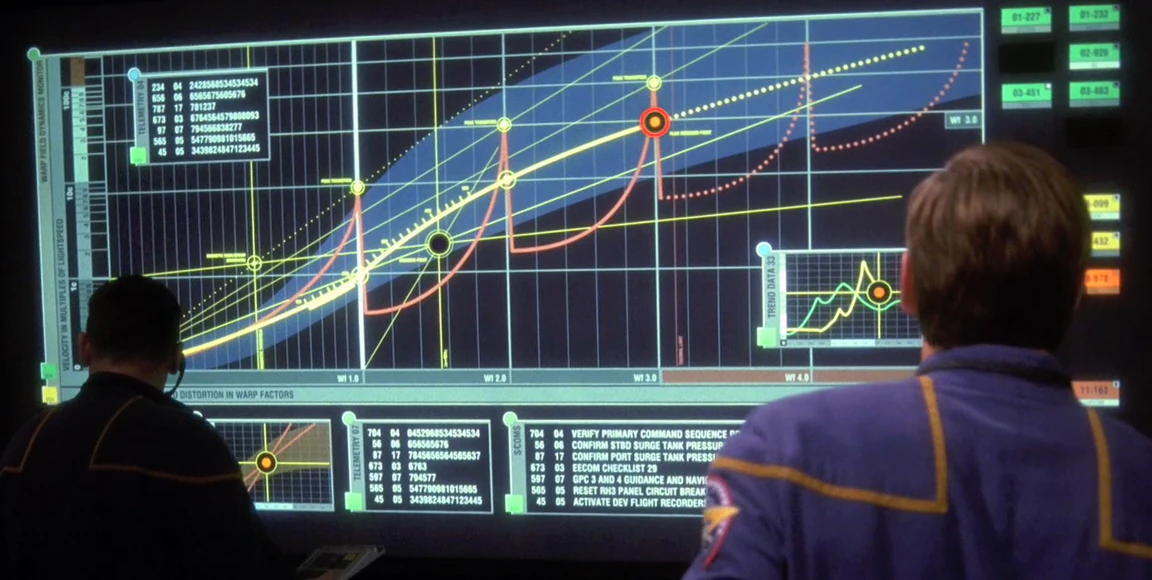
Looking at a warp chart of the warp charts for TOS and TNG, in TNG time (still so in Voyager), warp ten is infinite, you'd be occupying every space in the universe at once.

Warp 9.99 in TNG is 7,912 "Cochrane units".
Warp fifteen in the TOS chart is 3,375 "Cochrane units".

Warp thirty would put it well beyond infinity. There would be no delay across the entire universe.

Warp 9.9 = 4 billion miles per second which equates to about 21,473x c (from VOY, the 37's).

Warp 9 = 1,500 c.

Warp 8 = 1,000 c.

Incidentally, VOY displayed (on-screen) that it can only sustain 9.75 for 12 hrs (in episode 'The Swarm').

And since ENT-D was rated at about 9.6 being its 12hr sustainable speed... its a lot more reasonable to think VOY (a newer design) was never capable of 9.975 (which was in practicality never actually seen - only mentioned a handful of times and was likely a mistake).

Even in Threshold episode, VOY's maximum limit was 9.9 for about 45 seconds (and the computer warned that structural collapse would ensue in 45 seconds which forced Chakotay to reduce speed to 9.5).

It makes a lot more sense that speeds begin increasing a lot more the closer you get to 9.9 and then PAST Warp 9, each increment (aka, 0.01 increase) results in doubling of speed and power requirements.
So, Warp 9.91 = twice the speed and power consumption of Warp 9.9...
9.92 = double the speed and power consumption of Warp 9.9.

Anyway, for subspace comms or sensors, I think its somewhat different approach on how they USE subspace to attaint real-time bandwidth across numerous LY's - so actual bending of spacetime is likely just 1 method of a physical object achieving FTL speeds - but sending out comms or sensors doesn't need the same approach - also, usually comms and sensors have different mass properties than physical objects - starships need to reduce their inertial mass using sublight to achieve 75,000 km/s speeds, and also to use Warp.
I suspect you don't need to do the same method even if your sensors or comms use particles (because you have massless particles like photons) and their mass is proverbially negligible by default - so its probably a lot easier to have transmissions or sensor beams use subspace than it is to make a physical object like a ship to use it for FTL.

VOY was able to scan in a radius of 40 LY's (the ENT-D had about 25 LY range)... but its possible this wasn't real time - or at least, not exactly, and subspace comms move at very high speeds on the Warp scale - but the speed varies across centuries and is tech dependent (aka, base emitter which sends out the sensors and comms).

So the NX-01 was severely limited in subspace comms without amplifiers - but we do know from episode Regeneration that a subspace message would take 200 years to reach the DQ... but in the 24th century, VOY was said that their message to Earth would have taken YEARS (not decades) with standard subspace comms (this is likely because the ship's comms/sensor array was far more powerful vs what was used in the 22nd century) - but for VOY there were other practical limitations on sending a message like that across the galaxy - a single ship, cut off from support would be a prime target for opportunistic species, and the Kazon were on the ship's back spreading rumours - so for them it wasn't entirely practical - and subspace comms can also be deflected or degrade by a lot.
 
Somebody once pointed out that fictional spaceships move at the speed of plot.

Subspace radio seems to have both vaguely defined abilities and vaguely defined limitations. So can fit into whatever the plot demands, for any particular episode.
 
Warp 9.9 = 4 billion miles per second which equates to about 21,473x c (from VOY, the 37's).

Warp 9 = 1,500 c.

Warp 8 = 1,000 c.

Incidentally, VOY displayed (on-screen) that it can only sustain 9.75 for 12 hrs (in episode 'The Swarm').

And since ENT-D was rated at about 9.6 being its 12hr sustainable speed... its a lot more reasonable to think VOY (a newer design) was never capable of 9.975 (which was in practicality never actually seen - only mentioned a handful of times and was likely a mistake).

Even in Threshold episode, VOY's maximum limit was 9.9 for about 45 seconds (and the computer warned that structural collapse would ensue in 45 seconds which forced Chakotay to reduce speed to 9.5).

It makes a lot more sense that speeds begin increasing a lot more the closer you get to 9.9 and then PAST Warp 9, each increment (aka, 0.01 increase) results in doubling of speed and power requirements.
So, Warp 9.91 = twice the speed and power consumption of Warp 9.9...
9.92 = double the speed and power consumption of Warp 9.9.

Anyway, for subspace comms or sensors, I think its somewhat different approach on how they USE subspace to attaint real-time bandwidth across numerous LY's - so actual bending of spacetime is likely just 1 method of a physical object achieving FTL speeds - but sending out comms or sensors doesn't need the same approach - also, usually comms and sensors have different mass properties than physical objects - starships need to reduce their inertial mass using sublight to achieve 75,000 km/s speeds, and also to use Warp.
I suspect you don't need to do the same method even if your sensors or comms use particles (because you have massless particles like photons) and their mass is proverbially negligible by default - so its probably a lot easier to have transmissions or sensor beams use subspace than it is to make a physical object like a ship to use it for FTL.

VOY was able to scan in a radius of 40 LY's (the ENT-D had about 25 LY range)... but its possible this wasn't real time - or at least, not exactly, and subspace comms move at very high speeds on the Warp scale - but the speed varies across centuries and is tech dependent (aka, base emitter which sends out the sensors and comms).

So the NX-01 was severely limited in subspace comms without amplifiers - but we do know from episode Regeneration that a subspace message would take 200 years to reach the DQ... but in the 24th century, VOY was said that their message to Earth would have taken YEARS (not decades) with standard subspace comms (this is likely because the ship's comms/sensor array was far more powerful vs what was used in the 22nd century) - but for VOY there were other practical limitations on sending a message like that across the galaxy - a single ship, cut off from support would be a prime target for opportunistic species, and the Kazon were on the ship's back spreading rumours - so for them it wasn't entirely practical - and subspace comms can also be deflected or degrade by a lot.
No, the warp factor 9.975, isn't a mistake, the warp factor 9.75, however, is...

However there is another problem.

The creators had very specific warp factors and duration mind for the Intrepid class.

Warp factor 7.75 for sixteen days before fiel exhaustion.

Warp factor 9.25 for 2.5 days before fuel exhaustion.

And warp factor 9.975 for 12.65 hours before automatic warp shutdown.

Furthermore in testing the Voyager sustained warp factor 9.986 for better than 12 hours.

So, what does this give us? After looking into this for twenty plus years, my conclusion is that an Intrepid class starship has a standard cruising speed of warp factor eight (1024c). At this warp factor the intake of interstellar gases, in particular heavy Hydrogen, balanced with the power consumption. Do this means until the ship wears out. Why? The Enterprise-D could maintain warp factor six(~392c) for one hundred years...and yes, this is actual background information. Any warp factor beyond this, internal resources are being used to boost power to the needed levels. Such that Voyager with her improvements could handle warp factor eight, easily. The mention of traversing at warp factor six, is the speed of advance - in other words Janeway was being true to Starfleet as she said she would be.

The primary comes from an Omni magazine article. The creators of Star Trek: Voyager, knew that computer technology was changing very rapidly in the real world, such that any looking forward, by them, would look ridiculous in a few years.

For example: In 'The Star Trek Spaceflight Chronology', the subspace radio warp factors that are given are quite interesting. Because until the entry for 2188, no mention is made of the limitations of subspace radio. The warp factor thirty speed of the subspace radio, gives a usable range of three days away...and states that the previous subspace radio's warp factor twenty back to warp factor fifteen, as viewed from the perspective of 2188, could only transmit a quarter of that distance, with a great deal of static. Range limitations...

I'm terms of sensor capability for the Enterprise at launch for both wide angle and narrow angle, thirty light-years is the range given. Because of Duotronics and Dilithium based power supplies. The warp factor fifteen speed of the early subspace radio, was a shipboard limitation.

The high resolution at thirty light-years, is because of the better computers. Running older programs...that were Independent Thought Memory Scan.
 
Last edited:
No, the warp factor 9.975, isn't a mistake, the warp factor 9.75, however, is...

However there is another problem.

The creators had very specific warp factors and duration mind for the Intrepid class.

Warp factor 7.75 for sixteen days before fiel exhaustion.

Warp factor 9.25 for 2.5 days before fuel exhaustion.

And warp factor 9.975 for 12.65 hours before automatic warp shutdown.

Furthermore in testing the Voyager sustained warp factor 9.986 for better than 12 hours.

Forgive me but what the creators intended for fuel exhaustion makes for little sense.
This readily clashes with how much Deuterium ships can hold, or their Antimatter storage tanks (because under normal conditions, ships can go on for YEARS before needing resupplying).

For example, the ENT-D could operate for about 5 years before it needs to replace its Antimatter supplies.
VOY was said that their Warp core can work for 3 years before needing refilled (presumably with Antimatter and Deuterium).

Additionally, on-screen, we never saw the Intrepid ever sustaining 9.986 for 12 hours. On-screen data says 9.75 is maintainable for 12 hrs per 'The Swarm' episode - (and on-screen dialogue has a lot more weight than magazines which are not part of canon).

Threshold episode further establishes that Warp 9.9 can only be maintained by VOY for less than 45 seconds (because at that point, structural collapse happens) - this is per actual dialogue.

Additionally, in-universe no SF ship prior to VOY could maintain high warp speeds past Warp 9 reliably except the Galaxy and maybe the Nebula class ships (aka, newer generation designs).
In fact, throughout DS9, the USS Defiant couldn't even achieve Warp 9 without threatening to fly apart - and one Nebula class was modified so it could achieve Warp 9.5 barely (which was considered an achievement).

The USS Prometheus was the only SF ship (from Message in a Bottle episode) that was able to sustain 9.9 without structural instability (and it was described as the fastest ship in the fleet). No other Warp factors were mentioned for USS Prometheus - so while some fans said something about 9.985 or something similar, this was never mentioned on-screen or ever heard of or seen in dialogue or actual episodes).

And per episode 'the 37's' it was established VOY can achieve (but as we later saw, certainly not hold) Warp 9.9 which Tom Paris described as 4 billion miles per second (aka, 21,473 times c).


So, what does this give us? After looking into this for twenty plus years, my conclusion is that an Intrepid class starship has a standard cruising speed of warp factor eight (1024c). At this warp factor the intake of interstellar gases, in particular heavy Hydrogen, balanced with the power consumption. Do this means until the ship wears out. Why? The Enterprise-D could maintain warp factor six(~392c) for one hundred years...and yes, this is actual background information. Any warp factor beyond this, internal resources are being used to boost power to the needed levels. Such that Voyager with her improvements could handle warp factor eight, easily. The mention of traversing at warp factor six, is the speed of advance - in other words Janeway was being true to Starfleet as she said she would be.

We certainly agree on the speeds here... and the premise that VOY (as part of a new ship class) was likely able to sustain Warp 8 as its 'normal cruising speed' - which also tracks with the fact that it would be an improvement over what the Galaxy class initially launched with (naturally, over time, SF likely integrated sustainable speed improvements to other starships in the fleet too during their next refit/upgrade periods).

On-screen however, VOY was mostly seen using Warp 6, but that likely is a product of us catching the ship in the lower speed state for energy conservation and various problems they encountered early on which drained their Deuterium and Antimatter - so I suspect that 'off screen' the ship may have been using Warp 8 periodically (and it was using it at the end of a few episodes to 'make up for lost time').

The primary comes from an Omni magazine article. The creators of Star Trek: Voyager, knew that computer technology was changing very rapidly in the real world, such that any looking forward, by them, would look ridiculous in a few years.
That tracks for computer speeds and capabilities - but we DO have Voyager's computer core processor specs, and even today, that puts anything we have in real life to ridiculous shame... because of how many things it can do in parallel - something we can't yet scale to (maybe in another couple of decades though).

Still, magazines are NOT part of canon.

For example: In 'The Star Trek Spaceflight Chronology', the subspace radio warp factors that are given are quite interesting. Because until the entry for 2188, no mention is made of the limitations of subspace radio. The warp factor thirty speed of the subspace radio, gives a usable range of three days away...and states that the previous subspace radio's warp factor twenty back to warp factor fifteen, as viewed from the perspective of 2188, could only transmit a quarter of that distance, with a great deal of static. Range limitations...

We do have in-universe data from ST: Enterprise that it had to drop subspace amplifiers dozens of lightyears from Earth. in fact, NX-01 dropped 2 subspace amplifiers within relative closeness to each other.

Point being is to maintain 'real time comms' with Earth. Otherwise, without them, subspace messages would need time to travel back and forth - probably minor delay at first but much larger at bigger distances.

We also know from 'Regeneration' epiosde that a subspace message would take approximately 200 years to reach the Delta Quadrant (the Borg episode)... and in ST: VOY, we know that Janeway said in S1 that it would take a subspace message 'years' to be received by Starfleet.

So, a subspace message need 200 years in 2156 when sent from a ship using technology of that era to cross 70,000 odd lightyears... 'years' in late 24th century (we can say 5 to 10 years perhaps) - aka 'shipboard limitation' as you mentioned.

To me this implies that individual starship subspace comms technology improved quite a lot in 200 years... by a factor of 10 to 20 times it seems - which tracks with the rate of how SF and UFP developed - canon is surprisingly coherent here.


I'm terms of sensor capability for the Enterprise at launch for both wide angle and narrow angle, thirty light-years is the range given. Because of Duotronics and Dilithium based power supplies. The warp factor fifteen speed of the early subspace radio, was a shipboard limitation.

Except the ENT-D didn't use Duotronics. The 23rd century Enterprises did - so which Enterprise were you referring to here?
We have from on-screen dialogue stating about 25 LY's scanning radius for the ENT-D if I'm not mistaken.
VOY on-screen dialogue states 40 Ly's scanning radius.

But this largely tracks already.

The high resolution at thirty light-years, is because of the better computers. Running older programs...that were Independent Thought Memory Scan.

30 Ly's tracks more or less with what I said about ENT-D having a scanning radius of about 25 Ly's, but I doubt there would be older programs running on the ENT-D (because most would be upgraded to latest standards anyway).

At any rate, VOY having 40 Ly's scan radiuse is confirmed from on-screen dialogue, so it tracks with the smaller upgrades that SF would implement over 7 years time.

And it also clashes with the notion that Warp speeds would suddenly jump from Warp 9.6 to Warp 9.975 (that just doesn't make any sense)... because this would be the speed at which VOY would return home in just under a Week if it could sustain it - dialogue describes is as 'maximum sustainable cruise velocity' - which is obviously nonsense because actual speeds we have seen in use have VOY using Warp 9.75 for 12 hrs, and Warp 9.9 for LESS than 45 seconds (which is why I don't acknowledge Warp 9.975 and treat it as an error that the writers maybe wanted to say 9.75 for 12 hrs).

 
Please read 'The Star Trek Spaceflight Chronology'. The point with this reading material is to point out 'flaws' in the overall franchise.

The Constitution class Enterprise in 'The Star Trek Spaceflight Chronology' was written before TNG...
 
Somebody once pointed out that fictional spaceships move at the speed of plot.
That would have been Babylon 5 creator J. Michael Straczynski when asked about the cruising speed of the Excalibur.
 
I can confirm the 40 light-year radius for Voyager. Why? Because I tripped over it. In actuality. The episode is 'The Raven'...

Yes, I tripped. How? In a state of being board, I bought the complete series.

Forgive me... For buying it.

But the thirty light-year radius comes from the 'Star Trek Spaceflight Chronology'. Not anything more modern.
 
My thoughts are based on the notion that subspace coms have limitations due to being omni-directional, with signals expanding in spherical waves. The signals become weaker/become diluted the further they go. Unless boosted by relay stations.

Without relays, the effective ranges of different types of transmissions would degrade with distance. Effective band width would essentially become more and more constricted with distance, so..... First to become useless would be video, with the screen becoming fuzzier and fuzzier. Then, voice transmission, becoming garbled, then becoming so much static. Finally, beacons-used for Morse code-would become useless, as the signal essentially disappears.
 
Last edited:
Good point, Christopher. :)

As for Morse code, you would basically need a signal that could be detected as (if just barely) existing, and can be modulated into dots and dashes.
 
The other thing to remember is that TV remotes transmit the code five times, just in case of blockage or other problems.

Five times means that a clear signal gets through to the receiver. It doesn't take long to fire the transmitter Five times.

The only message you see/hear/taste/smell is the correct one. Why? Because if parts are missing, then having additional transmissions means that other parts are received correctly.

Update: since I now have the complete series of Voyager, I have rewatched Voyager almost completely. Episode 1 of season one, and the episode Relatively both state that Voyager' maximum safe cruising speed is warp factor 9.975. "Cruising speed " means a sustained speed. In other words the statement in Caretaker of a sustainable cruising speed of warp factor 9.975 is redundant. But why? If you use Steve Long's Spacedock, rules the energy never exceeds warp factor 9.6...
 
Last edited:
If you are not already a member then please register an account and join in the discussion!

Sign up / Register


Back
Top