
And sometimes even country isn't enough...Some people just do not make you want to be in the same room with them, nor even country.
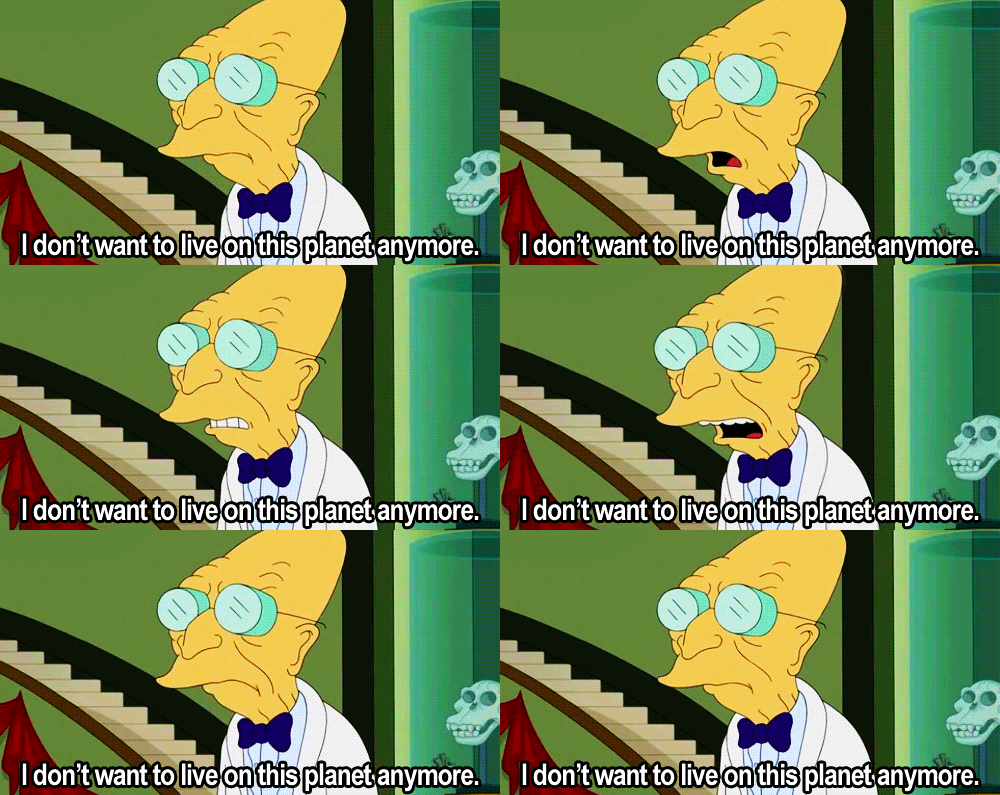
Fun fact searching for this quote had google's shitty ai bombarding me with suicide prevention hotlines.

And sometimes even country isn't enough...Some people just do not make you want to be in the same room with them, nor even country.

This is something fans of old properties really need to come to grips with. The reason you see modern Trek shows getting more in touch with the feelings of the characters is because that's what film and television as a whole has evolved into. It's not a trend that Trek is chasing. The days of static characters just doing jobs or missions without big emotional arcs is just not a thing anymore. Star Trek is just a rare example of a franchise that has been around long enough that you can actually see how writing styles have evolved within that franchise rather that just looking at the broader scope of film/tv medium. It's why DS9 was heavily criticized as being too soap opera-ish for its time.Well if I was a betting man I would guess we won't be seeing anyone puking sparkling glitter, an over abundance of crying and feels and no more focus on relationships and dating in so many episodes. I suspect we'll get back to the core of trek.

The part that makes it tough to swallow is that it's so frequently done in one monotonous register. As people on this board never tire of pointing out, Kirk was very emotionally expressive and often emotionally vulnerable, but in a way that broadly felt like an actual person (or at least, an exaggeration of one), and was reactive to the specific situations he found himself in.This is something fans of old properties really need to come to grips with. The reason you see modern Trek shows getting more in touch with the feelings of the characters is because that's what film and television as a whole has evolved into. It's not a trend that Trek is chasing. The days of static characters just doing jobs or missions without big emotional arcs is just not a thing anymore. Star Trek is just a rare example of a franchise that has been around long enough that you can actually see how writing styles have evolved within that franchise rather that just looking at the broader scope of film/tv medium. It's why DS9 was heavily criticized as being too soap opera-ish for its time.

Also, to cut costs. They don't need duplicate staffing.With mergers the final company usually lays people off, in an effort to drive up the stock price by showing shareholders they are cutting costs,

I've not come across anyone expressing that sentiment. What is known is the reality of the current situation: the Star Trek franchise is--for now--dead, and its in such a condition that no one can even predict a likely future for it.And others are free to tell themselves that what they wanted to see would also have lasted 10 years and created half a dozen shows and then been immune to studio politics.
Well, you can take up the VOY matter with its biggest cheerleader--Samuel Cockings from the Trekyards YouTube channel. He's the guy who once referred to VOY as a "legend". Yep.If the Kurtzman era is a smoking pile of rubble, then Voyager and Enterprise are steaming piles of dog shit.
The truth of TOS true appeal while on NBC (when the network replaced the Neilsen rating system) has been a matter of record for some time. Moreover, NBC was interested in getting any kind of Star Trek back, in the early 70s, leading to the network airing TAS, while TOS had already ascended to cultural phenomenon in syndication. There is no parallel to the TOS case with any other ST property, and that is most certainly not happening in the Kurtzman era. I seriously doubt SFA is going to come roaring back to become a cultural phenomenon, with mass audience demand for more.Hell, TOS lasted just 79 episodes that aired on NBC for three seasons and was a series that never got higher than 52nd in the year-end ratings.

Of course but to ascribe that it's current state is a direct result of the choices made comes with the implication that an alternative would have yielded a better outcome an alternative to the preference of the one making the implication.I've not come across anyone expressing that sentiment. What is known is the reality of the current situation: the Star Trek franchise is--for now--dead, and its in such a condition that no one can even predict a likely future for it.

Good.What is known is the reality of the current situation: the Star Trek franchise is--for now--dead, and its in such a condition that no one can even predict a likely future for it.
No one is expecting this. This is a straw man that basically takes the newest Star Trek and demands it be just like the old.. I seriously doubt SFA is going to come roaring back to become a cultural phenomenon, with mass audience demand for more

There is no parallel to the TOS case with any other ST property, and that is most certainly not happening in the Kurtzman era.
Not a surprise.No one is expecting this. This is a straw man...

People say this a lot, but I've never understood why. Humans, Denisovans, and Neanderthals were all compatible in that way, I wonder why a species as close to humans as Klingons or Vulcans wouldn't work.If Star Trek aliens were meant to be taken seriously as such, we wouldn't, couldn't even have Spock; alien interbreeding would not be a thing.
Especially as most humanoid races were cut from the same cloth by the Preservers/Progenitors whathaveyou. That distant relation probably does allow for hybridisation, fertile hybridisation at that. Plus as they intended for all the races they made to come together and be united being able to interbreed would probably be a deliberate part of the design.People say this a lot, but I've never understood why. Humans, Denisovans, and Neanderthals were all compatible in that way, I wonder why a species as close to humans as Klingons or Vulcans wouldn't work.
People say this a lot, but I've never understood why. Humans, Denisovans, and Neanderthals were all compatible in that way, I wonder why a species as close to humans as Klingons or Vulcans wouldn't work.

Especially as most humanoid races were cut from the same cloth by the Preservers/Progenitors whathaveyou. That distant relation probably does allow for hybridisation, fertile hybridisation at that. Plus as they intended for all the races they made to come together and be united being able to interbreed would probably be a deliberate part of the design.
Well, that's that, then - the verisimilitude of Star Trek has yet again been reduced to tatters.So, your real-world counterexample is three species of the same genus from the same planet. OK.
True but in real life human evolution wasn't artificial and designed to grow into the same model as pretty much every other race in the galaxy. One assumes based on Salome's monologue that animals existed throughout the galaxy just not sapient species. So it's a very different rulebook in play. It just stands to reason that human-alien interbreeding was something planned for.Never mind that in real life humans can't interbreed with all mammals, let alone all vertebrates or animals.

La'an might be the main victim of this phenomenon I can think of, she's established early on as a protocol-obsessed hardass which is a fun character archetype, and by the third season there's essentially no trace of that left and she's just been homogenised into the same beige-ness as everyone else (complete with a love triangle and several weepy DSC-esque "processing" scenes).
That's my point; by S3 she's arrived at the same tone as the rest of the characters. Same for Una, who we were told was terrifying and stern in S1, but talks and acts like more or less everyone else on the crew by S3.There are literally episodes about her realising she's got a stick stuck where the sun don't shine, and warming up, over the past several seasons.


We use essential cookies to make this site work, and optional cookies to enhance your experience.
