• Welcome! The TrekBBS is the number one place to chat about Star Trek with like-minded fans.
    If you are not already a member then please register an account and join in the discussion!

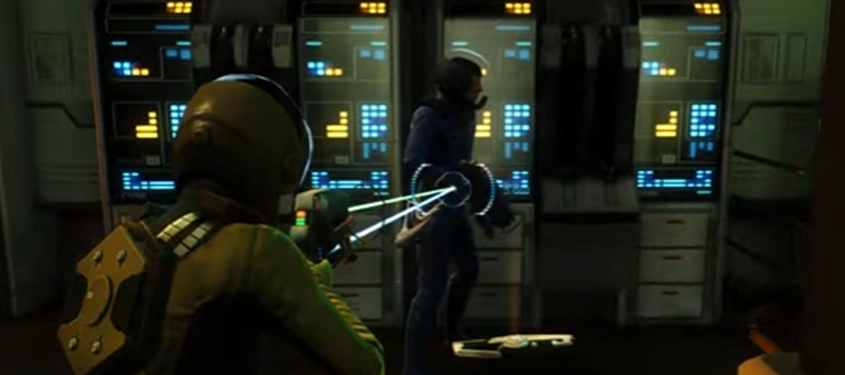
“Transporter Phasers” (from SFA “Vitus Reflux”)

FredH

Commodore
Commodore
We now have phasers that literally transport their targets to another location. This is used for combat training in the episode, but it would make a pretty amazing (and humane) weapon in actual combat, if you could set up a secure “prisoner receiving area” and set the phaser to delete the “casualty’s” weapons in mid-transport.

So:

* Is this a multiple-system item (like the tricom badges), where a single casing incorporates phaser and transporter systems?

* Or is it, somehow, an application of actual phaser technology to reproduce the effects of a transporter? I have no idea how that might work, but please share if you do.
 
They literally "Jerry-Rigged" the phasers in PIC S3 during the Final Battle crisis on the USS Titan to do that exact same thing so they don't kill their own Assimilated Crew-members.

Now it's just a standard feature that you can program in from what we can see.

Now if they only add in a "Strip the target naked & scan them for items hidden in their body before dumping them in a holding cell" feature.

That would be a ultimate weapon.
 
Didn't "Gambit" include weapons that could be used to transport their targets?

More or less. It's not that the phaser actually did the transporting itself -- rather, it "painted" a target that the ship's transporter would then lock onto and beam away, quickly enough that it appeared the target was disintegrated. I assume the later "transporting phasers" we've seen work the same way.
 
The 2013 Kelvinverse Gorn video game introduced this handy device for getting around tight spaces in the game.

 
The Romulans / Section 31 used this tech to not kill Sloane on DS9. They also had drones tag targets for transport in "Insurrection", and the TR-116 rifle could transport a solid slug through walls. The tech has been around for centuries, it's just now more mature.

The REAL question is whether or not the actual transporter tech is in the phasers, or if it's leveraging the Athena's transporters to beam stuff around... It was never really explained in DSC, but Data had a micro transporter that was combadge sized in 2379, so really, why not?

Mark
 
but Data had a micro transporter that was combadge sized in 2379, so really, why not?

I hated that. How can a transporter work if it dematerializes itself? Also, how can a transporter be smaller than the thing it transports? The particles have to be held in the pattern buffer before they're transmitted, so the buffer has to be large enough to contain them all.

Voyager: "Non Sequitur" had the alternate Tom Paris use a "portable transporter," but I always assumed it was just a remote activator for the Starfleet transporter network in San Francisco, i.e. a portable transporter console. I try to rationalize Data's Nemesis transporter pin the same way. The Enterprise's transporters were down at the time, but maybe it was just their control systems were down and the mechanisms themselves still worked, so Data's pin was able to access them remotely.
 
Also, how can a transporter be smaller than the thing it transports? The particles have to be held in the pattern buffer before they're transmitted, so the buffer has to be large enough to contain them all.

Buffer may contain the particles in subspace?

Surely the BoP's transporter buffer was smaller than two whales and a shitload of seawater?
 
Surely the BoP's transporter buffer was smaller than two whales and a shitload of seawater?

Maybe it just held a little at a time, like pouring a lot of water through a small pipe. But I can more easily believe that of a spaceship's buffer than of something the size of a lapel pin.
 
Maybe it just held a little at a time, like pouring a lot of water through a small pipe. But I can more easily believe that of a spaceship's buffer than of something the size of a lapel pin.
Or use any one of the Shuttle's Transporter Buffer's that are sitting in the Shuttle Bay in the back of the Enterprise-E.

But the Lapel Pin was clearly stated to be only useful for transporting 1-person, 1-way, & short distance as a "Emergency Get Out of Trouble" card.

He didn't go far, from the Scimitar to the Bridge of the Enterprise-E.

They were still very close to each other, so hundreds of meters at best.

Which isn't really useful in terms of long range transportation, but great for "GTFO of trouble".
 
Last edited:
I hated that. How can a transporter work if it dematerializes itself? Also, how can a transporter be smaller than the thing it transports? The particles have to be held in the pattern buffer before they're transmitted, so the buffer has to be large enough to contain them all.

Voyager: "Non Sequitur" had the alternate Tom Paris use a "portable transporter," but I always assumed it was just a remote activator for the Starfleet transporter network in San Francisco, i.e. a portable transporter console. I try to rationalize Data's Nemesis transporter pin the same way. The Enterprise's transporters were down at the time, but maybe it was just their control systems were down and the mechanisms themselves still worked, so Data's pin was able to access them remotely.

I'm kind of the same way. I think there should be reasonable limits on how small you can make certain advanced technologies, like the transporter. It's one reason I don't always mind the seeming tech stagnation that exists in some of the non-Trek franchises I enjoy, because sometimes it helps to keep a degree of logical consistency for those series.

I also feel like tech sometimes works better when you can't always solve every basic problem even with a degree of futuristic advancement. Battletech is usually my favorite example, and admittedly some of its realism has to do with game balance. :D But one of the problems that has always existed is dealing with waste heat.

Moving large, complex mechs and vehicles generates a lot of heat in addition to them firing in combat, and energy weapons are worse than ballistic weapons for heat. There's a lot of variability in design options, so some vehicles are very heat efficient and others risk a shutdown if they try to launch an alpha strike with their full weapons, but occasionally that's worth the risk.

There's also a limit in terms of how much mass you can utilize for the equipment you want, as heavier weaponry and equipment often means less armor and maneuverability. Omni units have an advantage with modular payloads, but even those have a sort of limit as to what payloads are more optimal. There are more exotic construction options like endo steel to make a stronger chassis that can support more equipment, but at the cost of the endo steel structure being bulkier and more expensive. There's always a general balance. :)
 
I'm kind of the same way. I think there should be reasonable limits on how small you can make certain advanced technologies, like the transporter. It's one reason I don't always mind the seeming tech stagnation that exists in some of the non-Trek franchises I enjoy, because sometimes it helps to keep a degree of logical consistency for those series.
This is why I would limit the ETU (Emergency Transporter Unit) to low 1## meters at most in terms of transporter distance for 1 person, 1 way.

That makes the most sense for a "Get Out of Trouble" card.

It shouldn't be used as a form of transportation, but a way to be outside the blast/danger zone.
 
But the Lapel Pin was clearly stated to be only useful for transporting 1-person, 1-way, & short distance as a "Emergency Get Out of Trouble" card.

I know what it was stated to be. I'm saying I reject what it was stated to be, because it's stupid as hell. Just because a story says something idiotic doesn't mean we're required to swallow it without question. We can use our own intelligence and imagination to try to handwave it into something less stupid.


He didn't go far, from the Scimitar to the Bridge of the Enterprise-E.

They were still very close to each other, so hundreds of meters at best.

Which isn't really useful in terms of long range transportation, but great for "GTFO of trouble".

The range has nothing to do with it. How the hell can a transporter beam anything when the transporter itself has been disintegrated into subatomic particles? The basic concept is pure nonsense.

The only way it would make sense is if the portable transporter is a 2-part system where one half beams the other half ahead and then the leading half receives the person's pattern, materializes them, and then beams over the trailing half of itself. But I cannot buy that when it's a pin as tiny as the one in NEM.


I'm kind of the same way. I think there should be reasonable limits on how small you can make certain advanced technologies, like the transporter. It's one reason I don't always mind the seeming tech stagnation that exists in some of the non-Trek franchises I enjoy, because sometimes it helps to keep a degree of logical consistency for those series.

Yes. Technology isn't magic. There should be reasonable limits on what even the most advanced technology is capable of.

One bit of 32nd-century tech that bugs me is the tiny "programmable matter" pads that people pin to their sleeves or whatever and can assemble a phaser from at will, even though the pad (I don't know what they're actually called) is much tinier than the phaser. Are we supposed to believe the PM is stored at hyperdensity, or that it's in a subspace pocket? Although this isn't unique to Trek; it goes for any sci-fi franchise where spacesuits or body armor suits have helmets that can retract and basically vanish into nothing.


I also feel like tech sometimes works better when you can't always solve every basic problem even with a degree of futuristic advancement. Battletech is usually my favorite example, and admittedly some of its realism has to do with game balance. :D But one of the problems that has always existed is dealing with waste heat.

Moving large, complex mechs and vehicles generates a lot of heat in addition to them firing in combat, and energy weapons are worse than ballistic weapons for heat. There's a lot of variability in design options, so some vehicles are very heat efficient and others risk a shutdown if they try to launch an alpha strike with their full weapons, but occasionally that's worth the risk.

There's also a limit in terms of how much mass you can utilize for the equipment you want, as heavier weaponry and equipment often means less armor and maneuverability. Omni units have an advantage with modular payloads, but even those have a sort of limit as to what payloads are more optimal. There are more exotic construction options like endo steel to make a stronger chassis that can support more equipment, but at the cost of the endo steel structure being bulkier and more expensive. There's always a general balance. :)

Yes. Not only is it good science, but imposing reasonable limits on the protagonists' capabilities, whether technological or magical, is a good way to keep them from being too powerful or getting out of trouble too easily.
 
The range has nothing to do with it. How the hell can a transporter beam anything when the transporter itself has been disintegrated into subatomic particles? The basic concept is pure nonsense.

The only way it would make sense is if the portable transporter is a 2-part system where one half beams the other half ahead and then the leading half receives the person's pattern, materializes them, and then beams over the trailing half of itself. But I cannot buy that when it's a pin as tiny as the one in NEM.
Then let's go with the easier & more practical solution.

The ETU is a form of Emergency Transponder Unit that contacts "Any Available Working Transporter" on the Enterprise-E to beam Captain JLP out of trouble and onto his vessel into a safe location.

That includes the Shuttle's parked in the back of the Enterprise-E or the Captain's Yacht.

If ALL of the Enterprise-E's Transporter's are down for whatever reason (Knock On Wood), there are so many Shuttles on board to call upon to do the exact same thing.

What are the chances that EVERY single Transporter Room/System on the Enterprise-E, the Shuttles, & the Captain's Yacht are all down at the same time?

Wouldn't that be a more believable solution instead?

The range has nothing to do with it. How the hell can a transporter beam anything when the transporter itself has been disintegrated into subatomic particles? The basic concept is pure nonsense.

The only way it would make sense is if the portable transporter is a 2-part system where one half beams the other half ahead and then the leading half receives the person's pattern, materializes them, and then beams over the trailing half of itself. But I cannot buy that when it's a pin as tiny as the one in NEM.
By that same Logic, the constant transporting in the 32nd Century is dependent on your StarShip/StarBase local Transporters to do all the work.

If you're not in communication range with any one of those systems, you're out of luck and w/o transporter capabilities.
 
Last edited:
Yes. Not only is it good science, but imposing reasonable limits on the protagonists' capabilities, whether technological or magical, is a good way to keep them from being too powerful or getting out of trouble too easily.

Agreed. Endo steel was originally an advanced composite developed by the Star League by mixing alloys in a zero-G environment, producing a version that was much stronger than the traditional steel manufactured on a planet with gravity. It's considerably bulkier but very useful if you really need the extra space for heavier units. Naturally, it was also one of the technologies that was lost for a time after the first Star League fell apart, because the orbital factories became popular targets. The version used by the Clans, the descendants of the Star League Defense Force, is a bit less bulky than its Inner Sphere counterpart because the wars which evolved the Clans never resulted in the same degree of technology loss.

This isn't to suggest the BT writers always get it right, of course. ;) After the interstellar communications grid was sabotaged to lead into the Dark Ages era of the timeline, it was never properly explained exactly how it was disabled to such a large degree or who managed to do so. The blackout affected both Clan and Inner Sphere systems even though they differ in some ways and the hyperpulse generators (HPGs) which serve as the relays are highly complex to manage. Some of them have been restored, but the major factions have mainly had to rely on ships to pass on news and orders. The mystery of the sabotage became something of a dangling plot thread that annoyed some fans. :lol:

I also like how the My Teacher Is An Alien series handled some aspects of the technology. When Peter goes aboard the alien ship New Jersey in the second book, the crew utilizes translators implanted in the brain to communicate. Every species speaks their normal language, which others then mentally "hear" translated into their own. The implants also recognize non-verbal cues, like how Broxholm (the alien Peter initially met on Earth in the first book) sighs by pulling his nose out and letting it snap back. Sometimes a phrase or gesture can have more than one meaning that's translated more humorously, like "I'm glad to be of help, and I hope my species never eats your children." :D
 
Then let's go with the easier & more practical solution.

The ETU is a form of Emergency Transponder Unit that contacts "Any Available Working Transporter" on the Enterprise-E to beam Captain JLP out of trouble and onto his vessel into a safe location.

Which is exactly what I suggested in post #8 earlier today.
 
If you are not already a member then please register an account and join in the discussion!

Sign up / Register


Back
Top