

Actually... images would be better.
The main issue with any type of physical measurement of irregular objects is that you can't be sure you are actually getting the correct measurement. Any bowing of the tape will throw off your measurements increasing error.
I know that in Track and Field world class events use optical measurements for most field events for this very reason. And it is even more important in the jumps were an attempt to measure from the landing site could disturb the actual impact shape with the possible effect of shortening the athlete's distance.
Light, in the form of laser projections and line of sight, is the only way to set up a truly orthogonal measuring system.
Further, we would be able to test and refine the equipment (if we were required to construct it ourselves) long before getting anywhere near the actual model (which would actually be required to support our findings). We would get perfect lengths and perfect curves using this method. Everything could be mathematically calculated from image data of this type.
Please don't mistake what I'm suggesting as some one running around snapping pictures... we have more than enough of that type of stuff available now. I am talking about precise placement of a camera (fully logged) and precise placement of laser markers (also fully logged) so that exact data (without question) can be retrieved.
Walking up to the Enterprise with a tape measure in hand isn't going to fly with the curators at the Smithsonian. The risk of poor data and damage to the model would make them shut everything down before we even began.
What I am talking about is data that can withstand intense academic scrutiny. Anything less and we're just a bunch of zealous fans trying to cop-a-feel of the ol' girl.
The main issue with any type of physical measurement of irregular objects is that you can't be sure you are actually getting the correct measurement. Any bowing of the tape will throw off your measurements increasing error.
I know that in Track and Field world class events use optical measurements for most field events for this very reason. And it is even more important in the jumps were an attempt to measure from the landing site could disturb the actual impact shape with the possible effect of shortening the athlete's distance.
Light, in the form of laser projections and line of sight, is the only way to set up a truly orthogonal measuring system.
Further, we would be able to test and refine the equipment (if we were required to construct it ourselves) long before getting anywhere near the actual model (which would actually be required to support our findings). We would get perfect lengths and perfect curves using this method. Everything could be mathematically calculated from image data of this type.
Please don't mistake what I'm suggesting as some one running around snapping pictures... we have more than enough of that type of stuff available now. I am talking about precise placement of a camera (fully logged) and precise placement of laser markers (also fully logged) so that exact data (without question) can be retrieved.
Walking up to the Enterprise with a tape measure in hand isn't going to fly with the curators at the Smithsonian. The risk of poor data and damage to the model would make them shut everything down before we even began.
What I am talking about is data that can withstand intense academic scrutiny. Anything less and we're just a bunch of zealous fans trying to cop-a-feel of the ol' girl.


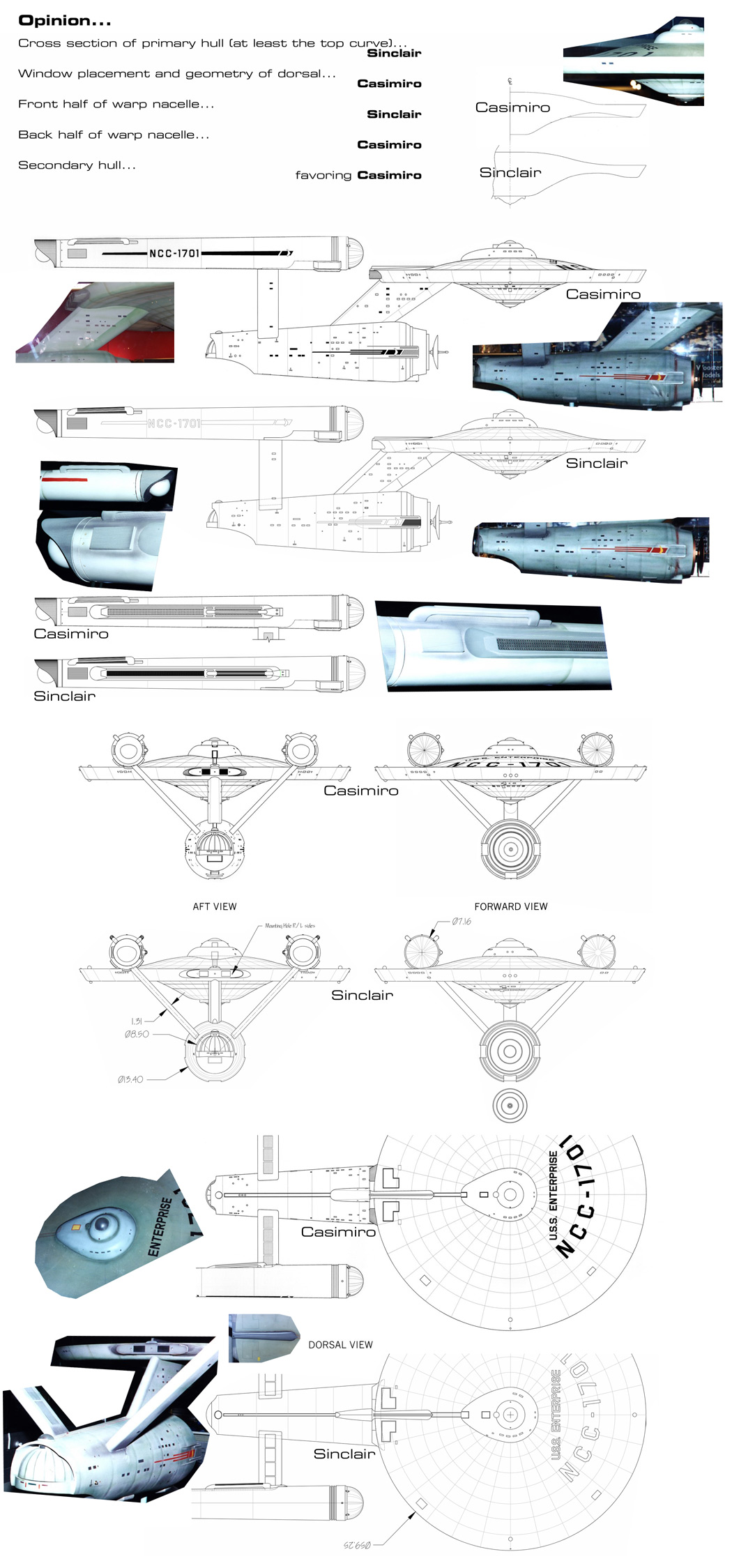
 BTWay, I placed mine back into the packaging in order to help accurately measure it and it measures about 1/32 less of an inch under 32.5 - takes up half of 1/16th space on my metal ruler, so 32.46" appears to be extremely close to being accurate - it's about 32.46875" or so give or take the hairswidth my eye may not be able to detect that it may be short or over the halfway point on the 1/16th slashes of my ruler).


