• Welcome! The TrekBBS is the number one place to chat about Star Trek with like-minded fans.
    If you are not already a member then please register an account and join in the discussion!

Hey, I never noticed that before....

I was flipping through my 'The Lost Years' book at dinner this evening, and, I got to the Chapter where the author interviewed David Gautreaux about his role as 'Xon' in the aborted "Star Trek II" series, and David mentioned something that hadn't clicked until now.
He said that after he screen tested and was offered the role of Xon, he went to Jeff Corey to help him find his Vulcan "center".
A former Star Trek guest star helping a, then current, Star Trek co-star.
 
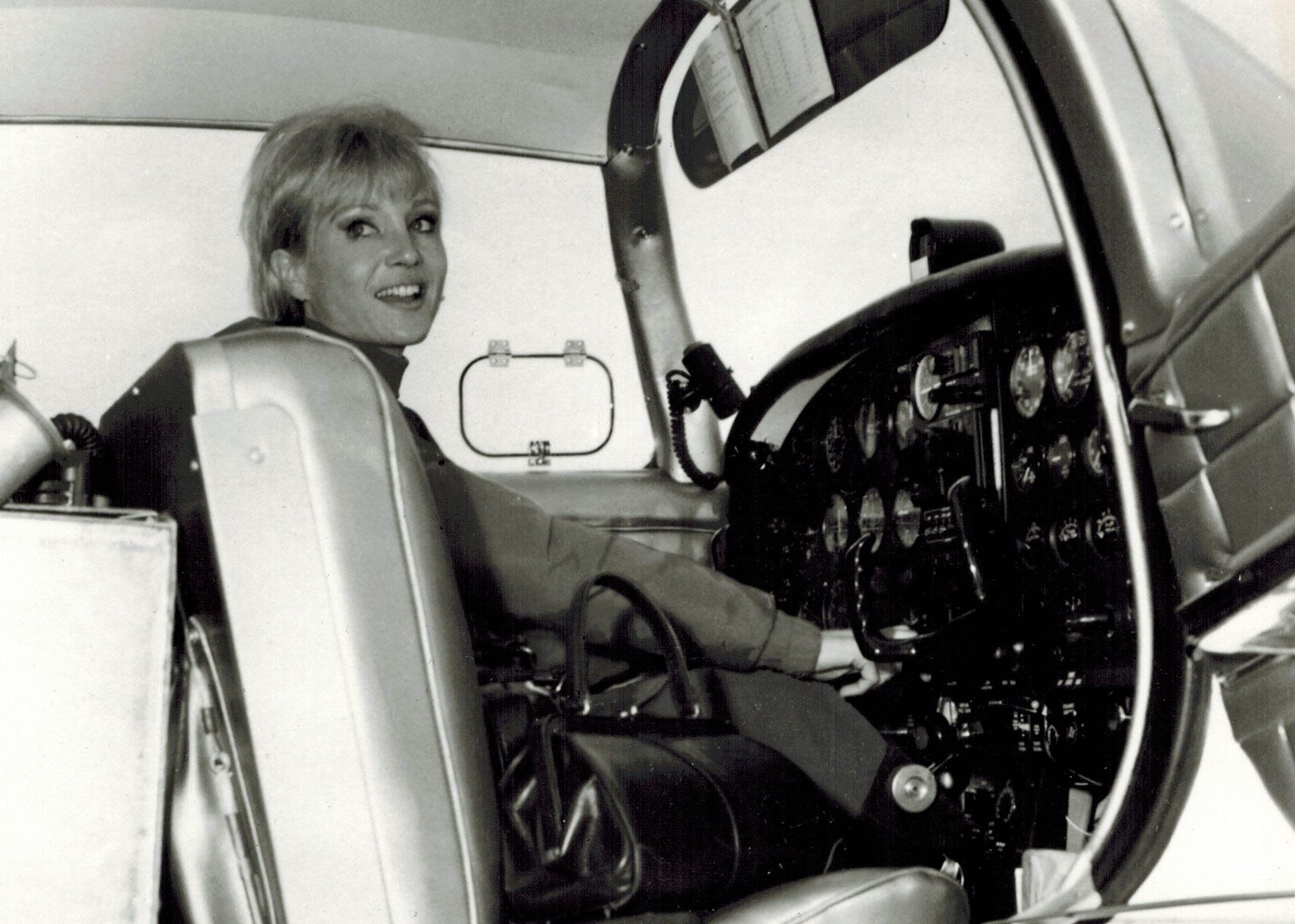
Back to Susan Oliver, she guest-starred on both The Twilight Zone ("People Are Alike All Over" and The Andy Griffith Show, both of which were heavily syndicated in the day, and I'm guessing those are the roles a lot of non-Trek fans of a certain age might know her for.
 
During the Next Voyage preview for ‘Shore Leave’ there is a great overhead/angled shot of the Knight charging at McCoy. I always wondered why the director and editor chose to omit this from the televised footage. I’m not totally sure but looking at the background there appears to be a wooden shed or building looming in the shadows. Perhaps that’s why it was left on the cutting room floor. :shrug:

To view this content we will need your consent to set third party cookies.
For more detailed information, see our cookies page.
 
Requiem For Methuselah

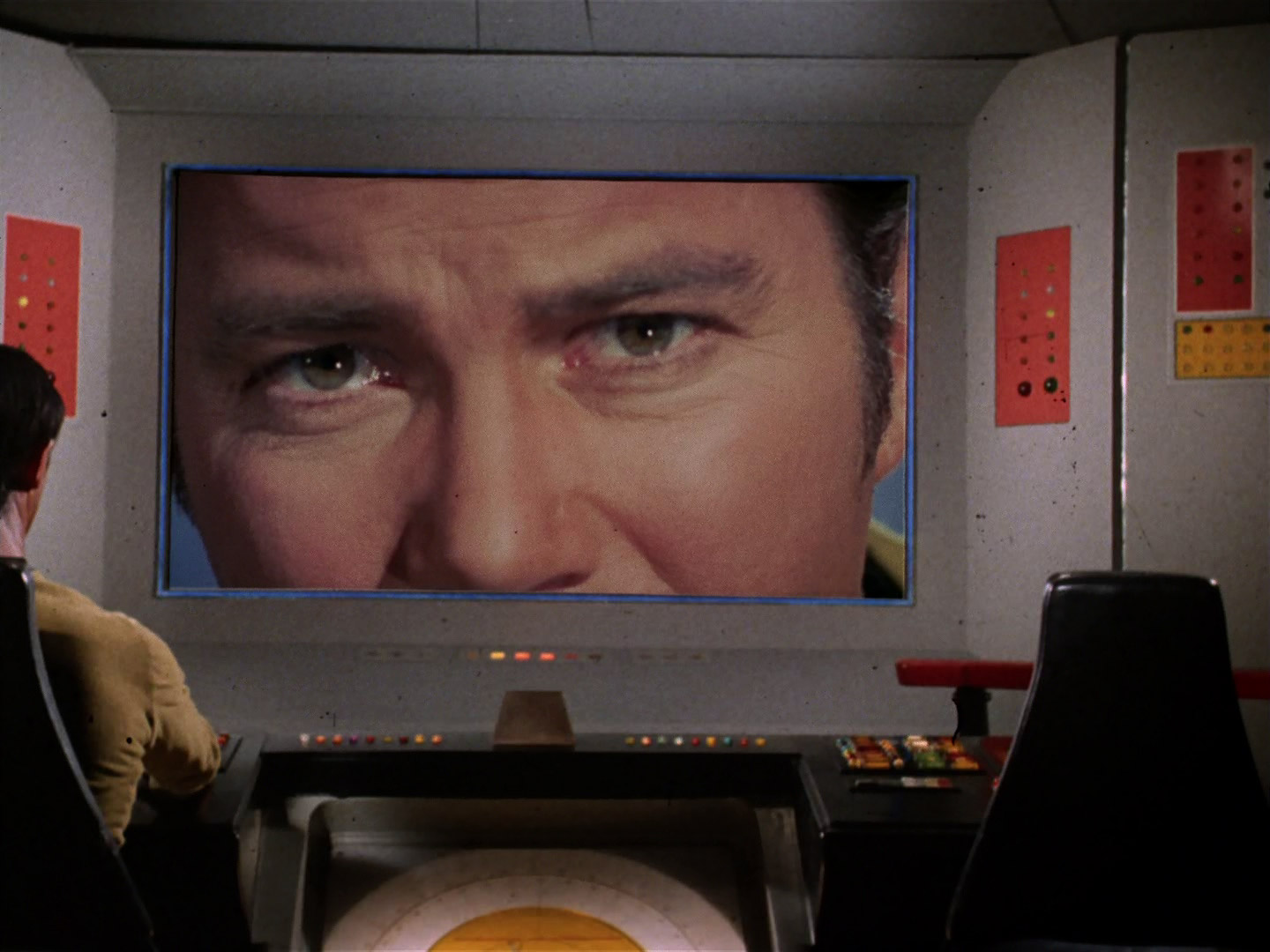
After Flint miniaturizes the Enterprise, Kirk looks in the Main Viewscreen. Bill Blackburn sits in the Helmsman’s seat while the Navigator’s seat is unoccupied.

requiem-for-methuselah-br-637.jpg


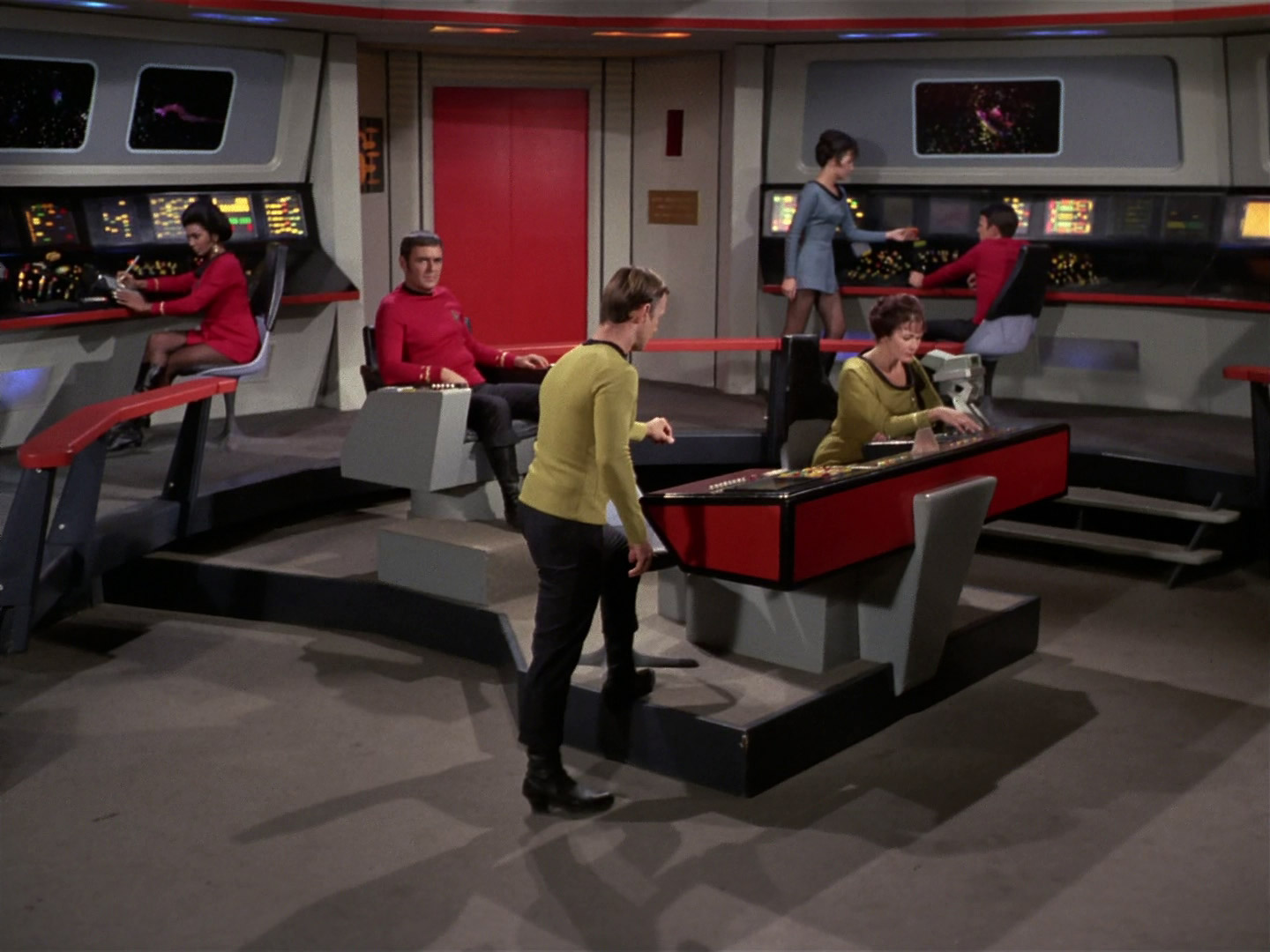
The next shot shows a female crew member at the helm and Bill Blackburn is by the Navigator’s position.

requiem-for-methuselah-br-638.jpg


***Trek Core supplied images***
 
Last edited:
This segment contains at least three tiny factoids that I enjoy:
  1. Earlier, when giving an update on the Rigellian fever, Scotty said "Nearly everybody aboard has got it, Captain. We're working a skeleton crew...." In the freeze-frame scene, that statement is supported by the fact that we see a lower-than-usual proportion of recognizable faces. No Takei, Koenig, Paskey, da Vinci, Malone, Veto, Holloway ... the only noticeably recurring extra is Billy Blackburn, and the other three background characters appear to be one-shots. That's a cool little bit of stealth continuity if you ask me.

  2. The gold-uniformed lieutenant played here by Sally Yarnell probably wins the prize for helmsman with the smallest dramatic footprint: as far as I can tell, she personally gets what amounts to one frame of screen time across the entire series.

  3. Although the scene does give the impression of an optical freeze-frame, with the actors being perfectly frozen by the camera rather than their own discipline, lights are nevertheless blinking all over the bridge. To me this seems like a subtly sophisticated effect for late 1968/early 1969 and probably involved a lot of masking/matting and optical printer work that we might not have realized. It also implies that Flint perhaps cannot stop time itself aboard the ship, but is able to greatly slow the progression of biological mechanisms — which he maybe did in order to prevent them from firing weapons inside his laboratory, or attempting to beam anyone up/down while such a severe scale disparity is in effect (perhaps with lethal results)?
 
Requiem For Methuselah

After Flint miniaturizes the Enterprise, Kirk looks in the Main Viewscreen. Bill Blackburn sits in the Helmsman’s seat while the Navigator’s seat is unoccupied.

requiem-for-methuselah-br-637.jpg


The next shot shows a female crew member at the helm and Bill Blackburn is by the Navigator’s position.

requiem-for-methuselah-br-638.jpg

Great catch. That's a hard one to explain away!


This segment contains at least three tiny factoids that I enjoy:
  1. Earlier, when giving an update on the Rigellian fever, Scotty said "Nearly everybody aboard has got it, Captain. We're working a skeleton crew...." In the freeze-frame scene, that statement is supported by the fact that we see a lower-than-usual proportion of recognizable faces. No Takei, Koenig, Paskey, da Vinci, Malone, Veto, Holloway ... the only noticeably recurring extra is Billy Blackburn, and the other three background characters appear to be one-shots. That's a cool little bit of stealth continuity if you ask me.

  2. The gold-uniformed lieutenant played here by Sally Yarnell probably wins the prize for helmsman with the smallest dramatic footprint: as far as I can tell, she personally gets what amounts to one frame of screen time across the entire series.

  3. Although the scene does give the impression of an optical freeze-frame, with the actors being perfectly frozen by the camera rather than their own discipline, lights are nevertheless blinking all over the bridge. To me this seems like a subtly sophisticated effect for late 1968/early 1969 and probably involved a lot of masking/matting and optical printer work that we might not have realized. It also implies that Flint perhaps cannot stop time itself aboard the ship, but is able to greatly slow the progression of biological mechanisms — which he maybe did in order to prevent them from firing weapons inside his laboratory, or attempting to beam anyone up/down while such a severe scale disparity is in effect (perhaps with lethal results)?

Terrific observations. I've wondered about the blinking lights before—first, why the effects team did it that way (instead of what seems to be obviously easier, just using a still shot), and secondly, what powers Flint actually had. Given the proximity in production date to "Wink of an Eye," which used a different approach for a similar concept, I think you're on to something with slowing down the biological processes but not the ship itself. Quite a trick!
 
  1. Although the scene does give the impression of an optical freeze-frame, with the actors being perfectly frozen by the camera rather than their own discipline, lights are nevertheless blinking all over the bridge. To me this seems like a subtly sophisticated effect for late 1968/early 1969 and probably involved a lot of masking/matting and optical printer work that we might not have realized.
It's not really a freeze frame with blinking lights composited in. There was no way they were gonna do something that fancy with the technology, schedule, and budget what it was. The actors are just holding still, and you only see them for two super-brief glimpses. I suspect Billy Blackburn's suspended arm was given a hidden support to steady it. Good old-fashioned show business craft.

I will say, I love that they took the trouble to do a real shot of the bridge, rather than just show a still frame. The Twilight Zone would use a still frame for this kind of moment, and it always seemed obvious.
 
In that teaser for Shore Leave the early establishing show of the planet shows clearly man-made hand rails(?) at 8 seconds in. They must have had a devil of a time shooting around all the structures in the "Africa USA" park. In the finished episode McCoy is sitting on a clearly cut down log while on his communicator and Kirk and McCoy later walk past a telephone pole!
 
In that teaser for Shore Leave the early establishing show of the planet shows clearly man-made hand rails(?) at 8 seconds in. They must have had a devil of a time shooting around all the structures in the "Africa USA" park. In the finished episode McCoy is sitting on a clearly cut down log while on his communicator and Kirk and McCoy later walk past a telephone pole!
I must have seen the episode a hundred times, man and boy, and I never noticed that stuff. So, for my money they got away with it.
 
Where abouts in the episode is the pole?

On the Blu-ray at 12:23-12:25 on the lower left by Kirk's arm you can see an actual wooden building with a pole right against it. You don't see the top of the pole so it could be a light pole or any other type pole. Also at the beginning you actually do see the wooden hand rails by the lake. I'm sure if you watched every scene and ignored the actors more man made objects could be spotted.
 
How close to the edge of the frame? Back then, they knew there was material that would fall outside the "safe zone" and display on a TV.
 
If you are not already a member then please register an account and join in the discussion!

Sign up / Register


Back
Top