
I thought I'd try coining a new phrase; and yes, it's a gentle jab at the controversy over the color of Kirk's shirt.
Yeah, it's cute; I like it. It sounds like you're also playing at the uncanny valley.
Yup, that was my inspiration.
Sincerely,
Bill

I thought I'd try coining a new phrase; and yes, it's a gentle jab at the controversy over the color of Kirk's shirt.
Yeah, it's cute; I like it. It sounds like you're also playing at the uncanny valley.
I would assume they corrected his skin color to blue. Due to the director's colorblindness, he was originally rendered with gray skin. (A tie-in novel in which he appeared a few years ago explained this by saying he was half-Aenar.)
The LaserDisc edition had him caucasian colored, giving me the impression that he was half-human, like Spock. The DVD had him grey colored. Also, take note that the black collar isn't on the DVD editon.


The collar is black on the DVD edition as well, it's just that one short scene where it isn't. I wonder why ...
Filmation's background paintings were always the best in the business, really lovely pieces of artwork.

The collar is black on the DVD edition as well, it's just that one short scene where it isn't. I wonder why ...
Not even the entire scene—just one shot. Something slipped through the cracks in the paint department during production.
Filmation's background paintings were always the best in the business, really lovely pieces of artwork.
Say what? I can't really call a Critic's Corollary to Sturgeon's Law on that one. The paintings weren't bad, but they were hardly the best in the business.
As for those suggesting a CGI remake of all the animation, that would be fairly easy with today's computer tools, and it would make TAS a truly animated series. But buying the series on DVD or Blu-ray or whatever is meant to be a trip down memory lane, or a revelation to those who did not see the series in first-run. I feel the same way about colorization or the upgraded FX in STAR WARS or TREK TOS. "Remastering" is fine, where noise and other artifacts that were never intended are removed and images are improved for today's display devices. But upgraded FX are "wrong"—they're an insult to the original artists and often do not match the production design of the original, thus standing out. ("Look, I'm a new effect!")
Art is often a compromise of time, materials, and other factors. It's the juggling of those factors that is a significant portion of the "art." Going back and reworking a published piece removes the "art" and turns the piece into a manufactured thing.

Art is often a compromise of time, materials, and other factors. It's the juggling of those factors that is a significant portion of the "art." Going back and reworking a published piece removes the "art" and turns the piece into a manufactured thing.


Filmation's background paintings were always the best in the business, really lovely pieces of artwork.
Say what? I can't really call a Critic's Corollary to Sturgeon's Law on that one. The paintings weren't bad, but they were hardly the best in the business.
do you seriously consider these TAS "space suits" to be "art"?
While it's fair to say that a lot of people in the industry found Filmation to be a bargain-basement studio in a lot of ways, there were also things it was praised for, and their lush background paintings were one of them.
The backgrounds are good, but "best in the business"? Perhaps it would be better to qualify that statement with "among made-for-TV animations of the '70s."

Although used exclusively in TAS, the life-support belt was invented during the run of Star Trek: The Original Series. Judy Burns, co-writer of "The Tholian Web", thought of using battery-powered "force field belts" in that episode, but the series' producers decided to feature EV suits instead. "They felt strongly that if they started something like a force field belt," explained Burns, "it might have ramifications down the line on other stories. I was a novice in those days, but today I probably would have countered that it was a prototype model that had been given to us this one time. In 25 years, we would get it back again." (Captains' Logs: The Unauthorized Complete Trek Voyages, 3rd ed., p. 72)
(Scotty, wearing a life-support belt, is trapped by the cover of the core)
MCCOY: The force field of his belt won't hold that weight for long, Jim.
[etc.]
Thus, the force field environment suits were a cost-saving "compromise," yet also provided options to the story writers.
One of the biggest advantages of TAS was that it was an animated TV series, thus there wasn't any need anymore to "compromise" as they could have visualized anything they wanted without considering budget restraints.
One of the biggest advantages of TAS was that it was an animated TV series, thus there wasn't any need anymore to "compromise" as they could have visualized anything they wanted without considering budget restraints.
To supplement Christopher's comments above, I am guessing that the life support halo was an "automatic" effect, generated with an optical printer in some fashion. The way the halo sometimes aligns with the characters exactly and other times is offset looks to me like a lens artifact (zooming, focusing).
Even if the halo was not an automatic effect, it would take an artist far less time to trace a quick outline than to draw the detail of a TOS-style environment suit—especially if archival cels were reused, as suggested above.
Does it present a "continuity" error with later TREKs? Sure, but what doesn't? The shuttlecraft in TAS doesn't look like the winged bread box in TOS.
No, they just would've painted colored outlines onto animation cels and layered them on top of the existing cels of the characters.
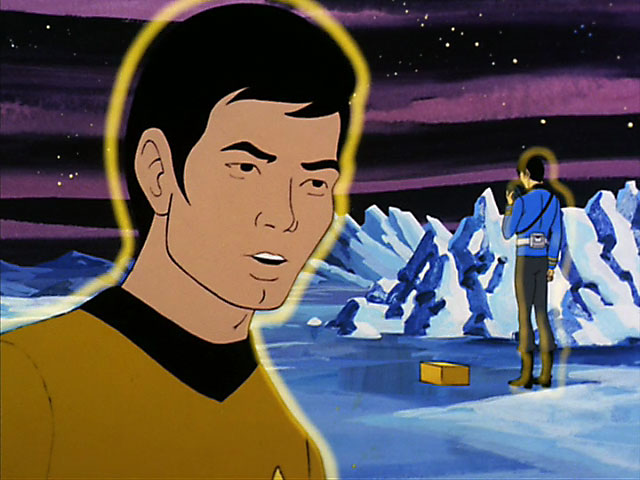
If the premise is that misalignment must be explained by cels being shot separately, then how does one explain misalignments such as those of the elevator doors in the shot of Cyrano Jones standing on the bridge?
Couldn't they have just airbrushed paint on cels to make the belt auras and shot them in one exposure with the rest of the elements, the way I assume they shot most every other frame?


We use essential cookies to make this site work, and optional cookies to enhance your experience.

