

Just for fun, I wrote a 2k-word newspaper editorial-style piece on how Trek has lost its way in the past quarter-century, and how it might get it back. Thought I'd share it here; comments welcome, of course!
In the year 2378, the USS Voyager returned to Sector 001 after a seven-year odyssey through the Delta Quadrant in a blaze of Borg-destroying glory. Using illicitly obtained technology from a quarter-century in the future, the ship generated weapons-resistant armor seemingly out of nowhere as it hurtled home through a wormhole, taking out an enemy transwarp hub in the process. “Endgame,” which aired in May 2001, was and remains a poorly received series finale, awkwardly riffing on the what-if element of the far superior The Next Generation conclusion “All Good Things…” from seven years before, but it was also a distinctly future-focused tale. Since then, however, the franchise has been almost entirely consumed with revisiting its own past, and, in so doing, has lost much of the sense of purpose and moral heft that once made it special.
The Voyager finale wasn’t the last time the franchise would move forward in time during the Rick Berman era; that distinction went to 2002’s Nemesis. But Nemesis was a tired, creaking husk of a movie that was more interested in rehashing 1982’s The Wrath of Khan and serving as an epilogue to the TNG years than telling a fresh story of its own. Meanwhile, on TV, the prequel series Enterprise was already running out of gas, reusing well-worn story concepts and awkwardly improvising a pointless “Temporal Cold War” that ultimately went nowhere. After four dormant years, the franchise was briefly resuscitated on the big screen with 2009’s Star Trek, but J.J. Abrams’ Original Series revamp, along with its two sequels, offered only surface-level popcorn thrills devoid of any substance. In 2017, Discovery kicked off a massive streaming TV revival, but this third straight prequel effort again failed to impress. After two seasons, the series made a time jump to the 32nd century, the furthest forward the franchise has yet ventured, but, because the Federation had broken apart by that point, in seeking to rebuild it, the remaining seasons of Discovery, as well as its follow-up Starfleet Academy, gave the impression of being a thematic rehash of the little-loved pre-Federation series Enterprise, which was itself a prequel to TOS. In short, ever since Voyager’s “Endgame,” the franchise has been mired in a quarter-century of looking backwards and repetition.
But, that’s not the worst of it: in that same quarter-century, the saga has also lost its cultural relevance. Star Trek was born in the thick of the Cold War, when the notion of a united and peaceful Earth still felt like a radical idea, and the ink on 1964’s Civil Rights Act of was scarcely dry. (It would be almost 30 years before women served on U.S. Navy warships, and 42 years before a non-white man earned a major party presidential nomination.) TNG, which updated TOS’ values with 1980s political correctness, also debuted during the Cold War, and Deep Space Nine brought unprecedented long-form narrative intellectual heft by exploring a Cold War-like clash of civilizations in its Dominion War storyline. Voyager had a neat narrative hook borrowed from Homer’s Odyssey, but its failure to serialize or mature quickly relegated it to pop-culture obscurity. (In a 2009 episode of The Colbert Report, its host memorably quipped that ‘Only God could love Star Trek: Voyager.’) If DS9 cast a skeptical eye at the post-Soviet “End of History” proclaimed by political theorist Francis Fukuyama, neither Voyager nor Enterprise had anything remotely new to say about the times in which they aired.
While Star Trek’s core values didn’t change, however, the world around it did. The liberal democratic utopia at the heart of the Trek’s optimism is inextricably linked with its post-scarcity dream of unlimited resources across an infinite cosmos, but, as the 1990s marched on, the foreboding science of global warming forecasts became impossible to deny. Cataclysmic climate change and the threat of ferocious wars for dwindling basic resources such as water, arable land, and territory fit for human habitation will almost certainly be the defining challenges of the 21st century, even if the most acute crises may not arrive for another few decades. In the face of such headwinds, Star Trek’s 60-year championing of international cooperation and liberal values remains important, but its fundamental promise that humanity can both have it all and keep growing forever, so long as it plays nicely with each other, now feels stale at best, and contemptibly naïve at worst. Indeed, that fantasy feeds directly into the pernicious lies, preached by Big Tech oligarchs such as Bezos and Musk, that humanity not only has the potential to create self-sustaining colonies outside of Earth, but that seeking to do so is more important than working towards international peace and preparing for the environmental trials barreling towards us now. And that grim realization brings us, of all things, to Star Trek’s younger sibling, Star Wars.
George Lucas’ space opera burst into theaters in 1977, one year after the American bicentennial celebrations, which had been dampened by the trauma and defeat of the Vietnam War one year prior, and the implosion of the Nixon Administration the year before that. Unlike Star Trek, which looked forward to a “real” imagined future, Star Wars introduced itself as a nostalgic fairy tale, taking place “A long time ago in a galaxy far, far away.” Moreover, in his book Blockbuster, critic Tom Shone argues that, with its cheerfully morally uncomplicated spirit, the film served as an emotional pastiche of the American Revolution itself, pitting a heroic group of scrappy, lily-white Yanks against prim yet tyrannical British imperialists – and, as a cosmic fantasy, there was no need to grapple with the nation’s original sins of indigenous genocide and slavery. 1983’s Return of the Jedi featured lovable forest-dwelling natives that echoed the U.S.’s then-recent North Vietnamese enemies, but, on the whole, the Original Star Wars Trilogy was a straightforward fantasy of waging a righteous, family-friendly war against space fascists who sounded like Brits and acted like Nazis. Star Trek inspired generations of youngsters to become astronauts, scientists, and engineers, whereas Star Wars, to the extent it inspired careers at all, mainly made children dream of becoming filmmakers. Trek stimulated minds; Wars excited hearts.
This dichotomy largely persisted all throughout the release of the Star Wars Prequel and Sequel Trilogies until 2022, when an utterly unexpected development occurred: the first season of Andor, a prequel series to the 2016 A New Hope prequel flick Rogue One, began earning critical acclaim that Trek hadn’t enjoyed for decades. Battles against the fascist Empire had of course always been a core feature of the saga, but Andor was the first screen iteration to take the misery and terror of totalitarianism utterly seriously, with no superheroic Jedi, pat and immediate victories, or morally unblemished protagonists in sight. Developed during the first Trump Administration, Andor was a bracing howl of protest whose two seasons topped critics’ best-of lists, and were both nominated for the Outstanding Drama Series Emmy, which Trek hadn’t managed since TNG’s last season in 1994. True to Star Wars form, Andor didn’t present or explore any new ideas, but in a time of societal and political regression, its old ideas felt new again, and the series thus achieved a degree of cultural relevance that left the scrupulously up-to-date attitudes and platitudes of the new Trek series Strange New Worlds and Starfleet Academy in the dust.
What, then, is Star Trek to do? If global warming is both too big and too slow-moving of a real-world issue to explore through any futuristic metaphor, the obvious answer would be to redouble its focus on social and political issues, as it has indeed attempted. But this course is actually a narrative and thematic trap, because there’s no meaningful philosophical debate to be had amongst the franchise’s audience. In 2026, Trek fans and potential watchers overwhelmingly agree that adults must have the freedom to identify and present, as well as form consenting relationships, as they see fit, and the twin phenomena of endlessly diverse entertainment options and the fragmentation of audiences into paywalled streaming services means there no longer exists any mass of casual channel-flippers to entice and persuade. When the franchise was at its peak popularity in the mid-90s, gay marriage was politically inconceivable, but it’s now been over a decade since it was imposed nationwide by the Supreme Court, and while opportunistic and brutish fights over trans rights still persist, they must be fought in the here and now, as such spitefulness has no place in the Federation’s enlightened future. What’s more, now that all manner of contemporary issues can be openly discussed and dramatized, sci-fi’s power to illuminate via parallels and metaphor has been severely diminished. In short, neither looming environmental crisis nor immediate social justice narratives seem capable of restoring Trek’s luster.
(Brief but necessary tangent: Trek faces an additional meta-narrative problem in that it may have run out of new futures to depict. In TNG, holodecks and force fields were clear upgrades over the TOS years, and Voyager added portable holo-emitters and Borg nanotechnology, along with a glimpse at a 29th-century Starfleet vessel that can time-travel at will. There comes a point where the line between futuristic technology and outright magic blurs, and another point where adding yet more holographic displays to maximally shiny sets, as recent series have done, no longer impresses. In the 80s, no TV productions could match Trek’s cosmic production values, but, four decades later, rival productions have long since caught up. In short: the franchise’s future-wow factor has also petered out, likely never to return.)
This is where Andor factors in. Of all the problems now facing first-world nations, the ever-present threat of authoritarianism is the only one that sci-fi can vibrantly and dynamically explore. Fortunately, the predominantly utopian Trek universe has a ready-made setting for such a narrative in the Mirror Universe. Introduced in the 1967 second-season TOS classic “Mirror, Mirror,” the Mirror Universe is a parallel reality in which a vicious Terran Empire acts as an anti-Federation, expanding via conquest rather than cooperation. Although the franchise has periodically returned to that nightmarish idea, most recently in 2022’s second season of Picard (which didn’t feature that exact Mirror timeline, but rather one very like it), it has never foregrounded the dimension for more than an occasional episode or plot point, leaving it ripe for a narrative spotlight. A series in which a Starfleet crew becomes stranded in the Mirror Universe with no known path home, forcing them to choose between keeping a low profile in order to simply survive, risking detection by actively working on a means of escape, or fomenting a democratic revolution against the Terran Empire could explore the depravities of authoritarianism as no Trek screen effort has done before, even if it would have to contend with the fact that Star Wars got there first.
Would this be a case of burning the saga down in order to save it? I don’t think so, but it’s worth asking if there are any viable alternatives. Whether due to poor quality or corporate Paramount headwinds, this year’s Starfleet Academy was a swiftly canceled disaster, numerous attempts to produce a new theatrical film have failed, and the streaming bubble of abundant funding in which Discovery premiered is widely understood to have all but evaporated. While a lack of objective data makes credible lay analysis nearly impossible, it seems plausible to at least posit that the franchise may be in dire need of a new creative direction. Perhaps a long and arduous voyage “through the looking-glass” is the dilithium shot Star Trek needs to renew its cultural relevance.
Star Trek’s Lost Purpose
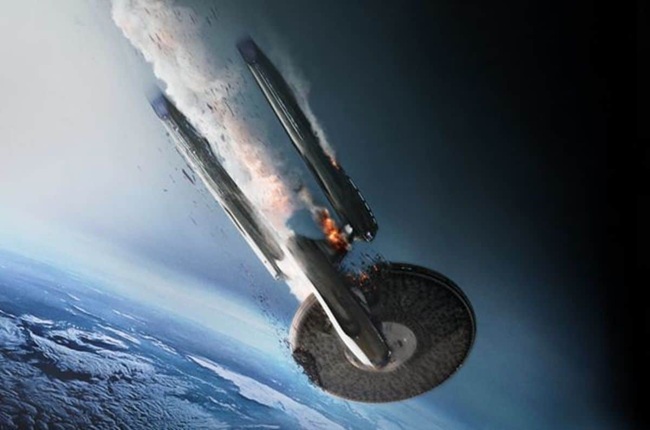
In the year 2378, the USS Voyager returned to Sector 001 after a seven-year odyssey through the Delta Quadrant in a blaze of Borg-destroying glory. Using illicitly obtained technology from a quarter-century in the future, the ship generated weapons-resistant armor seemingly out of nowhere as it hurtled home through a wormhole, taking out an enemy transwarp hub in the process. “Endgame,” which aired in May 2001, was and remains a poorly received series finale, awkwardly riffing on the what-if element of the far superior The Next Generation conclusion “All Good Things…” from seven years before, but it was also a distinctly future-focused tale. Since then, however, the franchise has been almost entirely consumed with revisiting its own past, and, in so doing, has lost much of the sense of purpose and moral heft that once made it special.
The Voyager finale wasn’t the last time the franchise would move forward in time during the Rick Berman era; that distinction went to 2002’s Nemesis. But Nemesis was a tired, creaking husk of a movie that was more interested in rehashing 1982’s The Wrath of Khan and serving as an epilogue to the TNG years than telling a fresh story of its own. Meanwhile, on TV, the prequel series Enterprise was already running out of gas, reusing well-worn story concepts and awkwardly improvising a pointless “Temporal Cold War” that ultimately went nowhere. After four dormant years, the franchise was briefly resuscitated on the big screen with 2009’s Star Trek, but J.J. Abrams’ Original Series revamp, along with its two sequels, offered only surface-level popcorn thrills devoid of any substance. In 2017, Discovery kicked off a massive streaming TV revival, but this third straight prequel effort again failed to impress. After two seasons, the series made a time jump to the 32nd century, the furthest forward the franchise has yet ventured, but, because the Federation had broken apart by that point, in seeking to rebuild it, the remaining seasons of Discovery, as well as its follow-up Starfleet Academy, gave the impression of being a thematic rehash of the little-loved pre-Federation series Enterprise, which was itself a prequel to TOS. In short, ever since Voyager’s “Endgame,” the franchise has been mired in a quarter-century of looking backwards and repetition.
But, that’s not the worst of it: in that same quarter-century, the saga has also lost its cultural relevance. Star Trek was born in the thick of the Cold War, when the notion of a united and peaceful Earth still felt like a radical idea, and the ink on 1964’s Civil Rights Act of was scarcely dry. (It would be almost 30 years before women served on U.S. Navy warships, and 42 years before a non-white man earned a major party presidential nomination.) TNG, which updated TOS’ values with 1980s political correctness, also debuted during the Cold War, and Deep Space Nine brought unprecedented long-form narrative intellectual heft by exploring a Cold War-like clash of civilizations in its Dominion War storyline. Voyager had a neat narrative hook borrowed from Homer’s Odyssey, but its failure to serialize or mature quickly relegated it to pop-culture obscurity. (In a 2009 episode of The Colbert Report, its host memorably quipped that ‘Only God could love Star Trek: Voyager.’) If DS9 cast a skeptical eye at the post-Soviet “End of History” proclaimed by political theorist Francis Fukuyama, neither Voyager nor Enterprise had anything remotely new to say about the times in which they aired.
While Star Trek’s core values didn’t change, however, the world around it did. The liberal democratic utopia at the heart of the Trek’s optimism is inextricably linked with its post-scarcity dream of unlimited resources across an infinite cosmos, but, as the 1990s marched on, the foreboding science of global warming forecasts became impossible to deny. Cataclysmic climate change and the threat of ferocious wars for dwindling basic resources such as water, arable land, and territory fit for human habitation will almost certainly be the defining challenges of the 21st century, even if the most acute crises may not arrive for another few decades. In the face of such headwinds, Star Trek’s 60-year championing of international cooperation and liberal values remains important, but its fundamental promise that humanity can both have it all and keep growing forever, so long as it plays nicely with each other, now feels stale at best, and contemptibly naïve at worst. Indeed, that fantasy feeds directly into the pernicious lies, preached by Big Tech oligarchs such as Bezos and Musk, that humanity not only has the potential to create self-sustaining colonies outside of Earth, but that seeking to do so is more important than working towards international peace and preparing for the environmental trials barreling towards us now. And that grim realization brings us, of all things, to Star Trek’s younger sibling, Star Wars.
George Lucas’ space opera burst into theaters in 1977, one year after the American bicentennial celebrations, which had been dampened by the trauma and defeat of the Vietnam War one year prior, and the implosion of the Nixon Administration the year before that. Unlike Star Trek, which looked forward to a “real” imagined future, Star Wars introduced itself as a nostalgic fairy tale, taking place “A long time ago in a galaxy far, far away.” Moreover, in his book Blockbuster, critic Tom Shone argues that, with its cheerfully morally uncomplicated spirit, the film served as an emotional pastiche of the American Revolution itself, pitting a heroic group of scrappy, lily-white Yanks against prim yet tyrannical British imperialists – and, as a cosmic fantasy, there was no need to grapple with the nation’s original sins of indigenous genocide and slavery. 1983’s Return of the Jedi featured lovable forest-dwelling natives that echoed the U.S.’s then-recent North Vietnamese enemies, but, on the whole, the Original Star Wars Trilogy was a straightforward fantasy of waging a righteous, family-friendly war against space fascists who sounded like Brits and acted like Nazis. Star Trek inspired generations of youngsters to become astronauts, scientists, and engineers, whereas Star Wars, to the extent it inspired careers at all, mainly made children dream of becoming filmmakers. Trek stimulated minds; Wars excited hearts.
This dichotomy largely persisted all throughout the release of the Star Wars Prequel and Sequel Trilogies until 2022, when an utterly unexpected development occurred: the first season of Andor, a prequel series to the 2016 A New Hope prequel flick Rogue One, began earning critical acclaim that Trek hadn’t enjoyed for decades. Battles against the fascist Empire had of course always been a core feature of the saga, but Andor was the first screen iteration to take the misery and terror of totalitarianism utterly seriously, with no superheroic Jedi, pat and immediate victories, or morally unblemished protagonists in sight. Developed during the first Trump Administration, Andor was a bracing howl of protest whose two seasons topped critics’ best-of lists, and were both nominated for the Outstanding Drama Series Emmy, which Trek hadn’t managed since TNG’s last season in 1994. True to Star Wars form, Andor didn’t present or explore any new ideas, but in a time of societal and political regression, its old ideas felt new again, and the series thus achieved a degree of cultural relevance that left the scrupulously up-to-date attitudes and platitudes of the new Trek series Strange New Worlds and Starfleet Academy in the dust.
What, then, is Star Trek to do? If global warming is both too big and too slow-moving of a real-world issue to explore through any futuristic metaphor, the obvious answer would be to redouble its focus on social and political issues, as it has indeed attempted. But this course is actually a narrative and thematic trap, because there’s no meaningful philosophical debate to be had amongst the franchise’s audience. In 2026, Trek fans and potential watchers overwhelmingly agree that adults must have the freedom to identify and present, as well as form consenting relationships, as they see fit, and the twin phenomena of endlessly diverse entertainment options and the fragmentation of audiences into paywalled streaming services means there no longer exists any mass of casual channel-flippers to entice and persuade. When the franchise was at its peak popularity in the mid-90s, gay marriage was politically inconceivable, but it’s now been over a decade since it was imposed nationwide by the Supreme Court, and while opportunistic and brutish fights over trans rights still persist, they must be fought in the here and now, as such spitefulness has no place in the Federation’s enlightened future. What’s more, now that all manner of contemporary issues can be openly discussed and dramatized, sci-fi’s power to illuminate via parallels and metaphor has been severely diminished. In short, neither looming environmental crisis nor immediate social justice narratives seem capable of restoring Trek’s luster.
(Brief but necessary tangent: Trek faces an additional meta-narrative problem in that it may have run out of new futures to depict. In TNG, holodecks and force fields were clear upgrades over the TOS years, and Voyager added portable holo-emitters and Borg nanotechnology, along with a glimpse at a 29th-century Starfleet vessel that can time-travel at will. There comes a point where the line between futuristic technology and outright magic blurs, and another point where adding yet more holographic displays to maximally shiny sets, as recent series have done, no longer impresses. In the 80s, no TV productions could match Trek’s cosmic production values, but, four decades later, rival productions have long since caught up. In short: the franchise’s future-wow factor has also petered out, likely never to return.)
This is where Andor factors in. Of all the problems now facing first-world nations, the ever-present threat of authoritarianism is the only one that sci-fi can vibrantly and dynamically explore. Fortunately, the predominantly utopian Trek universe has a ready-made setting for such a narrative in the Mirror Universe. Introduced in the 1967 second-season TOS classic “Mirror, Mirror,” the Mirror Universe is a parallel reality in which a vicious Terran Empire acts as an anti-Federation, expanding via conquest rather than cooperation. Although the franchise has periodically returned to that nightmarish idea, most recently in 2022’s second season of Picard (which didn’t feature that exact Mirror timeline, but rather one very like it), it has never foregrounded the dimension for more than an occasional episode or plot point, leaving it ripe for a narrative spotlight. A series in which a Starfleet crew becomes stranded in the Mirror Universe with no known path home, forcing them to choose between keeping a low profile in order to simply survive, risking detection by actively working on a means of escape, or fomenting a democratic revolution against the Terran Empire could explore the depravities of authoritarianism as no Trek screen effort has done before, even if it would have to contend with the fact that Star Wars got there first.
Would this be a case of burning the saga down in order to save it? I don’t think so, but it’s worth asking if there are any viable alternatives. Whether due to poor quality or corporate Paramount headwinds, this year’s Starfleet Academy was a swiftly canceled disaster, numerous attempts to produce a new theatrical film have failed, and the streaming bubble of abundant funding in which Discovery premiered is widely understood to have all but evaporated. While a lack of objective data makes credible lay analysis nearly impossible, it seems plausible to at least posit that the franchise may be in dire need of a new creative direction. Perhaps a long and arduous voyage “through the looking-glass” is the dilithium shot Star Trek needs to renew its cultural relevance.
Last edited:


