• Welcome! The TrekBBS is the number one place to chat about Star Trek with like-minded fans.
    If you are not already a member then please register an account and join in the discussion!

The Nature of the Universe, Time Travel and More...

  • Thread starter Will The Serious
  • Start date
"The US Top Secret-cleared aerospace and nuclear workforce is ~700,000 people," science writer, investigator and pseudoscience debunker Mick West wrote on 16 April on his Substack.

"Ordinary mortality over 22 months predicts ~4,000 deaths, ~70 homicides, and ~180 suicides. The list has 10 … The deaths are real. The families' grief is real. The pattern is not."

Louise Grillmair, similarly, says that - while her husband "would laugh" at speculation that the deaths might be connected - he would also "probably talk statistically" to squelch conspiracies.
Precisely why I decided not to take any of the conspiracy theories seriously until someone came up with figures that suggested these occurrences constituted a real statistical outlier cluster.
 
I think the point of the block universe is that there is a universal time, exactly as there is a universal meter and a universal 360 degree circle. The meter and the degree are, of course, arbitrary measures of humans, as is the second, but they are defined the same and behave the same no matter where we go on the xyzt axis of universal coordinates. We exist at one point, and to move to another point, we must move through all the intervening points, both positionally and across time.

So, to jump to another universe in the block universe, would mean that if there was an adjacent "parallel" to a parallel universe, that's where we would have to go first to travel across to it. That is simply the adjacent point. You'd be guaranteed to collide with your identical counterpart unless your identical counterpart was jumping across to the next block universe at the same time; actually moving out of the way.

Personally, I hate the idea of Einstein's block universe and time as a relative 4th dimension to space's 3. It take away cause and effect. Where everything exists at once in the block, there is no reason for things to happen. We fall because that is our destiny, not because of gravity.

Ultimately, as time is tied in as a 4th dimension, what motivates movement in time? A ball sitting on a one dimensional "x" axis, still needs a reason to move to another point on that axis. So to would it need motivation to move to another point along the "t" axis. Where is that cause and effect in a block universe?
You might think that, but you'd be wrong. Still, what you believe to be the truth is up to you.
I'll expand my reasoning a bit:

Your mistake is conflating the block universe picture with absolute space and time. In relativity (as formalized in Minkowski spacetime), the "block" just means that all events - past, present, and future - are part of a single four-dimensional structure. It does not imply that there is a unique, observer-independent way to divide that structure into space and time, or to define a universal "now”".

One of the central results of Special Relativity (SR) is that simultaneity is relative. Observers in relative motion disagree about which distant events are happening "at the same time", and this disagreement is not a matter of perception or signal delay - it reflects the geometry of spacetime itself. If absolute time existed, there would be a single, globally agreed-upon notion of simultaneity. But SR shows that no such notion exists.

This is tightly connected to Lorentz invariance. The laws of physics take the same form in all inertial frames, and no experiment can single out a preferred one. An absolute space or time would effectively define such a preferred frame, breaking that symmetry. Since Lorentz invariance is extremely well confirmed experimentally, introducing absolute structure contradicts the core of the theory.

The block universe removes Newtonian absolutes. You still have a fixed spacetime "block", but there is no privileged slicing of it into space and time, and no universal present. Any attempt to reintroduce absolute space or time either conflicts with SR or becomes physically unobservable and therefore superfluous.

There are ways to introduce a preferred frame (such as Lorentz ether theories), but:
  • They are empirically indistinguishable from SR
  • The preferred frame becomes unobservable by construction
Even in those formulations, absolute space and/or absolute time exist only as surplus structure, not as physical reality.

  • Special Relativity establishes relativity of simultaneity
  • Minkowski spacetime provides a geometric formulation with no preferred slicing
  • Lorentz invariance forbids a detectable preferred frame
 
Last edited:
Thanks for taking the time, Asbo.
No problem, I know plenty of people out there have claimed to be able to overturn the framework I mention, but with little success. In fact the greatest problem it faces is its inability to mesh with quantum mechanics. My solution is to overturn everything and think about what we perceive as reality in a different way. That is far from an original thought on my part as I've mentioned. I'm not even sure my prediction of inconsistency between histories of perception that I derived aided by AI is valid.* It seems it might be testable by simulating the discrete analogue of a path integral over observer-states, but I'll leave someone else to work out whether that's even worth doing and actually do it if it is. It's not something about which I feel any passion.

* The probability of paths differing by ΔN bits of information varies as exp(-ΔN). Normalising so that the sum of all probabilities is 100% implies that the probability of zero difference between two observations of an event is only 63%.
 
Last edited:
To view this content we will need your consent to set third party cookies.
For more detailed information, see our cookies page.
So "Virtual" Particles, what are they really?
 
Not real. The clue's in the name.
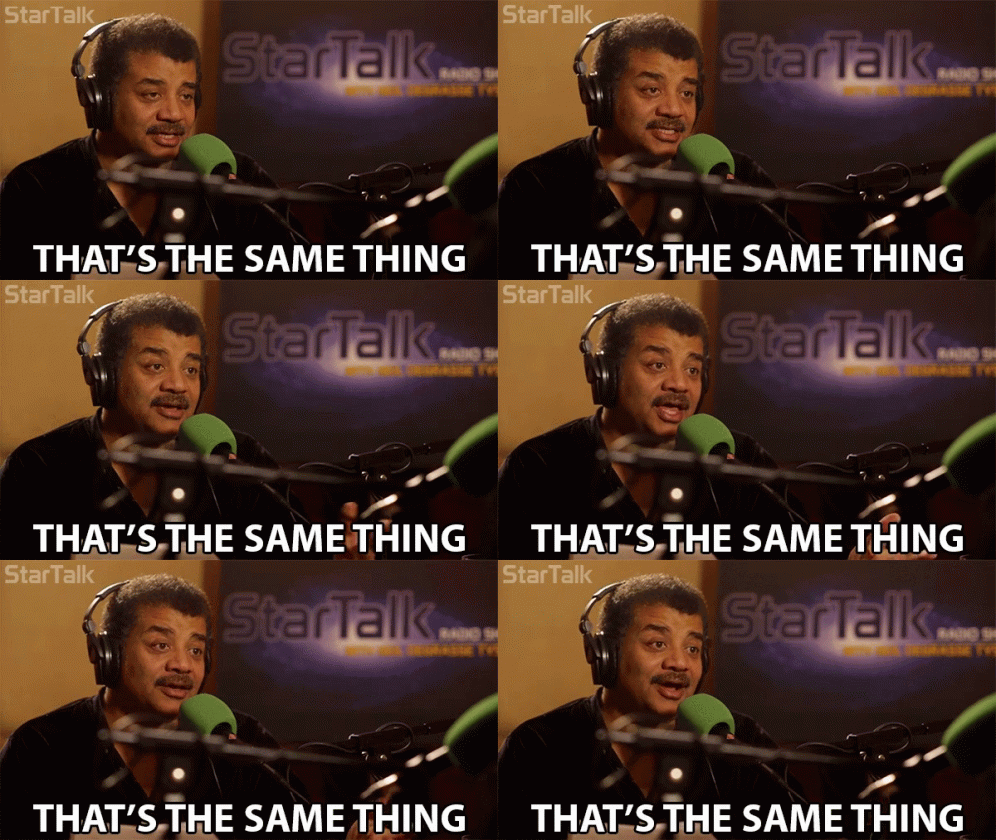
Yeah but isn't it virtually the same thing?
thats-the-same-thing-same.gif

Nearly.

-Will
 
Yeah but isn't it virtually the same thing?

Nearly.

-Will
It would be hard to explain how the exchange of real photons would give rise to an attractive force between positively and negatively charged particles via the electromagnetic field. They'd need to be able to convey negative momentum. That's something for which we need virtual photons and the mathematics of QED (or QFT).

Personally, I doubt even "real" electrons are real if everything we perceive is an illusion - in which case they're are different kind of observed virtuality. That's not the conventional wisdom, naturally. The old moderator used to get very flakey if we started making up our own hypotheses - mine are borrowings from the fringe.
 
if everything we perceive is an illusion
I've heard about this several places, even one of my sons talked a little about this a while back. I never bothered to study this or read anything about it. I can google it of course but i can ask here if there is a short answer..... What does it mean if we are, or are inside an illusion? is nothing real? How and why are we here/there...?
 
I've heard about this several places, even one of my sons talked a little about this a while back. I never bothered to study this or read anything about it. I can google it of course but i can ask here if there is a short answer..... What does it mean if we are, or are inside an illusion? is nothing real? How and why are we here/there...?
You don't really expect a short answer do you? OK, 42, but I expect that's insufficient.

There are different versions of the idea ranging from simple perception filters that our brain applies to an actual, external physical reality and which evolved by natural selection almost to deceive us - not controversial - up to base reality being one of all possible conscious states. There is nothing new about the latter viewpoint - one of the ancient Greeks - Parmenides of Elea - had a similar notion, and, of course, there was Plato's allegory of the cave.

A more extremal version, which lies closer to my current viewpoint, is described here:

and, in more detail, here:
The nature of consciousness and its relationship to physical reality remain among the most profound scientific and philosophical challenges. This paper presents a novel framework that integrates consciousness with fundamental physics, proposing that consciousness is not an emergent property of neural processes but a foundational aspect of reality. Building upon insights from quantum field theory and non-dual philosophy, a model based on the three principles of universal mind, universal consciousness, and universal thought is introduced. These principles describe an underlying, formless intelligence (mind), the capacity for awareness (consciousness), and the dynamic mechanism through which experience and differentiation arise (thought). Within this framework, the emergence of space–time and individual awareness is modeled mathematically by treating universal consciousness as a fundamental field. Differentiation into individual experience occurs via mechanisms such as symmetry breaking, quantum fluctuations, and discrete state selection—paralleling established concepts in physics, including Bohm’s implicate order, Heisenberg’s potentia, and Wheeler’s participatory universe. This model suggests that the apparent separateness of individual consciousness is an illusion, with all experience ultimately arising from a unified, formless substrate. The framework aligns with emerging theories in quantum gravity, information theory, and cosmology that posit classical space–time as emergent from a deeper pre-spatiotemporal order. It offers a non-reductionist alternative in neuroscience, suggesting that consciousness interacts with physical processes as a fundamental field. By drawing from insights from physics, metaphysics, and philosophy, this conceptual framework proposes new directions for interdisciplinary inquiry into the nature of consciousness and the origins of structure and experience.

Universal consciousness as foundational field: A theoretical bridge between quantum physics and non-dual philosophy

Somewhere in between that view and the conventional one lies Integrated Information Theory.
Integrated information theory (IIT) proposes a mathematical model for the consciousness of a system. It comprises a framework ultimately intended to explain why some physical systems (such as human brains) are conscious, and to be capable of providing a concrete inference about whether any physical system is conscious, to what degree, and what particular experience it has; why they feel the particular way they do in particular states (e.g. why our visual field appears extended when we gaze out at the night sky), and what it would take for other physical systems to be conscious (Are other animals conscious? Might the whole universe be?).

Meanwhile, in the conventional viewpoint, some are looking for a theory that underlies quantum mechanics:
We find a process satisfying the axioms of hyperdecoherence, which produces standard quantum theory from the theory of quantum boxes (higher-order quantum theory with the nonsignaling tensor product). This hyperdecoherence map evades the no-go theorem of Lee and Selby [Proc. R. Soc. A 474, 20170732 (2018)] by relaxing constraints on signaling to the past and the uniqueness of purifications. We discuss natural opposing conclusions, namely, that the existence of this map might be evidence of a genuine hyperdecoherence process producing causal quantum theory from its causally indefinite higher-order theory or that it serves as an indication that the axioms of hyperdecoherence might need careful reconsideration, especially regarding the subtle albeit central role that purity plays.
Decoherence to quantum theory from a causally indefinite post-quantum theory
 
Last edited:
I've heard about this several places, even one of my sons talked a little about this a while back. I never bothered to study this or read anything about it. I can google it of course but i can ask here if there is a short answer..... What does it mean if we are, or are inside an illusion? is nothing real? How and why are we here/there...?
There are three basic approaches, as far as I understand.

There is the Brain in a Vat concept, we exist only as a being of perception, but the universe is being fed to us as an illusion. Traditionally, the illusion is described as coming from an "evil wizard". Our brains can't tell. This is the foundation for the movie The Matix.

Then there is the dreaming. We exist, but all that we perceive, we've made up. It's the sleeping Red King from Alice's Through the Looking Glass.

The third one is the Universe is material, real, phenomenal, but we can't actually know it. Only our senses tell us about it, (Parmenidean), so it might as well be as fictional as the first one, the Brain in the Vat.

These ideas are all based on the epistemology of experience. Can we truly know? Since we can't truly experience directly.

These philosophies are referred to as variations of Idealism. I tend towards Reductive Idealism, that only consciousness exists.

-Will
 
Last edited:
I find all this rather nihilistic. Why even?
Nihilism is only a perspective. Meaning can be found or it can be applied, regardless of the existence of a universal motive or not.

We are here.

We feel it. Cogito ergo sum. Our personal experiences are as real as we feel them to be. Whether one wants to believe everything is made up by one consciousness or not, there is motivation to be. "Lila", for joy, is as good s reason as any; probably the only reason.

-Will
 
You don't really expect a short answer do you? OK, 42, but I expect that's insufficient.

There are different versions of the idea ranging from simple perception filters that our brain applies to an actual, external physical reality and which evolved by natural selection almost to deceive us - not controversial - up to base reality being one of all possible conscious states. There is nothing new about the latter viewpoint - one of the ancient Greeks - Parmenides of Elea - had a similar notion, and, of course, there was Plato's allegory of the cave.

A more extremal version, which lies closer to my current viewpoint, is described here:

and, in more detail, here:

Universal consciousness as foundational field: A theoretical bridge between quantum physics and non-dual philosophy

Somewhere in between that view and the conventional one lies Integrated Information Theory.


Meanwhile, in the conventional viewpoint, some are looking for a theory that underlies quantum mechanics:

Decoherence to quantum theory from a causally indefinite post-quantum theory
wow... that was a lot. I read everything and i absolutely don't get it.... i mean i didn't get a clear philosophy out of this. Maybe 42 is the right answer for me. I do appreciate you taking the time trying to educate me but i'm probably the student at the back of the class staring out the window......
There are three basic approaches, as far as I understand.

There is the Brain in a Vat concept, we exist only as a being of perception, but the universe is being fed to us as an illusion. Traditionally, the illusion is described as coming from an "evil wizard". Our brains can't tell. This is the foundation for the movie The Matix.

Then there is the dreaming. We exist, but all that we perceive, we've made up. It's the sleeping Red King from Alice's Through the Looking Glass.

The third one is the Universe is material, real, phenomenal, but we can't actually know it. Only our senses tell us about it, (Parmenidean), so it might as well be as fictional as the first one, the Brain in the Vat.

These ideas are all based on the epistemology of experience. Can we truly know? Since we can't truly experience directly.

These philosophies are referred to as variations of Idealism. I tend towards Reductive Idealism, that only consciousness exists.

-Will
ah ok, a little clearer here... i dont know. it's like falling a sleep in the fourth spatial dimension and when i start dreaming there is when i wake up her in the 3d world except it's a dream and when i dream here... i wake up there....

wild stuff....
 
I find all this rather nihilistic. Why even?
We feel it. Cogito ergo sum. Our personal experiences are as real as we feel them to be. Whether one wants to believe everything is made up by one consciousness or not, there is motivation to be. "Lila", for joy, is as good s reason as any; probably the only reason.
To view this content we will need your consent to set third party cookies.
For more detailed information, see our cookies page.
To view this content we will need your consent to set third party cookies.
For more detailed information, see our cookies page.
To view this content we will need your consent to set third party cookies.
For more detailed information, see our cookies page.
wow... that was a lot. I read everything and i absolutely don't get it.... i mean i didn't get a clear philosophy out of this.
The wilder theories don't make intuitive sense and that's been true in physics since the early 1900s. We haven't evolved to perceive things as they actually are - only as they need to be perceived to optimise the chance of passing on our genes. I've tried asking AI if it's possible to control the perceptual path one's consciousness takes through the realm of all possible conscious states, but it didn't get the question. Perhaps I'm not qualified to be a Q.
 
Last edited:
If you are not already a member then please register an account and join in the discussion!

Sign up / Register


Back
Top