
Bingo!
Lots of misalignment in the matte and foreground element, too. The ship shots improved in later seasons. It's amazing Trek survived its first season. It was such an unusual show.

Bingo!
If that "yikes!" is in regard to all the lab work needed to pull a traveling matte from bluescreen, I agree. In video, the technique is called chroma-key (or "colour separation overlay" in the UK). Basic chroma-key used the blue channel information to drive a switching circuit. If pixel is blue, go with background image. If pixel is not-blue, go with foreground image. This absolute either-or switching produced "non-linear" composites. That is, if the CK threshold was too low, slight variations in the blue background (say from shadows) would create unsightly, electronic "holes" in the image.yikes !
I don't think so. Some optical printers have metal blades in the gate, something like the blades of a lens aperture. They can be used for simple garbage mattes. But the "Armageddon" image posted by Zap is not a straight edge.The specific shot in question is a straight-line cropping error, not some blue screen issue other than an optical printing error.
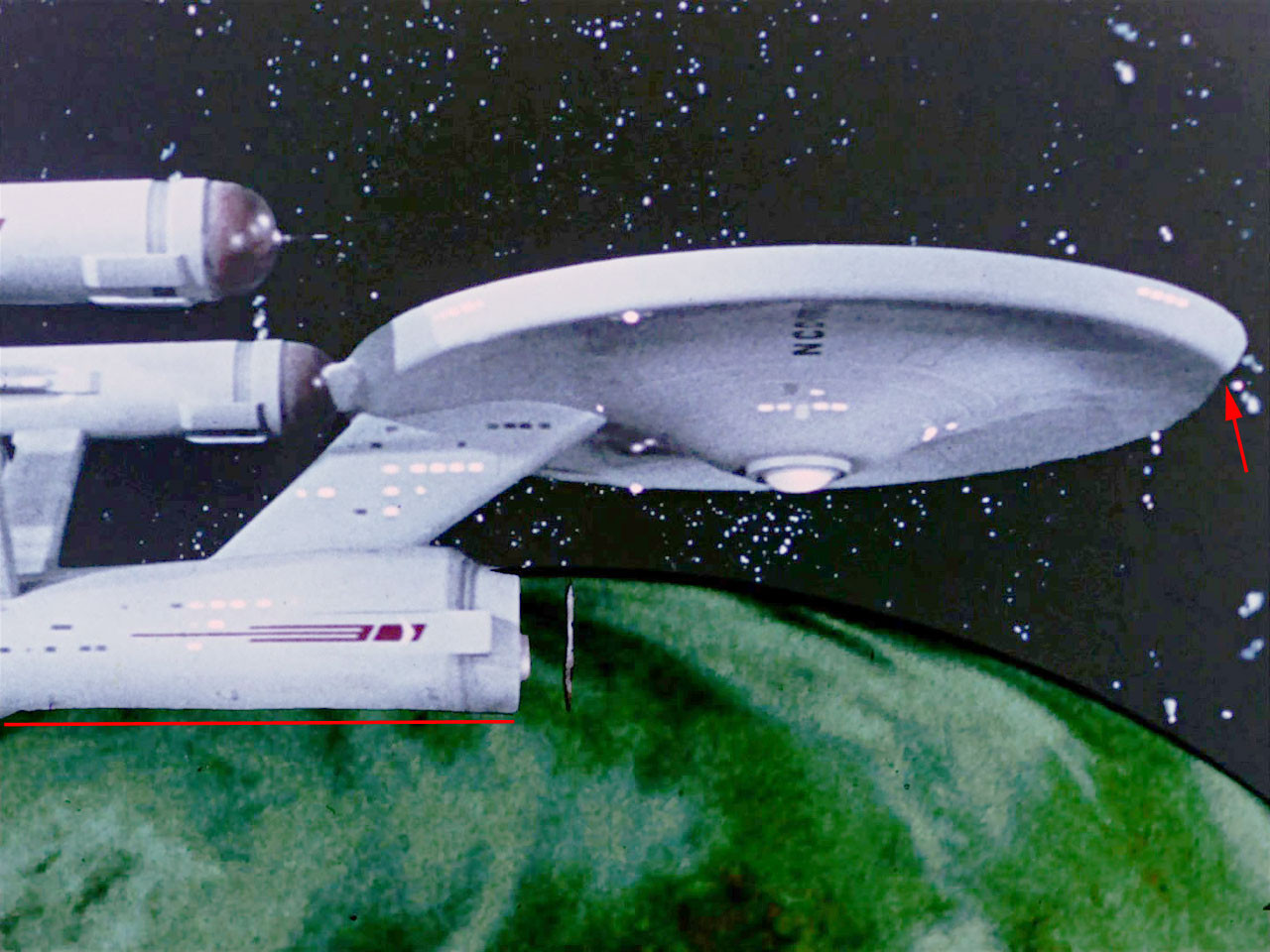


I think it was originally filmed for WNMHGB. It has the nacelle spikes and the oversized main deflector dish. Here it is in "The Doomsday Machine":That's a stock element used throughout the series and on the main titles starting in season two, where it looks mostly fine.
We use essential cookies to make this site work, and optional cookies to enhance your experience.


