
-
Welcome! The TrekBBS is the number one place to chat about Star Trek with like-minded fans.
If you are not already a member then please register an account and join in the discussion!
You are using an out of date browser. It may not display this or other websites correctly.
You should upgrade or use an alternative browser.
You should upgrade or use an alternative browser.


Yes, I remember both cuts (I discovered them when I bought the fotonovel). The first cut actually affects two scenes: the one with Kirk, Spock and Dehner on the bridge, and Kirk visiting Mitchell in Sickbay. I still seem to recall the Paramount cuts focusing more on portions than whole scenes, but I wasn't watching Trek much at that point (they ran it in the late evening) so I'm probably not the best one to testify about such things.Just from memory of Where No Man:
The second captain's log was interrupted by a cut: "Heading back on impulse power only. Main engines burned out--" {SNIP} "Is that Gary Mitchell? The one you used to know?"
The very end:
"Add to official losses...Dr. Elizabeth Dehner. Be it noted she gave her life in performances of her duty--" {SNIP} music, shot of view screen annnnnnd scene!
That was before the 80's Paramount pre-cut versions.
I had that episode on audio cassette tape the longest. Other than The Doomsday Machine.

Jeez are you me?Yes, I remember both cuts (I discovered them when I bought the fotonovel).

The Paramount cuts were more strategic. They still sucked, but mostly the episodes still made sense by keeping lines of dialog intact.The first cut actually affects two scenes: the one with Kirk, Spock and Dehner on the bridge, and Kirk visiting Mitchell in Sickbay. I still seem to recall the Paramount cuts focusing more on portions than whole scenes, but I wasn't watching Trek much at that point (they ran it in the late evening) so I'm probably not the best one to testify about such things.

I might argue that Spock's Brain is in the top middle tier of Season Three. It's not as good as Day of the Dove, Savage Curtain, or The Enterprise Incident. But I like it better than Paradise Syndrome.
It's not even in the running with And the Children Shall Lead.
It's beautifully shot.
It's not even in the running with And the Children Shall Lead.
It's beautifully shot.

The top of the middle?I might argue that Spock's Brain is in the top middle tier of Season Three.
My favest 3rd year adventures feature Kang, Alexander and Losira. I found EMPATH to be overly prolonged with aliens who dished it out while never having to take it (like Rojan and Claudius, I guess). METHUSELAH had Rayna, but I never sympathized with Flint before or after she died.
I will definitely always defend "THE EMPATH". It was the best illustration of the brotherhood of Kirk, Spock, and McCoy in the series. Plus, it had a fantastic vibe throughout... the absolute minimalist approach to the set and background gave it a great creepy and horror atmosphere.The top of the middle?
My favest 3rd year adventures feature Kang, Alexander and Losira. I found EMPATH to be overly prolonged with aliens who dished it out while never having to take it (like Rojan and Claudius, I guess). METHUSELAH had Rayna, but I never sympathized with Flint before or after she died.
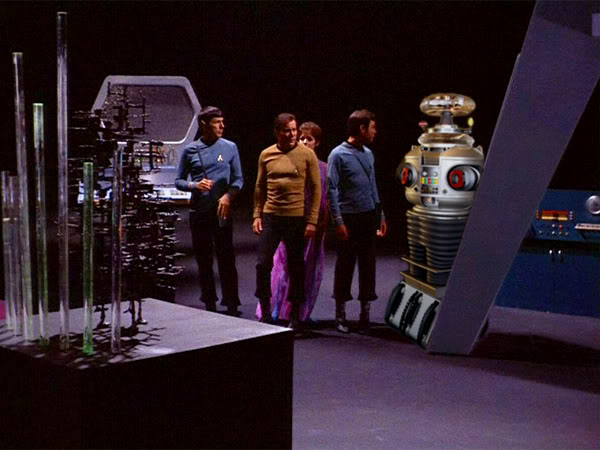
It's a Star Trek episode on an Irwin Allen set. The "limbo" setting, Jupiter 2 freezing tubes and some props from Voyage and there you go. It just has a more sentimental script than you'd usually see on an Irwin series.I will definitely always defend "THE EMPATH". It was the best illustration of the brotherhood of Kirk, Spock, and McCoy in the series. Plus, it had a fantastic vibe throughout... the absolute minimalist approach to the set and background gave it a great creepy and horror atmosphere.
It was still well executed.It's a Star Trek episode on an Irwin Allen set. The "limbo" setting, Jupiter 2 freezing tubes and some props from Voyage and there you go. It just has a more sentimental script than you'd usually see on an Irwin series.
I think the only TOS episode more polarizing than the Empath on this forum is Plato's Stepchildren. Very strong opinions in both directionsI will definitely always defend "THE EMPATH". It was the best illustration of the brotherhood of Kirk, Spock, and McCoy in the series. Plus, it had a fantastic vibe throughout... the absolute minimalist approach to the set and background gave it a great creepy and horror atmosphere.

Empath is excellent and utilizes horror better than most TOS episode.I will definitely always defend "THE EMPATH". It was the best illustration of the brotherhood of Kirk, Spock, and McCoy in the series. Plus, it had a fantastic vibe throughout... the absolute minimalist approach to the set and background gave it a great creepy and horror atmosphere.
It is leaps and bounds above Spock's Brain.

I never cared for the pointless torture porn. This one is bottom tier for me but for the emoting of Ms. Hays, which still doesn't make it worth it.
No accounting for taste? Perhaps, but this one pushes me away on a personal level perhaps because PTSD.
I'd rather watch Spock's Brain.
No accounting for taste? Perhaps, but this one pushes me away on a personal level perhaps because PTSD.
I'd rather watch Spock's Brain.
I also, despite its double belt-torture moments. A bit too similar to the TRISKELION collars.I never cared for the pointless torture porn. This one is bottom tier for me but for the emoting of Ms. Hays, which still doesn't make it worth it.
No accounting for taste? Perhaps, but this one pushes me away on a personal level perhaps because PTSD.
I'd rather watch Spock's Brain.
I agree, I was just making the comparison.It was still well executed.

I don't see it.It's a Star Trek episode on an Irwin Allen set. The "limbo" setting, Jupiter 2 freezing tubes and some props from Voyage and there you go. It just has a more sentimental script than you'd usually see on an Irwin series.
I think the best use of a blackout stage was LIS "The Magic Mirror" with Michael J. Pollard. Black & white cinematography and some good set clutter helped the atmosphere. And it was nice to see Angela Cartwright get an episode.
To each their own.I never cared for the pointless torture porn. This one is bottom tier for me but for the emoting of Ms. Hays, which still doesn't make it worth it.
No accounting for taste? Perhaps, but this one pushes me away on a personal level perhaps because PTSD.
I'd rather watch Spock's Brain.
I hate the removal of autonomy of Spock and find that highly disturbing and it treated as kind of humorous at times.
Funnily enough, you put the robot next to a console that was in Voyage.I don't see it.
It works well in a story sense too. The infinity beyond the mirror. Unlike some episodes where it was simply to save money - and he used this trick on all of his shows of the era.I think the best use of a blackout stage was LIS "The Magic Mirror" with Michael J. Pollard. Black & white cinematography and some good set clutter helped the atmosphere.
She was best served in the first season. It's a fun and sinister fantasy that can charm and scare younger folks. I have a soft spot for this episode. It was the first episode I discovered after over a decade of not finding the series. I had vague memories of it as a kid and only really remembered the color episodes. The series was walking a tightrope here, balancing fantasy, light comedy and adventure.And it was nice to see Angela Cartwright get an episode.
Yes, it was. In the end she had roughly five episodes or so where she was the focus. It happened with Marta Kristen about three times but never with June Lockhart. More often than not they were galley slaves....or ordered to strap down below decks while insufferable twits like Will and Smith found excuses to remain above.I don't see it.
I think the best use of a blackout stage was LIS "The Magic Mirror" with Michael J. Pollard. Black & white cinematography and some good set clutter helped the atmosphere. And it was nice to see Angela Cartwright get an episode.
MAGIC MIRROR's cinematography was by the incomparable Conrad Hall. He worked on the original OUTER LIMITS, and in MIRROR it shows.
Less autonomy leads to drama....just not in this particular episode. Spocko needed just as much autonomy in A PRIVATE LITTLE WAR, so it's a good thing M'Benga was able to slap it back into him.I hate the removal of autonomy of Spock and find that highly disturbing and it treated as kind of humorous at times.
Shall we call that one ''In The Heat of the Sickbay'' dur to its black-on-white slappage?

The episode's DP is credited as Charles Clarke, not Conrad Hall. Hall never worked on an Irwin Allen production.MAGIC MIRROR's cinematography was by the incomparable Conrad Hall. He worked on the original OUTER LIMITS, and in MIRROR it shows.
Gene Polito was shooting "The Challenge" at the same time, focusing on Bill Mumy. Which is why Will isn't in "The Magic Mirror" and Penny is absent from "The Challenge."
With no plot explanations given for their absences. Penny sat out the Robby the Robot episode as well. Bill Mumy's a decent enough actor, though whenever Will rarely does miss an episode I often wish he'd multiply that habit while taking Smith with him. But please leave the Robot. He's as funny as Smith tries to be, only he's more successful at the job.Gene Polito was shooting "The Challenge" at the same time, focusing on Bill Mumy. Which is why Will isn't in "The Magic Mirror" and Penny is absent from "The Challenge."
I reluctantly confirm that. The ambience of MIRROR certainly shared the feel of most of the similarly black-and-white OUTER limits. I seem to gave a ''ghost memory'' of Conrad Hall being mentioned in a LIS commentary.The episode's DP is credited as Charles Clarke, not Conrad Hall. Hall never worked on an Irwin Allen production.
Other posters have entertained the idea of Cartwright portraying Miri instead of Kim Darby. That Could have been potentially compelling*....and it'd've provided her with a reunion with Michael J. Pollard shortly after MIRROR was completed.
(* Sidebar: Shatner, Cartwright and Jonathan Harris appear in one photo together. I don't remember the occasion for it, but it's probably around 1966 or '67.
Last edited:
Similar threads
- Replies
- 117
- Views
- 6K


- Replies
- 7
- Views
- 1K


- Replies
- 12
- Views
- 9K

If you are not already a member then please register an account and join in the discussion!