
When it comes to simply presenting the information from the Roddenberry Archive, it's useful. However, Cushman tends to editorialize or grossly misinterpret the facts.That bad?

When it comes to simply presenting the information from the Roddenberry Archive, it's useful. However, Cushman tends to editorialize or grossly misinterpret the facts.That bad?

My impression was that he gets some dates wrong, and when he doesn't really know some behind-the-scenes situation, he might spin a plausible anecdote figuring no one will ever know the difference. But sometimes the lifelong fan will happen to know when Cushman pulls this and he's way off.When it comes to simply presenting the information from the Roddenberry Archive, it's useful. However, Cushman tends to editorialize or grossly misinterpret the facts.

That bad?
If they’re the books by Marc Cashman, they contain a lot of inaccuracies.
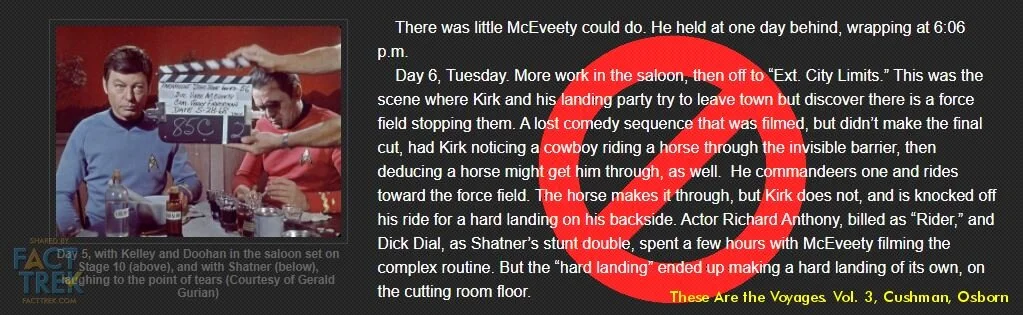
Cash Markman is little more than an armchair historian. His writing demonstrates a lack of understanding of the documentary evidence and treats long after-the-fact statements as having the same historical weight as primary sources. In his write-up about "Spectre of the Gun", we caught him making up events that didn't actually happen because they were in scenes omitted from the script before shooting, as proved by the daily production reports.When it comes to simply presenting the information from the Roddenberry Archive, it's useful. However, Cushman tends to editorialize or grossly misinterpret the facts.


Is there another way to browse this information in print or online? I went to the Roddenberry Archive's website, but it seems to be all videos and VR recreations.When it comes to simply presenting the information from the Roddenberry Archive, it's useful.
Unfortunately, the RA hasn't been putting any of the documents online... yet. I think that's the intent in the future. The only places to browse the scripts/memos in person is either at the private Roddenberry Archive somewhere in Los Angeles, or UCLA's special collections library which has Roddenberry's TOS papers only, as well as Bob Justman's.Is there another way to browse this information in print or online? I went to the Roddenberry Archive's website, but it seems to be all videos and VR recreations.
They've uploaded all the shared documents to The Trek Files' Memory Alpha page:The other place I thought to look was the website for Larry Nemecek's The Trek Files but it looks like the actual "files" themselves are all stored on Facebook (which I don't use).
The walled gardens of the modern Internet continue to vex me.

 memory-alpha.fandom.com

I also second this recommendation if you want to go deeper on the series' production.I think the best book about how the original Star Trek was made is “Inside Star Trek: The Real Story” by Herbert F. Solow and Robert H. Justman. Very good read and incredible photos and reproductions.

How would you rate Gerrold's WORLD OF?Star Trek Lost Scenes is great.
The Making of Star Trek is good, even if it's a tad biased.
Inside Star Trek by Solow & Justman is good, but suffers from some historic inaccuracies and Solow really has it in for Roddenberry, and it shows.
As a reality check on some of the other works recommended here:
Star Trek Fact Check blog, recommended by Mental Floss, Neatorama, Den of Geek, and the American Press Institute (twice!) by Michael Kmet.
I barely recall it. I don't remember it being much about BTS stuff.How would you rate Gerrold's WORLD OF?
In the second half of the book, he negatively dissects ENTERPRISE INCIDENT, plus describes his vastly different original CLOUD MINDERS outline, in which Uhura is severely injured.I barely recall it. I don't remember it being much about BTS stuff.
He also hated "The Omega Glory," had not one nice word for it IIRC, and he absolutely trashed Lost in Space. I'm mean, like this was a moral conflict and he was fighting evil. It was a bit much.In the second half of the book, he negatively dissects ENTERPRISE INCIDENT, plus describes his vastly different original CLOUD MINDERS outline, in which Uhura is severely injured.

Indeed. If anything, Gerrold was a primary source for painting Roddenberry as a god, besting even the job Roddenberry did for himself.The Gerrold-Rodenberry dust up was during the pre-production of TNG. Until then Gerrold had mostly goods things to say about him.
The Gerrold schism was also generated through the toxic influence and interference of Gene's lawyer, Leonard Maizlisch.The Gerrold-Roddenberry dust up is similar to the Harold Livingston-Roddenberry fall out during the production of "Star Trek II"/"TMP" in that Roddenberry kept rewriting/inserting things into the script for "In Thy Image" without Livingston knowledge or approval.

I am a big fan of William Shatner's two Trek memoirs, Star Trek Memories and Star Trek Movie Memories. Now, in candor, I take Shatner's comments in the books with a heavy grain of salt. Much of what he says is obviously exaggerated or incorrect. However, the thing I like about them is that he interviewed so many people directly involved in the making of the show and the films, and many of their comments, stories, etc. are transcribed verbatim throughout the two books. Through that, they provide a great deal of insight.
That bad?


Yeah, when Gerrold was basically co-creating TNG with Fontana and Roddenberry, he was trying to get GR to approve an AIDS allegory episode that GR kept encouraging but never approved despite a series of rewrites.


We use essential cookies to make this site work, and optional cookies to enhance your experience.