• Welcome! The TrekBBS is the number one place to chat about Star Trek with like-minded fans.
    If you are not already a member then please register an account and join in the discussion!

Some great camera tricks

This may have been discussed before, but is the term "nacelle" used in "The Savage Curtain" or "By Any Other Name," one where separation is discussed and the other where catastrophic explosion is discussed when positive energy is suggested to be combined with anti-matter?
Here, thanks to Chrissy's Transcripts site, are all the references I could find (with highlighting added by me):

2x06 THE DOOMSDAY MACHINE
KIRK: We have to stop it. If it's a robot, what are the chances of deactivating it?​
SPOCK: I would say none, Captain. The energy generated by our power nacelles seems to attract it.​

2x09 THE APPLE
KIRK: Tie every ounce of power the ship has into the impulse engines. Discard the warp drive nacelles if you have to, and crack out of there with the main section, but get that ship out of there!​

2x14 BREAD AND CIRCUSES
SPOCK: The space debris comes from the survey vessel SS Beagle. ... Portions of the antimatter nacelles, personal belongings.​

2x21 BY ANY OTHER NAME
SPOCK: The barrier we must penetrate is composed of negative energy.​
SCOTT: I have opened the control valves to the matter-anti-matter nacelles. On your signal, I will flood them with positive energy.​

3x22 THE SAVAGE CURTAIN
KIRK: Scotty, inform Starfleet Command. Disengage nacelles, jettison if possible. Mister Spock, assist them.​

Personally, I would not consider the secondary hull a "nacelle" in the context of the available canonical dialog, but I also don't think we have to call it one for Kirk's line in The Apple to make sense. "Discard the nacelles" could be a general command that in some cases involves dropping them individually while in other cases means saucer separation. I would assume the support pylons could be disconnected at the top and/or the bottom, leaving multiple drop-points to ditch the nacelles.

If you "crack out of there with the main section," you are definitely discarding the nacelles. You might also be discarding the engineering hull, or you might not, but that's not the primary or even secondary point to articulate in this moment of crisis. Abandon the now-useless warp drive; save the saucer; if you can also save the secondary hull, great, but Kirk's leaving that "detail" up to Scotty.

From a production standpoint, this is a way to convey the drama of the situation without getting so specific about how this all works that you pigeonhole yourself in future episodes.
 
Last edited:
An order to discard the warp drive nacelles doesn't mean they must keep the secondary hull, even if it's not considered some sort of nacelle.
 
In "The Apple," when the ship is being dragged down by Vaal's tractor beam, Kirk tells Scotty "Jettison the nacelles and crack out of there with the main section if you have to."

This line makes sense only if the secondary hull can be referred to, at least loosely, as a nacelle. If Scotty just jettisons the overhead warp engines, then the sec. hull would be dead weight for the impulse engines to haul, and the ship would have shed only its biggest propulsion units.

Whatever you name the secondary hull, it is a tubular casing attached to the saucer by a pylon, and that's what a nacelle is. The only difference is, there are people in this casing.

I remember that you first came up with this excellent insight on another recent thread—namely, that the writers/production team likely thought of "nacelles" as including the secondary hull. What you may not remember is my far less trenchant follow-up indicating that the writer of "Tomorrow is Yesterday"—who if memory serves was no less than Ms. Fontana—or its teleplay revisionists had Christopher describe the Enterprise as "big," with "two cylindrical projections on top, one below." So I believe they thought of the secondary hull as a projection or a nacelle too. After all, they came from about the same point in time as Christopher . . . . ;)
 
Mind you, Roddenberry and Jefferies were both pilots and certainly knew what a nacelle is.
 
all the references I could find
Wow. Appreciate the research!

Based on what I am reading it sounds like CPT Christopher at least thought of the secondary hull as a nacelle, but that does not necessarily mean he was meant to be correct. He did apparently think it was so likely the enemy ship was a flying saucer that he did not even bother to say that part out loud.

Again, I don't really consider anything made after 2009 to be canon, but I sometimes consider references worth considering if they support an idea from early material. All this to preface the fact that I have the Kelvin diagrams placing a habitable engineering area in the nacelle. It's a stretch that ship ship is supposed to be before the timeline change, since that would require explaining why Starfleet would have a big, one-nacelle-d ship years before the Enterprise and still consider the Enterprise big, but it might at least suggest that a control room in the nacelles is not unprecedented.

Mind you, Roddenberry and Jefferies were both pilots and certainly knew what a nacelle is.
Good point. Which leads to the question, why make CPT Christopher an Air Force pilot and not a Navy pilot? Would not making him a Navy pilot make him more amenable to Kirk and Spock, who apparently seem more like Navy officers to him anyway?
 
Good point. Which leads to the question, why make CPT Christopher an Air Force pilot and not a Navy pilot? Would not making him a Navy pilot make him more amenable to Kirk and Spock, who apparently seem more like Navy officers to him anyway?
Why not an Air Force pilot? And amenable isn't what the story is about.
 
In "The Apple," when the ship is being dragged down by Vaal's tractor beam, Kirk tells Scotty "Jettison the nacelles and crack out of there with the main section if you have to."

This line makes sense only if the secondary hull can be referred to, at least loosely, as a nacelle
Only a Sith speaks in absolutes (the Jedi says, speaking in absolutes).

Kirk could easily be speaking in short hand. And what he said probably would make more sense to 1967 audiences than "separate the saucer."
 
Only a Sith speaks in absolutes (the Jedi says, speaking in absolutes).

Kirk could easily be speaking in short hand. And what he said probably would make more sense to 1967 audiences than "separate the saucer."
I'm thinking "Encounter at Farpoint" was the first on screen use of the word saucer. But the dialogue was linked to explicit visual fx that TOS couldn't do, and everybody got it.
 
I'm thinking "Encounter at Farpoint" was the first on screen use of the word saucer. But the dialogue was linked to explicit visual fx that TOS couldn't do, and everybody got it.
Right, in fact they seemed to studiously avoid the word saucer even in Tomorrow is Yesterday - maybe to step away from "flying saucer" - of which one was on a CBS series at the time. :rommie:

Point is, they didn't call the "saucer" section anything really in the original series. So "jettison the nacelles and crack out of there with the main section" always meant to me to mean the saucer was the "main section." That's an open interpretation I admit, but one Roddenberry seemed to back up when he complained about destroying the Enterprise in Star Trek III. He suggested saving the saucer, which could be united with a new lower half later because he knew fans knew the Enterprise could always separate.
 
Why not an Air Force pilot? And amenable isn't what the story is about.
To clarify, there's no reason why not an air force pilot. It's just interesting that the choice was not a Navy pilot, when Star Trek used naval technology so audiences would understand what is going on; in-universe Starfleet itself, though explicitly a "combined service," operates vessels apparently enough like a Navy ship to the degree that CPT Christopher even wondered aloud if the Enterprise was a Navy ship.
He suggested saving the saucer, which could be united with a new lower half later because he knew fans knew the Enterprise could always separate.
For some reason I thought I heard it was the other way around, that Roddenberry had suggested the saucer, the main part of the ship would be destroyed but that they could keep the lower part of the ship. That would mean losing just part of the ship, and we'd be debating if the new ship was "really" the Enterprise.

I, and others, have previously suggested that the Constellation 1017 was possibly an older ship, only part of which had survived and then had a refit to make it look like a Constitution-class ship. That would certainly invite debate about how long a starship platform could last. I knew someone who thought that the NX-01 would be reworked over 110 years until it looked like a Constituion class ship, and be renumbered to match being part of the 17th starfleet design, then used for 20 more years until being destroyed. Now, I don't think that, but that would be a strange way for things to work out, and explain why Kirk's ship is still the "first starship" to be called Enterprise.
 
Right, in fact they seemed to studiously avoid the word saucer even in Tomorrow is Yesterday - maybe to step away from "flying saucer" - of which one was on a CBS series at the time. :rommie:
And on an ABC series also.

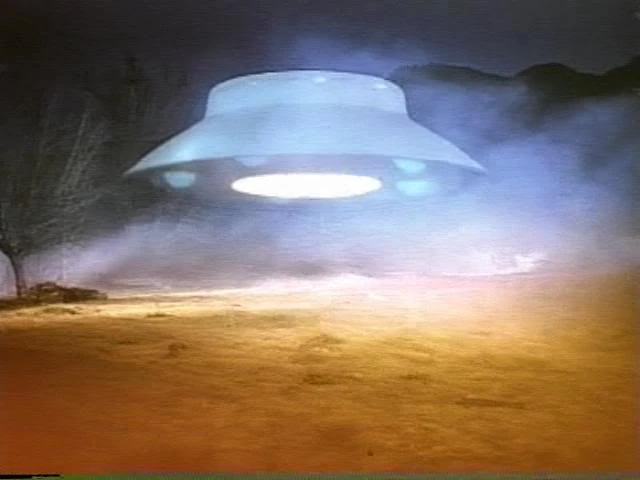
Invaders-saucer-landing.jpg
 
Here's a not so great vfx moment. Something went wrong with the blue screen process and cut off the keel of the Enterprise:

What might have caused this?
The color separation process used for bluescreen is multiple steps. A blue and negative red composite results in a low-grade "matte" of the Enterprise in silhouette, only the "blacks" and "whites" of the composite are actually grays. Once processed to lithographic film for a pure black or white matte which is then used for compositing foreground (ship) and background (planet and space), any "blue spill" light on the model can result in a matte that goes the wrong way. That is, some blue light from the background bluescreen must have reflected on the underside of the Enterprise model. Since other lighting on the model was from above, the underside of the lower hull separated out the wrong way for the matte. This can be seen in a frequently used shot of the ship leaving orbit. (Although this screencap from "The Enemy Within" is dark. Seen in other episodes, in motion one can notice a flickering edge to the underside of the starboard engine. That's spill light fouling a bluescreen separation.)

https://tos.trekcore.com/gallery/albums/screencaps/season1/104-enemy-within/enemy-within-br-688.jpg

enemy-within-br-688.jpg


There are numerous ways to generate "automatic traveling mattes," bluescreen was one of the more common because it did not require any special cameras or lighting. 2001: A Space Odyssey, which was produced during the same general time period as TOS, used in-camera, multi-pass composites to preserve the first-generation quality of the film. The movie did feature a few post-production composites which used hand rotoscoped mattes. That produces greater quality, but is much more time consuming and expensive.

EDIT:
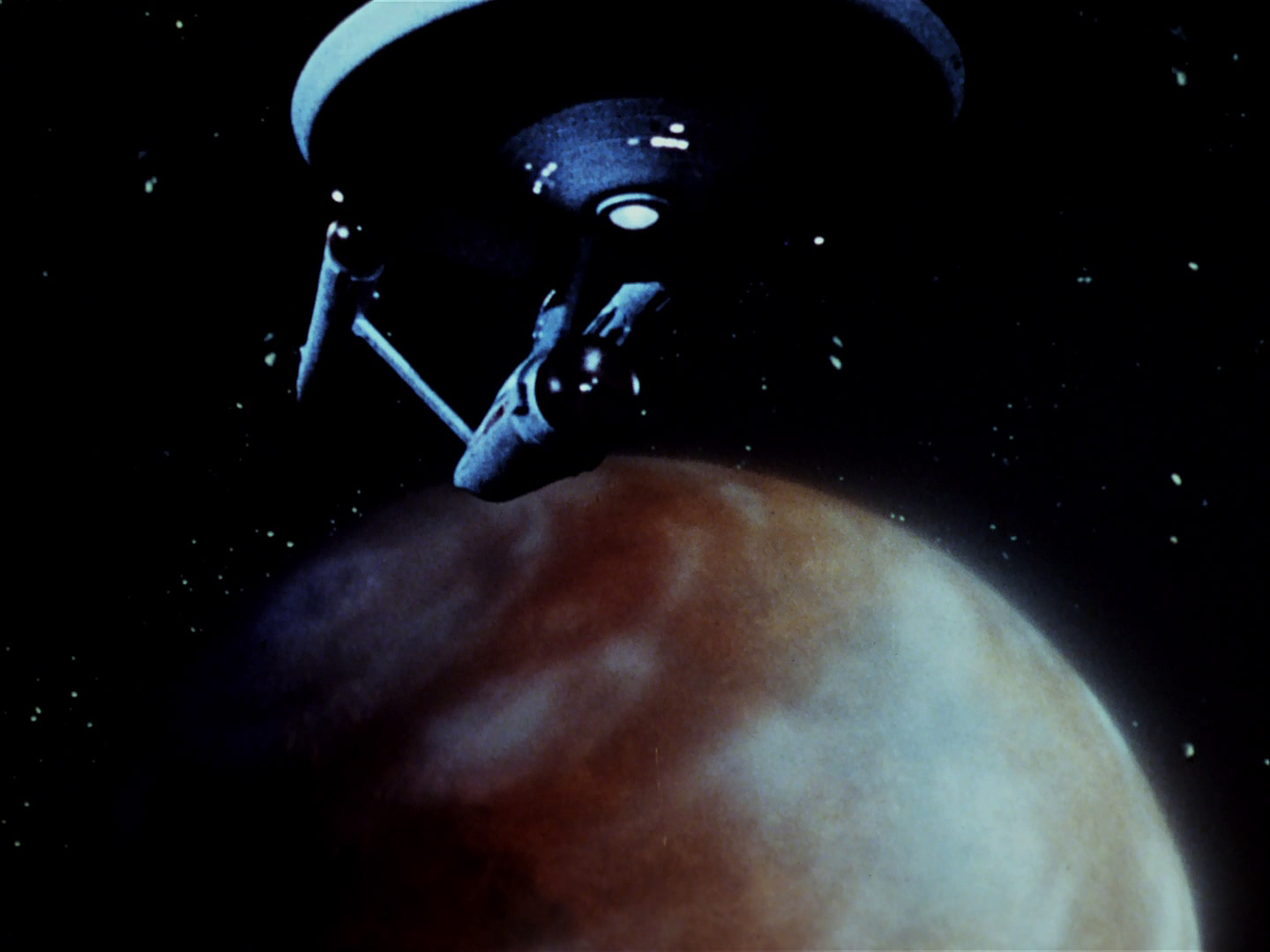
A slightly better shot showing the bad bluescreen separation under the starboard engine. There's an episode where the Enterprise leaves orbit early in the episode, and the bright planet is directly behind the Enterprise overlay. The bad matte can't be missed. I just can't remember which episode right now. This shot was used many times, but the FX artists tried to keep the Enterprise higher on the screen in the blackness of space where the bad matte would not be as visible.


conscience-of-king-br-621.jpg
 
Last edited:
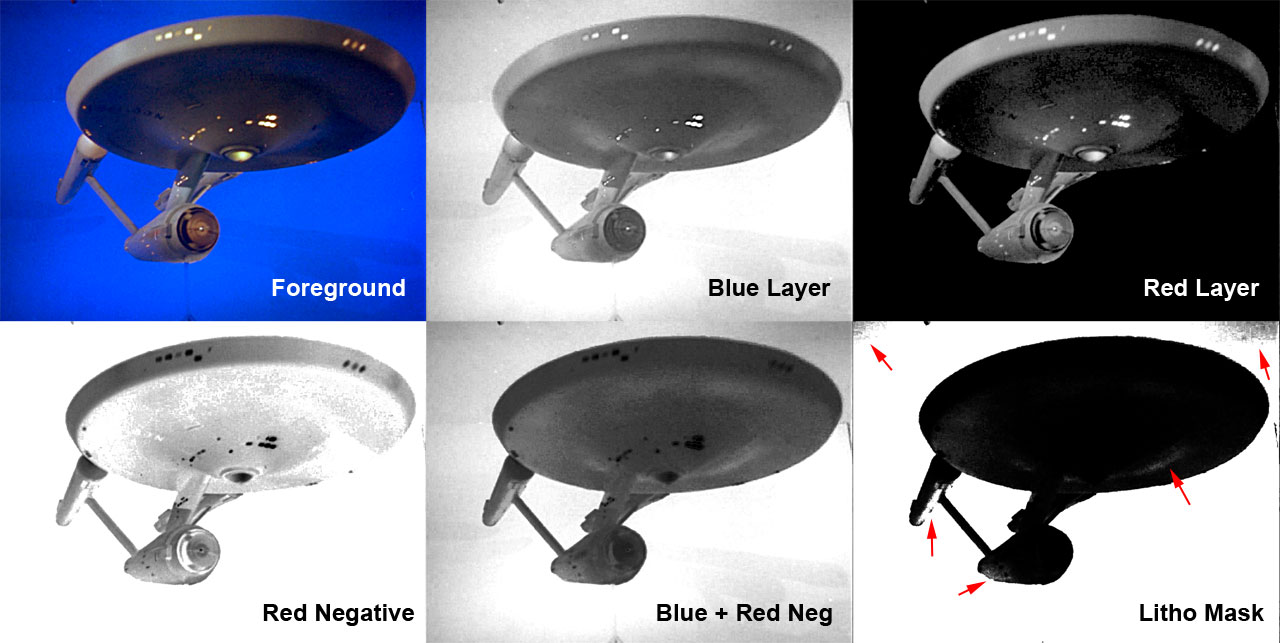
Apologies for posting in sequence, but I wanted to elaborate on the bluescreen separation process described above.


The "foreground" image shows the model photographed on the blue stage. The next two frames show just the blue and red layers from that film. Note how the blue background turns black on the red sensitive layer.

Next, the red layer is made negative, thus its background is also "white" (or clear on film). Since it is a negative, all the bright areas (like windows, or highlights) turn dark. When "bi-packed" (sandwiched) with the blue layer and copied on an optical printer, the result is the "blue + red neg" image. The positive-negative fills in to make a silhouette.

That bi-packed image is then copied to litho film, which is pure black or white, no grays. Depending on the exposure, and how well lit the original model was shot, you end up with a black silhouette of the Enterprise against a white background. Note that the litho is not perfect. Blue spill light on the model "eats away" the underside of the starboard warp engine, as well as other areas of the model. Poorly lit blue also darkens (corners). Adjusting the exposure of the litho can clean up some of these problems, but only at the expense of making other problems worse.

Short of hand fixing these problems, or using "garbage mattes" (yet another generation of film), this is the limitation with bluescreen on a short schedule, as with weekly VFX for TOS. Part of the solution is to wash out any blue spill with more white light in shadow areas. And that is why the Enterprise tended to have a ghostly light with rarely any true shadows.

The final image, "litho mask," was then used to control a "double exposure" so that the ship and background would not expose through each other.
 
EDIT:
A slightly better shot showing the bad bluescreen separation under the starboard engine. There's an episode where the Enterprise leaves orbit early in the episode, and the bright planet is directly behind the Enterprise overlay. The bad matte can't be missed. I just can't remember which episode right now. This shot was used many times, but the FX artists tried to keep the Enterprise higher on the screen in the blackness of space where the bad matte would not be as visible.

You must mean this guy:

Same ship footage, a cleaner moment from it (and higher over the planet):
 
Last edited:
If you are not already a member then please register an account and join in the discussion!

Sign up / Register


Back
Top