• Welcome! The TrekBBS is the number one place to chat about Star Trek with like-minded fans.
    If you are not already a member then please register an account and join in the discussion!

Does Maurice Hurley deserve more credit for his Star Trek work?

I remember MacGyver having clip shows at least once a season. It was a common practice in action shows. Later series like Showtime's Outer Limits and Stargate SG-1 had annual clip shows built into their budgets from the start -- even though Outer Limits was an anthology series, so it was bizarre to see them try to retroactively lump multiple unrelated stories together in a shared continuity (although there was at least one season where they set it up from the start, using a recurring tech/robotics company in multiple episodes). The fourth season of the syndicated The Adventures of Superboy actually had two consecutive clip episodes. Hercules: The Legendary Journeys and Xena: Warrior Princess had fun with their obligatory annual clip shows, doing goofy frame stories like having the casts play caricatures of the show's production staff.

Technically, Star Trek: "The Menagerie" is a clip show; it's just built around clips from an unaired episode. Gilligan's Island's season 1 Christmas episode did much the same with footage from its unaired pilot.

Technically, but surely only to get episode count and series production cost under control by using footage designed solely to convince studio executives to commission a full series? That's the one difference I'm seeing in this. "Star Trek" was one of the most expensive shows to make at the time and it likely wasn't cheap to film Gilligan and the rest on location in Hawaii either (as the greenlit, official series never went back there but instead built a fake lagoon that had not-quite-tropical water in it). I'm curious on the Xmas episode to see how the pilot clips were used as there were some different castaways (removed/retooled for what would become the iconic group.)

The other shows' clip shows were just using repeat fodder to fill out time for episodes' lacking content that couldn't be padded out, or to make up for lost time, budget crunches, like what you said about incorporating a clip show in to the season (thus allowing money and time to be appropriated and applied better, especially if script rewrites were needed), or other behind-the-scenes issues. It does sound like Xena had some fun with the format, but by the 1990s something had to change as audiences who watched every episode probably got tired of clips. TV was definitely more expensive, if not other issues, and cutting a budget would necessitate a clip show too. To be a fly on the wall... I'm amazed that "The Golden Girls" never did a clip show involving all 4 of their wardrobes, given the sheer amount of costume changes and those costumes were always spectacular...
 
Technically, but surely only to get episode count and series production cost under control by using footage designed solely to convince studio executives to commission a full series?

All clip shows are about cutting costs and saving time. That's the point. "The Menagerie" was made because the show was falling behind schedule and building a 2-parter around the pilot footage let them do two episodes in the time (and for the cost) of one, thereby getting back on track. By the same token, clip shows are made because reusing old footage means they can be shot in less time and for less money than full episodes, thereby helping to balance it out if other episodes go over budget or schedule. The principle is the same. If the reused footage happens to have been previously unseen by the audience, that's just a bonus.

There's also the related practice where a production saves money by building episodes around clips from other productions. This was the bread and butter of Irwin Allen's The Time Tunnel -- the time-travel format was an excuse to build episodes around stock footage from historical movies and shows. The first season of The Incredible Hulk built three episodes around recycled footage from Universal movies -- "747" from Airport 1975, "Earthquakes Happen" from Earthquake, and "Never Give a Trucker an Even Break" from Steven Spielberg's TV movie Duel. MacGyver did the same with two first-season episodes, "Thief of Budapest" from the original The Italian Job and "Trumbo's World" from The Naked Jungle. There's an episode of the 1990 Zorro series, co-starring Henry Darrow as Zorro's father, that used footage from an episode of Darrow's 1960s series The High Chaparral as flashbacks to an old romance, bringing back the guest actress from that episode in the present-day scenes.


I'm curious on the Xmas episode to see how the pilot clips were used as there were some different castaways (removed/retooled for what would become the iconic group.)

Naturally the footage of John Gabriel, Kit Smythe, and Nancy McCarthy from the unaired pilot was not used in the Christmas episode; the flashback material used scenes featuring the other actors and some reshot scenes with the final cast. Although the pilot actors can be briefly glimpsed lying unconscious on the Minnow's deck in the portions of pilot footage used in the first aired episode.


The other shows' clip shows were just using repeat fodder to fill out time for episodes' lacking content that couldn't be padded out

No. Clip shows are not done for story reasons, they're done to save time and money, period. There are occasional cases where an episode running short may have a small amount of flashback content added to pad it out, but that's not the same thing as an actual clip show, an episode designed from the start as a vehicle for reusing footage, with a frame story that's created for the specific purpose of setting up the flashbacks and that can be shot on a minimal schedule and budget.


by the 1990s something had to change as audiences who watched every episode probably got tired of clips.

It's true that in the years after "Shades of Gray," more effort was made to create interesting and meaningful clip shows with clever frame devices. But the budgetary and logistical reasons for doing clip episodes didn't change.
 
😱 Oh wow. Thanks for the correction! I recall how sitcoms had done it ("The Golden Girls" being a repeat offender, even in the same season) but not as much for dramas, though I hadn't watched many at the time.
Oh lordy they were so common, they routinely got spoofed. On one hand, they were often lazy and timeslot fillers, but some of us (well, me) liked them because they tended to run clips from great episodes and this was before VCRs were commonplace and/or cheap and the shows weren't in reruns yet, so we got to revisit.

I remember MacGyver having clip shows at least once a season. It was a common practice in action shows.
Buck Rogers in the 25th Century had one and used it to celebrate New Years Eve. As you say, they were common. Some tried to weave a relevant story around them. The second season finale of The Mod Squad was a clip show that served to convince Pete Cochran to stay with the team while showing us a little bit of his family dynamic. At least it was better then "hey remember when Linc got beat up?"
All clip shows are about cutting costs and saving time. That's the point.

There's also the related practice where a production saves money by building episodes around clips from other productions. This was the bread and butter of Irwin Allen's The Time Tunnel -- the time-travel format was an excuse to build episodes around stock footage from historical movies and shows.
Voyage to the Bottom of the Sea also used footage from prior episodes in new contexts to create "fresh" episodes which were shot in few days, which was an interesting spin on the "clip show" concept. Lost in Space did one for each color season also.
The first season of The Incredible Hulk built three episodes around recycled footage from Universal movies -- "747" from Airport 1975, "Earthquakes Happen" from Earthquake, and "Never Give a Trucker an Even Break" from Steven Spielberg's TV movie Duel.

No. Clip shows are not done for story reasons, they're done to save time and money, period. There are occasional cases where an episode running short may have a small amount of flashback content added to pad it out, but that's not the same thing as an actual clip show, an episode designed from the start as a vehicle for reusing footage, with a frame story that's created for the specific purpose of setting up the flashbacks and that can be shot on a minimal schedule and budget.
At least when The Incredible Hulk did their two part clip show, "Mystery Man" it made it compelling by having the two stars have long discussions, flesh out the Jack McGee character and finally have him learn that the Hulk transformed into a regular person. It was my favorite episode for years even though there's arguably only enough story for a one hour episode. The flashbacks bought them a second week.

Then there was "Proof Positive" which gave Bixby the week off. It was a strong focus on McGee with a lot of clips, but a well written story. They just made no attempt to hide the fact that Bixby was absent.

Clip shows and two-parters were part of the TV landscape and in the days before serialization was common, two-parters were usually big deals and often my favorite episodes of their respective series.
 
Oh lordy they were so common, they routinely got spoofed. On one hand, they were often lazy and timeslot fillers, but some of us (well, me) liked them because they tended to run clips from great episodes and this was before VCRs were commonplace and/or cheap and the shows weren't in reruns yet, so we got to revisit.


Buck Rogers in the 25th Century had one and used it to celebrate New Years Eve. As you say, they were common. Some tried to weave a relevant story around them. The second season finale of The Mod Squad was a clip show that served to convince Pete Cochran to stay with the team while showing us a little bit of his family dynamic. At least it was better then "hey remember when Linc got beat up?"

Voyage to the Bottom of the Sea also used footage from prior episodes in new contexts to create "fresh" episodes which were shot in few days, which was an interesting spin on the "clip show" concept. Lost in Space did one for each color season also.

At least when The Incredible Hulk did their two part clip show, "Mystery Man" it made it compelling by having the two stars have long discussions, flesh out the Jack McGee character and finally have him learn that the Hulk transformed into a regular person. It was my favorite episode for years even though there's arguably only enough story for a one hour episode. The flashbacks bought them a second week.

Then there was "Proof Positive" which gave Bixby the week off. It was a strong focus on McGee with a lot of clips, but a well written story. They just made no attempt to hide the fact that Bixby was absent.

Clip shows and two-parters were part of the TV landscape and in the days before serialization was common, two-parters were usually big deals and often my favorite episodes of their respective series.
Even serialized shows will do clip shows. Soap operas use them on anniversary shows or to celebrate a cast member who has passed.
 
Clip shows and two-parters were part of the TV landscape and in the days before serialization was common, two-parters were usually big deals and often my favorite episodes of their respective series.

Clip shows have always been routine in Japanese tokusatsu shows and are still done regularly to this day. Nearly every Ultraman season for the past decade has been 25 episodes with a clip show as episode 13, bisecting the season into two 12-episode arcs, and sometimes it can be a good way to remind the viewer of the story arc to date. Also, when the show takes a week off, they fill the time slot with a sort of supplementary clip special focusing on exclusive side characters who are supposedly in the same reality as the series reflecting on its past events. And in the 24 or so weeks between seasons, they fill the time slot with entire series-length clip shows, sometimes framing montages of clips from multiple past Ultra seasons, sometimes just replaying entire episodes with brief frame scenes around them.

Other toku shows don't go that far, but they still invariably have a clip episode every season, some better than others. Ohsama Sentai King-Ohger did one of the most brilliant clip shows I've ever seen, since it came right after a major revelation about the true agenda a character had been keeping secret all season, and the clips illustrated that character's explanation of what had really been going on the whole time. So it didn't feel like a clip show at all, because it completely recontextualized all the clips and made them feel brand new.

On the subject of multiparters, some of the Metal Heroes series in the '80s-'90s would occasionally do 2- or 3-part crossover specials in which the first episode was a clip show featuring footage of the returning guest characters set to their character insert songs, basically as music videos, to remind the audience of who they were before getting into the main story in the rest of the crossover.

And of course, the practice in toku and anime of giving characters long transformation sequences or finisher-move sequences is an excuse to reuse the same footage week after week, so basically every episode is a clip episode to an extent.


Even serialized shows will do clip shows. Soap operas use them on anniversary shows or to celebrate a cast member who has passed.

Stands to reason, since clip shows are done for budgetary and logistical reasons, so the need for them is the same regardless of the story content of the series.

Heck, clip shows predate television. They were a routine part of theatrical adventure serials in the 1930s-50s. Those serials were often made on very tight budgets, so they had to economize however they could. So typically they'd do a clip episode in the latter half of the serial, with an excuse like the hero filling in a new character on events to date, or the lead characters going over what they've learned in an attempt to solve the mystery. Also many serials would recycle action footage from older serials, often having the characters drive the same cars or wear the same costumes as previous serials' heroes so the stock footage would match. And of course they'd replay the previous episode's cliffhanger at the start of the next, sometimes several minutes' worth, so they'd save money by using it twice.
 
😱 Oh wow. Thanks for the correction! I recall how sitcoms had done it ("The Golden Girls" being a repeat offender, even in the same season) but not as much for dramas, though I hadn't watched many at the time.
The Golden Girls also did a "clip show" at the end of season 1 that was all new footage. It had the usual setup of a clip show, with them sitting at the kitchen table reminiscing but it was about how they all met and moved in with each other, so none if that was reused footage. I remember it being a pleasant surprise, I remember thinking "Oh, it's on of those episode ..." and then it wasn't. The writers knew what they were doing there and played with the audience expectations.
 
The Golden Girls also did a "clip show" at the end of season 1 that was all new footage. It had the usual setup of a clip show, with them sitting at the kitchen table reminiscing but it was about how they all met and moved in with each other, so none if that was reused footage. I remember it being a pleasant surprise, I remember thinking "Oh, it's on of those episode ..." and then it wasn't. The writers knew what they were doing there and played with the audience expectations.

Star Trek: Lower Decks did that too, didn't they?
 
Even serialized shows will do clip shows.
I never said they didn't. ;)

I said:
Clip shows and two-parters were part of the TV landscape and in the days before serialization was common, two-parters were usually big deals and often my favorite episodes of their respective series.

What I meant was that episodic TV gave us weekly individual stories allowing for "favorite episodes" and special events, like multi-parters. A serialized show removes that for the most part. Now we say "Season 2 had a great arc, but season 3 was terrible" or vice versa. It was a bit of drift on my part.

Soap operas use them on anniversary shows or to celebrate a cast member who has passed.
Prime time shows did that also. I just watched the Barney Miller episode honoring Jack Soo.

Daytime soaps have different requirements, filling out an entire year and having an episode's worth of plot stretched out over 5 days, repeating the same beats and stretching conversations out over an hour by intercutting and other cheats. When I used to watch All My Children (don't judge) it was the most padded series I'd ever seen, and was made so you could miss an episode and pretty much be just fine. It makes sense that they'd have a room for clip shows and not lose anything.

Talk shows, reality shows and other formats also still have them, but in the case of regular prime time or streaming shows, if they still happen, I imagine it's rare. I don't have off the air or cable anymore, so I don't really have current info, but with shorter seasons, I assume it doesn't happen all that much if ever. And the streaming model doesn't need them at all. 8 - 13 episodes are budgeted for and completed before the first even airs. It's hard to justify a clip show when you can stream prior episodes just as easily as a new one.
 
It's hard to justify a clip show when you can stream prior episodes just as easily as a new one.

Except a clip show is not made for the audience's benefit, it's made for the production's economic benefit, which is all the justification it needs. As I said, many Japanese TV shows still do clip shows regularly, even though you can stream prior episodes easily. It's for the production's convenience, not the audience's -- which is why clip shows have always been made even though audiences have always hated them.
 
I've read books in a cozy mysteries series where they repeat essentially the same information when introducing certain characters (understandably expecting new readers won't know who they are) every time. I wish they'd just summarize it at the beginning of the book so those who've read it before (and may be reading one title in the series after another, as I did) could skip that information if they remember it. It's a bookish clip segment.

Are there any examples of clip show episodes that get a pass? Ones that are loved (somehow)? Perhaps that take all the best moments of bad episodes and spare people having to watch the bad parts?
 
Are there any examples of clip show episodes that get a pass? Ones that are loved (somehow)?

There have been some pretty good ones here and there. I mentioned the terrific Sentai one earlier, and I think I mentioned the zany clip shows Hercules and Xena often did. I quite liked the "Who is Superboy?" clip episode of the 1988 syndicated Superboy, which used the clips to support an excellent character-driven frame story rather than just using the frame to set up the clips. Gene Roddenberry's Andromeda's "The Unconquerable Man" was a clever one that incorporated the clips into an alternate-timeline narrative in which a different character replaced the series lead. Stargate SG-1 managed to make a number of its clip shows important in advancing the story arc, though they still had the weakness of being clip shows.
 
Except a clip show is not made for the audience's benefit, it's made for the production's economic benefit, which is all the justification it needs. As I said, many Japanese TV shows still do clip shows regularly, even though you can stream prior episodes easily. It's for the production's convenience, not the audience's -- which is why clip shows have always been made even though audiences have always hated them.
I get that, but sticking with the American streaming TV model, which is what I was specifically referring to in my post,

8 - 13 episodes are budgeted for and completed before the first even airs.
a 8-10 episode streaming series won't have a clip show because they budget for the number of shows they're making and don't need to fill in a broadcast slot with a cheap catch up episode since the shows are done before they air. Why would they set up a 10 episode season and need a clip show? They wouldn't and I have yet to run into one.
It's hard to justify a clip show when you can stream prior episodes just as easily as a new one.

I agree with you on this point in my comment - and obviously the shows you're talking about have many more episodes. I don't watch much overseas content.

Are there any examples of clip show episodes that get a pass? Ones that are loved (somehow)? Perhaps that take all the best moments of bad episodes and spare people having to watch the bad parts?

The episode of the Incredible Hulk episode I mentioned, Mystery Man, gets a pass from fans and is considered a pivotal episode because of the character development and exploration. The series is actually somewhat advanced by the knowledge that a man transforms into the Hulk, even if Jack McGee doesn't know who the man is - only the "John Doe" alias he had. And from that point on, he refers to him as "John" when they meet a few times afterwards (with Banner's face obscured of course).
 
a 8-10 episode streaming series won't have a clip show because they budget for the number of shows they're making and don't need to fill in a broadcast slot with a cheap catch up episode since the shows are done before they air. Why would they set up a 10 episode season and need a clip show? They wouldn't and I have yet to run into one.

Well, maybe. While it's true that sometimes clip shows are afterthoughts resulting from budget overruns, as was the case with "Shades of Gray," I've already mentioned that many series build clip shows into their seasonal budgets from the start, because they have a finite amount to start with and know going in that they'll need to economize as much as possible. Arguably not doing an annual clip show is a luxury that only higher-budget shows like TNG or DS9 could afford. So it's probably true that a shorter season would be less likely to include a clip show, but not for the reason you suggest. It's just that they don't have to spread the budget over as many episodes. And if they did run over budget, they might just shorten the season by an episode, since season lengths are more flexible on streaming.


The episode of the Incredible Hulk episode I mentioned, Mystery Man, gets a pass from fans and is considered a pivotal episode because of the character development and exploration. The series is actually somewhat advanced by the knowledge that a man transforms into the Hulk, even if Jack McGee doesn't know who the man is - only the "John Doe" alias he had. And from that point on, he refers to him as "John" when they meet a few times afterwards (with Banner's face obscured of course).

Indeed, I didn't even remember that "Mystery Man" was a clip show. I just remember how pivotal it was to the series.
 
I don't think Hurley's take is particularly better than Roddenberry's (or Justman's) or Piller's but it is also at least solid, made some good gems and contributions and he deserves at least considerable appreciation too and probably hasn't gotten it. He did have generally good influences particularly in yes bringing in Snodgrass.

Given Gene Roddenberry's reputed excessively proprietary behavior with regard to ST, taking credit for everything anybody came up with, there's no doubt in my mind that Hurley deserves more credit for his ST work.

I think it's cool that though they resented each other they both contributed a lot to the Borg and what made them great.
 
Had no clue until recently that Maurice had Tracy Torme's stories edited for various reasons and ultimately causing him to leave the show (with Berman unsuccessfully trying to get him back).

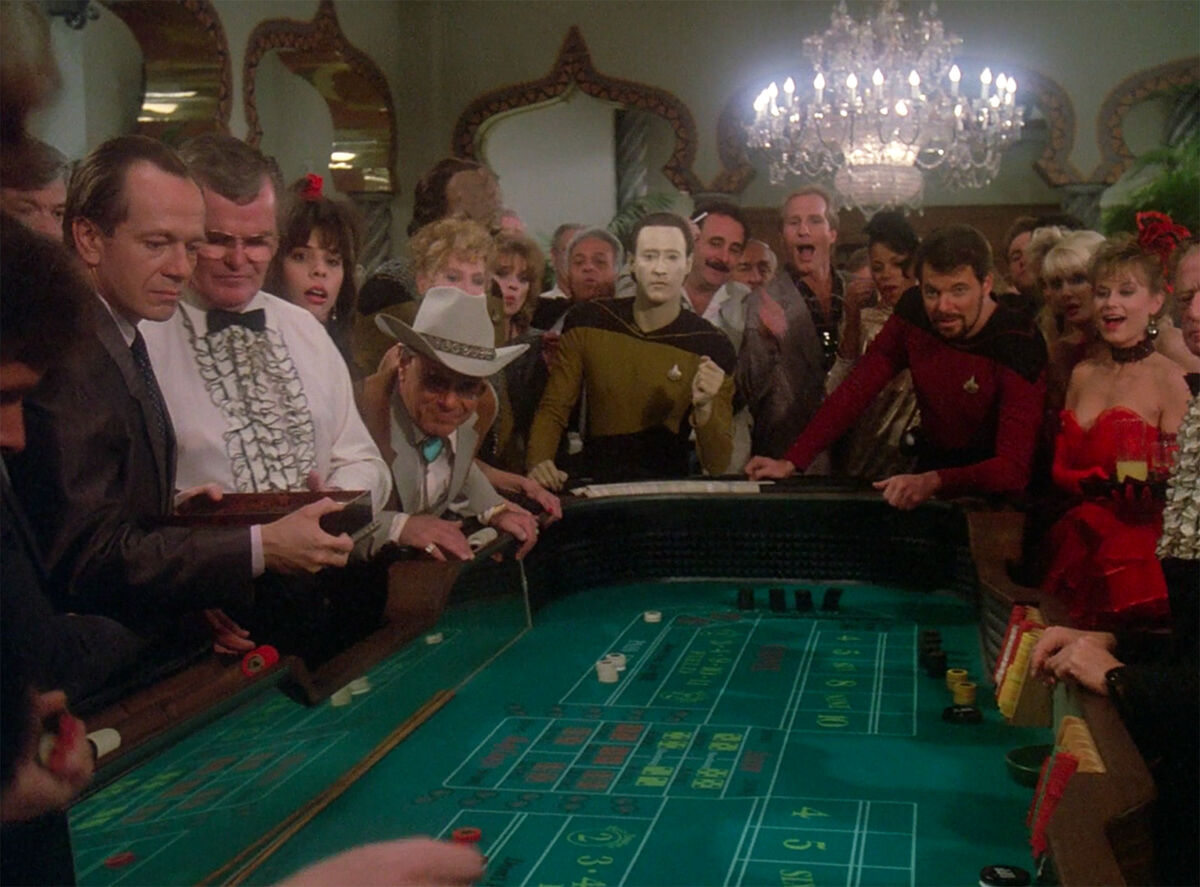
For "The Royale", along with toning down the comedy, the original story was perceived to be closer to TOS's "A Piece of the Action". It's not like TNG had copied TOS tropes before, but I liked the changes to the final product, even if the pacing was inconsistent, as there's more tragedy and an innovative take on why an alien society would mimic a human one (misperceiving the novel that the astronaut had and thinking preserving him in that environment would be a great thing to do, which seems somewhat original an idea). Then again, it'd be cool to more fully compare the original draft to what was filmed... yet if the original also paid "homage" by Pulaski pulling a McCoy with the corny "I'm a doctor, not a parrot" routine...)


Regardless, the crux of the episode is an interesting "slice of Trek", for lack of better term:

RIKER: Yes. I write this in the hope that it will someday be read by human eyes. I can only surmise at this point, but apparently our exploratory shuttle was contaminated by an alien life form which infected and killed all personnel except myself.
...
I awakened to find myself here in the Royale Hotel, precisely as described in the novel I found in my room.
...
And for the last thirty eight years I have survived here. I have come to understand that the alien contaminators created this place for me out of some sense of guilt, presuming that the novel we had on board the shuttle about the Hotel Royale was in fact a guide to our preferred lifestyle and social habits. Obviously, they thought this was the world from which I came.
...
I hold no malice toward my benefactors. They could not possibly know the hell they have put me through.
...
for it was such a badly written book, filled with endless cliché and shallow characters. I shall welcome death when it comes.

How much of that is Torme vs Hurley...

(which does bring up some differences)
 
Had no clue until recently that Maurice had Tracy Torme's stories edited for various reasons and ultimately causing him to leave the show (with Berman unsuccessfully trying to get him back).

Showrunners almost always rewrite staff or freelance writers' drafts; that's part of their job, to ensure that the characters, continuity, and storytelling voice remain consistent from episode to episode. But sometimes it's done with a heavier hand than others, and sometimes a showrunner and a staffer just don't agree on how to approach the show, or the staffer doesn't feel they're being treated well.
 
My impression of Hurley was he was basically trying to keep the fires out at this party point. I would like to have seen some more of his work mind you. I actually thought the latter half of the first season and the second season is stronger than proceeds quite a bit of the show. He doesn’t strike me as a particularly brilliant person, but how often were TV executives at that time? He had some interesting ideas for the show and I’d be interested to have seen more.
 
If you are not already a member then please register an account and join in the discussion!

Sign up / Register


Back
Top