• Welcome! The TrekBBS is the number one place to chat about Star Trek with like-minded fans.
    If you are not already a member then please register an account and join in the discussion!

Star Trek The Wrath of Khan Book Club

Tallguy

Vice Admiral
Admiral
Greetings, Programs! Last year for the 45th anniversary of Star Trek: The Motion Picture I "hosted" a daily book club for Gene Roddenberry's novel of the film. It was fun! (I thought it was fun.)

Here we are a year later. Let's do it again! Logic suggests (Logic! The man's talking about logic!) that this year we should do Vonda N. Mcintyre's novelization of The Wrath of Khan!

I saw The Wrath of Khan on opening day, June 4th 1982. I saw it at General Cinema's Cinema I-II-III at Metrocenter in Phoenix, Arizona. You can see the mall in Bill and Ted's Excellent Adventure but not the cinema. There are a couple of shots where they had to be filming right outside the doors though. (It was across from and above the skating rink.) I think this might have been the only Star Trek film that showed there. I know it's the only one I saw there.

I actually started reading the novel when a kind-hearted soul loaned it to me on the flight home from my grandmother's funeral in mid July. Then I bought it when we got home. What did I think of the book vs. the movie? We shall see!

Anyway, let's start on December 7th (Star Trek Movie Day) with the Prologue. It's been a few years since I've read this. But if memory serves, the chapters of this book are a little beefier than The Great Bird's book. (I might also be thinking of The Search for Spock.) So this year I'm going to do a chapter every other day rather than daily. Let's just say after the Prologue we'll do Monday-Wednesday-Friday.

See you then, I hope!
 
They filmed Bill & Ted's Excellent Adventure in Phoenix? I've lived in Arizona for most of my life, and I'm a huge fan of the movies and I had no idea they filmed it here. I've actually been to Metrocenter a few times.
 
They filmed Bill & Ted's Excellent Adventure in Phoenix? I've lived in Arizona for most of my life, and I'm a huge fan of the movies and I had no idea they filmed it here. I've actually been to Metrocenter a few times.
I don't know about the parts that take place in a mall, but the "Waterloo" water park sequence was filmed at Golfland/Sunsplash.
 
Not the tangent I was expecting. :) Yep, filmed in the Valley of the Sun. The Circle K was (I believe) in Tempe. Recently torn down. I think the bowling alley was in Scottsdale but don't quote me on that. The mini golf place was in Mesa (As @Desert Kris mentioned). The high school was Arcadia? I bet this is all actually documented someplace now.

I just remember I had a friend who was working at the hot dog on a stick place. His boss took over his shift because she knew they were filming that day. He was pissed.

Of all the BIG movies of my childhood and teenage years I think the only two that were there were Wrath of Khan and Return of the Jedi. Lots more int the other two theaters outside the mall proper. 16 years later I waited in line in front of where that theater had been for The Phantom Menace but it had been totally remodeled into a different theater and the entrance was moved outside.

Although if we count that, I had my first date with my future wife there.

Go read!
 
OK, sorry this will be my last post on this tangent, but I just looked on Wikipedia, and holy crap a lot more movies than I realized filmed out here in AZ. I knew they filmed old westerns out here, but I thought once the westerns stopped so did most filming in Arizona, with a few rare exceptions like Star Wars: A New Hope & Return of the Jedi.
 
OK, sorry this will be my last post on this tangent, but I just looked on Wikipedia, and holy crap a lot more movies than I realized filmed out here in AZ. I knew they filmed old westerns out here, but I thought once the westerns stopped so did most filming in Arizona, with a few rare exceptions like Star Wars: A New Hope & Return of the Jedi.

The Getaway (1994) was filmed in parts of Phoenix (I think) and Prescott (I know). That was when I tripped over Kim Bassinger and Alec Baldwin on my way to breakfast.
 
My first Trek movie in the theaters was First Contact at the Fiesta 5 theater near Fiesta Mall in Mesa (both now defunct). It was a phenomenal experience.

I love the novelization of Wrath of Khan. I will be reading other things during December but will happily read the chatter in this thread.
 
My first Trek movie in the theaters was First Contact at the Fiesta 5 theater near Fiesta Mall in Mesa (both now defunct). It was a phenomenal experience.
I saw First Contact at my beloved Cine Capri. The only Star Trek film that I saw there. But I saw The Voyage Home and The Final Frontier at The Kachina (as seen in Steven Spielberg's The Fablemans).

I love the novelization of Wrath of Khan. I will be reading other things during December but will happily read the chatter in this thread.
I'm also doing a Lord of the Rings reading project that will kick back up when the Fellowship leaves Rivendell on Christmas day. But I couldn't pass this up.
 
Happy Star Trek Movie Day! (Totally a thing.) (Shhhh. No more movie theater talk. The book is starting.)

STAR TREK: THE WRATH OF KHAN

A novel By Vonda N. McIntyre
Screenplay by Jack B. Sowards
Based on a story by Harve Bennett and Jack B. Sowards
(Something something uncredited Nicholas Meyer)

Vonda says:
For Jane and Ole, with love & snarks

Captain's Log: Stardate 8130.5
Starship Enterprise on training mission to Gamma Hydra. Sector 14, coordinates 22/87/4. Approaching Neutral Zone, all systems functioning.

OK, if you have never seen or read The Wrath of Khan (TWOK) then... this is where you're going to start? Um, welcome aboard but I will be throwing around spoilers like they are candy at a parade.

Gamma Hydra is, of course a callback to The Deadly Years where Gamma Hydra was located near the Romulan neutral zone. There never having been a Klingon neutral zone before this film. Or at least no Klingons in the Romulan neutral zone. And never again outside of The Undiscovered Country. But they had the footage and the name recognition. OTOH, what would the treaty implications be if the Klingons entered the zone? (Not just a sternly worded letter. A very sternly worded letter!)

Right off the bat McIntyre gives us a much more populated ship. All the regular crew have a trainee that they are working with. (Where do they sit?) Not to skip ahead, but are the "intercom" people off the bridge in their own sims? We get a security contingent ready to board the Kobayashi Maru. And Dr. Chapel is on board even if she isn't in the film.

Dr. Chapel is the first bit of continuity from Star Trek: The Motion Picture. McIntyre directly acknowledges the first film while the movie pretty much ignores it. I think the movie assumes that the first film never happened. (I also think it assumes that everything in TOS actually looked like this movie. Hence Khan has a contemporary Starfleet insignia as a necklace.)

Maybe this was just 13 year old me, but when I saw TWOK the first time even though they said this was a training mission in the Captain's Log (which I'm sure I missed) I really thought Saavik was the new captain of the Enterprise. This makes it explicit that she is actually a trainee.

On the other hand this sequence in the book is rather extended, allowing Saavik to show a little more character and overall strategy. It also tells us from the jump that she is part Romulan. We (I) don't get the same surprise of a Vulcan saying "damn" that was in the film.

Bones seems pretty passionate about the moral outcomes of a simulation. Which of course plays into the bait and switch that worked so perfectly the first time we read or saw this story. I realize the dramatic necessities of this scene for the audience, but I actually liked seeing the cadets in Star Trek '09 acting more like a) it was a sim and b) they had done this a few times now. Of course that would not have worked for the mind-blowing reveal in TWOK.

Did McCoy ever call Chapel "Chris" in the show?

For me this was possibly the greatest cold open in Star Trek history. And I figured the movie would be about Kirk rescuing the Enterprise.

If I remember rightly McIntyre will use very little dialogue from the film. Certainly she doesn't in this chapter. She is more likely to write her own line rather than directly quote the dialogue. In this case I quote like Meyer's dialogue so this is a bit of a downside for me.

I've always wondered how much of the character of Saavik was given to McIntyre and how much she created herself. Between Kirstie Alley's performance and this book Saavik is one of the most fully realized characters in Star Trek. (And the there is The Pandora Principle. Swoon.)

"All hands," she said again. "Abandon ship."
 
I've always wondered how much of the character of Saavik was given to McIntyre and how much she created herself.

Presumably all McIntyre was "given" was what was in the script -- that Saavik "is half Vulcan and half Romulan," she "has none of the expressionless facial immobility of a Vulcan," and that, according to Spock, "The admixture makes her more volatile than -- me, for example."

If anything, McIntyre realized the same thing the filmmakers did in editing -- that the above makes no damn sense, because Romulans and Vulcans are biologically the same species differing only in culture, so there's no reason why being half-Romulan would make her inherently "more volatile" in and of itself. The filmmakers corrected this script error by cutting out the references to her Romulan heritage, and McIntyre corrected it by inventing a more plausible reason why being half-Romulan would result in Saavik being more emotional -- that she was born to a Vulcan captive on a Romulan prison colony and never learned Vulcan ways until Spock rescued her in adolescence.
 
Presumably all McIntyre was "given" was what was in the script -- that Saavik "is half Vulcan and half Romulan," she "has none of the expressionless facial immobility of a Vulcan," and that, according to Spock, "The admixture makes her more volatile than -- me, for example."

If anything, McIntyre realized the same thing the filmmakers did in editing -- that the above makes no damn sense, because Romulans and Vulcans are biologically the same species differing only in culture, so there's no reason why being half-Romulan would make her inherently "more volatile" in and of itself. The filmmakers corrected this script error by cutting out the references to her Romulan heritage, and McIntyre corrected it by inventing a more plausible reason why being half-Romulan would result in Saavik being more emotional -- that she was born to a Vulcan captive on a Romulan prison colony and never learned Vulcan ways until Spock rescued her in adolescence.

I cannot imagine such a detail even entering the thought of anyone working on the film. All they had to go off of was TOS itself and in TOS Vulcans not having emotions was a physical characteristic. We saw this in Charlie X (where emotions were harmful to Spock in a way that they weren't for others) and All Our Yesterdays where Spock "devolves" to be emotional like his forebears.

Even in Star Trek IV Amanda tells Spock that he will have emotions because he is half human not because Vulcans have emotions they are trained to ignore. Those were the days.

Also Star Trek is rife with "this species is inherently THIS or THAT" (odd message for a show like Star Trek to have, but there we are). Worf grew up in Russia on Earth and yet his "blood hungers" and he is "drawn to the hunt" and other such fiddle faddle.

I can see it being cut for time, to streamline the story, or even because Alley wasn't up to it, or a combination of all three. But Meyer or someone who could / would influence his storytelling (after cameras had rolled)? I'd have to hear that from the horse's mouth.

McIntrye (and we) might realize that evolutionary differences between Vulcans and Romulans over such a minuscule period of time must be silly. But she also insists on renaming Ceti Alpha to be the more correct (I'm told) Alpha Ceti. She had opinions. And in these heady days of "people not paying that much attention" she could get away with it.
 
I cannot imagine such a detail even entering the thought of anyone working on the film. All they had to go off of was TOS itself and in TOS Vulcans not having emotions was a physical characteristic. We saw this in Charlie X (where emotions were harmful to Spock in a way that they weren't for others) and All Our Yesterdays where Spock "devolves" to be emotional like his forebears.

That is not correct. From "Balance of Terror": "Vulcan, like Earth, had its aggressive colonising period. Savage, even by Earth standards. And if Romulans retain this martial philosophy, then weakness is something we dare not show." Spock explicitly said they differ in philosophy, not physiology. ("The Enterprise Incident" explicitly stated that the physiological difference between Vulcans and Romulans was almost indetectably slight.) Episodes like "The Naked Time" and "This Side of Paradise" show that Spock does not lack emotion, but has strong emotions that he keeps contained by choice, and that break free when his self-control is impaired. In "Amok Time," Spock says that pon farr "rips away our veneer of civilization," further confirming that their logical discipline is a choice to control their inner passions, not a lack of such passions.

There is nothing in "Charlie X" about emotion being harmful to Spock; indeed, the episode shows him smiling at Uhura as they perform music together in the rec room. You must be thinking of "Plato's Stepchildren," where McCoy told the Platonians that forcing emotion out of Spock would "destroy" him. Given what had been established over the previous two seasons, McCoy obviously did not mean that Spock lacked emotion, but that to force emotional release onto someone whose entire identity structure was built around controlling his emotions would be psychologically traumatizing.


Even in Star Trek IV Amanda tells Spock that he will have emotions because he is half human not because Vulcans have emotions they are trained to ignore. Those were the days.

Yes, there are certainly writers who make the mistake of assuming Vulcans' lack of emotion is innate rather than learned. It's an annoyingly common occurrence throughout the Trek canon. My whole point is that the writers of TWOK's script made that mistake -- but then the filmmakers realized the mistake and corrected it by cutting out the references to Saavik's half-Romulan nature, and Vonda McIntyre realized the mistake and corrected it by coming up with a more plausible reason for Saavik's emotionality.


McIntrye (and we) might realize that evolutionary differences between Vulcans and Romulans over such a minuscule period of time must be silly. But she also insists on renaming Ceti Alpha to be the more correct (I'm told) Alpha Ceti. She had opinions. And in these heady days of "people not paying that much attention" she could get away with it.

Now, that's needlessly condescending. It's not that people weren't paying attention; it's that novelizations were expected to stand as works in their own right, inspired by the source material but not slavishly limited to copying it -- in much the same way that movies based on novels are free to change their text. It used to be understood that adapting a work of fiction meant changing it, no matter which direction the adaptation went. Just as you'd expect a band performing a cover song to do it in their own style rather than copying the original style, it was expected that an author novelizing a movie would make it their own, tell the story in their own voice and style and bring their own interpretation to its ideas. We did pay attention, but continuity was not the only thing we paid attention to. We also paid attention to writers' individual styles and voices, and part of the reason for seeking out a novelization was to see how a particular author interpreted the work in their own style.
 
(Today's chapter is farther down the post.)

All fair points about Balance of Terror. But "Half Vulcan / Half Romulan" was supposed to be recognizable shorthand for something just as "Half Human / Half Vulcan" was and "Half Human / Half Klingon" was in Voyager. Is it racist as all get out? Probably.

The Serene Squall in SNW took a moment to deconstruct these tropes and assumptions. Because they are existing tropes and assumptions. Much stronger in 1982 than they are now. Most people, writers or otherwise were saying "Heyyyy, this doesn't really make sense from a biology standpoint." Definitely not the film makers who made The Wrath of Khan.

Yes, there are certainly writers who make the mistake of assuming Vulcans' lack of emotion is innate rather than learned. It's an annoyingly common occurrence throughout the Trek canon.
Which is the canon that Meyer and Bennett were drawing from. And which writer vs. filmmaker are we talking about? My understanding is that the script that Meyer filmed was essentially (entirely?) his own script.

Bennett and Meyer would go on to write four years later that Spock only has feelings because he's half human.

I admit that Star Trek has moved on from this idea. But in 1982 it hadn't. In 1986 it hadn't either.

Episodes like "The Naked Time" and "This Side of Paradise" show that Spock does not lack emotion, but has strong emotions that he keeps contained by choice, and that break free when his self-control is impaired. In "Amok Time," Spock says that pon farr "rips away our veneer of civilization," further confirming that their logical discipline is a choice to control their inner passions, not a lack of such passions.
SPOCK was never supposed to lack emotion. VULCANs were. That's why Spock was supposed to be different.

There is nothing in "Charlie X" about emotion being harmful to Spock; indeed, the episode shows him smiling at Uhura as they perform music together in the rec room. You must be thinking of "Plato's Stepchildren," where McCoy told the Platonians that forcing emotion out of Spock would "destroy" him. Given what had been established over the previous two seasons, McCoy obviously did not mean that Spock lacked emotion, but that to force emotional release onto someone whose entire identity structure was built around controlling his emotions would be psychologically traumatizing.
Sorry. My mistake. I don't watch Charlie X that often and I never watch Plato's Stepchildren if I can help it. But yes, you identified what I was thinking about.

Aren't there other scenes where someone (McCoy, usually) will rebut when Spock says "I don't have feelings / can handle pain / am more advanced because I am a Vulcan" by replying "Yes, Mr. Spock but you are ALSO half human!" There was supposed to be something biological and immutable that was preventing him from being as emotionless as full Vulcans. Which Spock refused to acknowledge.

Now, that's needlessly condescending.
No, it's describing the landscape of the time. McIntyre herself noted that this landscape changed from when she wrote this to when she had things she wasn't allowed to do on The Voyage Home. (Does anyone know what?) Because this Star Trek thing was getting attention and making money. (Did it also involve Richard Arnold? I may have that very wrong, of course.)


Anyway, Monday:

Chapter One
McIntyre continues to both flesh out the character's interactions with each other (they joke together rather than just interacting with Kirk). She also continues to write her own dialog. (I'll stop mentioning it unless it's something really different in intention rather than just structure. But when you know these words as well as many of us do...)

I really enjoy the exchange between Kirk and Saavik in the debriefing. (Did she just call Starfleet a military?) The bond between Kirk and Saavik works very well in the film with a minimum of setup but this lays more groundwork than the film does. But IIRC Saavik will be more of a co-star and less of a supporting character here.

A "Rickoverian paradox". I gather this refers to Admiral Hyman Rickover but I cannot find that this is an example of anything. I know he gave some rather mind-gamey tests to his submarine captains and candidates.

We get an expansion of Saavik's history. And I will accept no other.

"How in the world did you know it was my birthday?"

Good grief. They've been friends and colleagues for how many years now? Jim Kirk might be a little messed up.

After purchasing the gift,

Purchased with what I do wonder. Ahhh, the before times.

For some reason I'm remembering that Spock purchased this in San Francisco. Which, I know, makes sense, but I was remembering it stated more explicitly than this. I wonder what I am jumbling this up with?

See you Wednesday.
 
Most people, writers or otherwise were saying "Heyyyy, this doesn't really make sense from a biology standpoint." Definitely not the film makers who made The Wrath of Khan.

You're only assuming that, so you have no business saying "definitely." I can't remember where, but I did read once that it was the filmmakers who chose to cut the reference when the illogic of it was pointed out to them -- perhaps by Nimoy, though I don't recall for sure.


SPOCK was never supposed to lack emotion. VULCANs were. That's why Spock was supposed to be different.

I already explained why that is a complete misreading of TOS. Yes, again, many writers did make the mistake of assuming that Vulcan logic was an innate species trait, but that just proves they were ignoring what was explicitly established in episodes like "Balance of Terror" and "The Naked Time," that Vulcan control was a personal and cultural choice rather than an innate lack of emotion. You are absolutely wrong to claim that the idea only came later. It was there from the first season, even though it was often overlooked.


No, it's describing the landscape of the time. McIntyre herself noted that this landscape changed from when she wrote this to when she had things she wasn't allowed to do on The Voyage Home. (Does anyone know what?) Because this Star Trek thing was getting attention and making money. (Did it also involve Richard Arnold? I may have that very wrong, of course.)

Oh, I see, when you said people were not paying attention, you meant that studios weren't paying attention, not that audiences were oblivious to the changes. Still, I don't think that's true. I think the culture of the time just wasn't as obsessive about continuity as modern audiences. And books were still valued as worthwhile creations in their own right, not merely as promotional items for films. Once upon a time, books were seen as more prestigious than movies, and movies touted the books they were adapted from in their trailers. That was less the case by the '60s and '70s, but original movies like Fantastic Voyage and Star Wars would release their novelizations in advance in hopes that the movies could ride on the books' coattails. There was more respect for books and more willingness to let them go their own way in telling the stories.

I mean, look at 2001: A Space Odyssey. Stanley Kubrick and Arthur C. Clarke developed and wrote the film and the novel simultaneously in close collaboration, so you can hardly say the filmmakers were unaware of what the novelist was doing. Yet the film and the novel still take the story in wildly different directions. The novel has the Discovery use a gravity assist at Jupiter to get to its ultimate destination at Saturn, while the movie simplifies it by placing the Monolith at Jupiter. And Clarke's novel explains everything that happens while Kubrick's movie deliberately makes it as unclear and mysterious as possible, in keeping with the two creators' very different styles. The difference between the two was a feature, not a bug.


I really enjoy the exchange between Kirk and Saavik in the debriefing. (Did she just call Starfleet a military?)

Of course she did, because it is and always has been. Nobody started questioning it until TNG came along and Roddenberry tried to downplay the military aspects of Starfleet that had always been front and center in TOS. And Bennett & Meyer's version of Starfleet is easily the most militaristic portrayal of the institution in the entire canon.


Purchased with what I do wonder. Ahhh, the before times.

TOS and TAS repeatedly established that money and capitalism still existed. Kirk twice referred to Scotty earning his pay for the week, there was an exchange in "The Apple" about how much money had been invested in Spock's training, we saw capitalist characters like Harry Mudd, Cyrano Jones, and (on the more benevolent side) Carter Winston, and Flint was so rich he bought his own planet.

It stands to reason that the Federation didn't become moneyless until replicators became ubiquitous sometime between the TOS & TNG eras, making it fully a post-scarcity society. The reference in TVH to not using money in the 23rd century is presumably a reference to using electronic credits instead of hard currency.
 
You're only assuming that, so you have no business saying "definitely." I can't remember where, but I did read once that it was the filmmakers who chose to cut the reference when the illogic of it was pointed out to them -- perhaps by Nimoy, though I don't recall for sure.

From Memory Alpha (apparently by way of an interview in Enterprise Incidents):
It was Nick Meyer who removed the idea of Saavik being half-Romulan. He explained, "I didn't see that it made any difference. There was nothing about her that was Romulan, so let her be Vulcan." (Enterprise Incidents, issue #14, p. 62) Still, the notion of her mixed heritage has lingered on into the script of The Search for Spock where a script annotation for scene 229 stated that "[e]ven a half-Vulcan has a breaking point", though it has remained unspoken in the movie.
 
Which is not incompatible with someone having pointed out the problem to Meyer before he made that decision. We'd need the fuller context of the quote to know for sure.

Regardless of why it was removed, though, the larger point is that McIntyre created her own Saavik backstory rather than getting it from the filmmakers, and indeed her version was a correction to the lazy assumptions made by the script.
 
@Christopher and if the "purchase" was made as a moneyless transaction, "purchased" would just be shorthand for having requested and received it from the person who previously possessed it, with whatever (digital) paperwork might be used to record a transfer of ownership.
 
Chapter 2

Duty Log: Stardate 8130.4: MOST SECRET
Log Entry by Commander Pavel Chekov, Duty Officer. U.S.S. Reliant on orbital approach to Alpha Ceti VI, continuing our search for a planet to serve as a test site for the Genesis experiment. This will be the sixteenth world we have visited; so far, our attempts to fulfill all the requirements for the test site have met with failure.

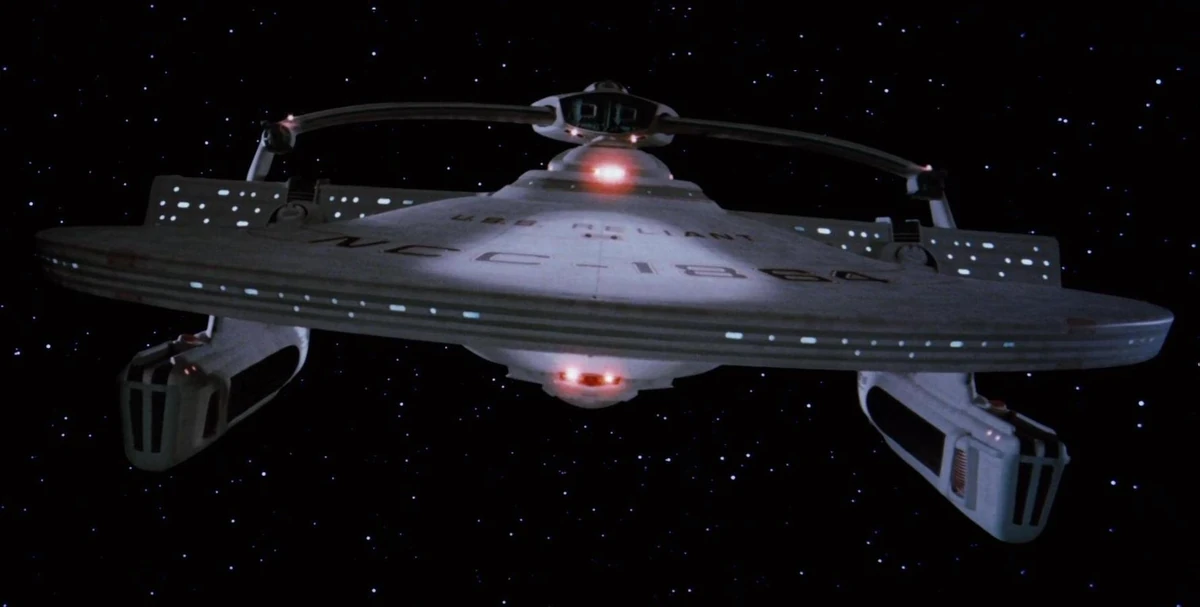
Well here we are on the Reliant. I have always wondered if there was ever a thought that (keeping with the traditions of TOS) the ship would have just been another Enterprise. It's indicated to be an old ship.

Chekov is duty officer here rather than first officer. Did someone tell me that this was a late change to the film that was handled with the voice over for some reason?

We spend a little more time with him and get to hear about how long and boring the assignment has been. We are told this does not come close to comparing with his time on the Enterprise.

I have long thought the addition of Surak as the "alien third" in the formulation of "Newton, Einstein, Surak" was an odd choice. (Warning: TV Tropes - https://tvtropes.org/pmwiki/pmwiki.php/Main/FamousFamousFictional) Two scientists / mathematicians and a philosopher. Maybe this tells us something about Surak that we didn't know?

(My Kindle edition does not have line breaks between scene changes. It's annoying.)

Now we go to Kirk's apartment. Funny that McIntyre includes the lines about the glasses being 400 years old with the lenses intact (that was removed from the final cut of the film) but then goes on to explain that, no, not really.

McIntyre does a delightful job of giving scenes air. In the film Kirk and McCoy are running through a tightly scripted scene that will tell us that Kirk is unhappy and having a midlife crises. (Who the heck has a midlife crises at 49?) This has more of the feeling of Kirk and McCoy spending a quiet (very quiet) evening together having a couple of ales.

Here is a direct reference to Star Trek: The Motion Picture that the movie never went near.

You never should have given up the Enterprise after Voyager.

And then:

If you'd made a few waves, they wouldn't have had any choice but to reassign you."

Which, if you will recall our read through last year was exactly Kirk's intention at the end of Roddenberry's novel.

Back with Chekov and Terrell. They encounter a child. I gather that this was something that was actually filmed?

All of the inhabitants are out, they left a child alone, and there is hot stew on the stove. How did these people make it 15 years?

McIntyre also gives the impression of a much larger space than we saw on screen.

Bible? Twentieth-century mythology, if he recalled correctly.

It's one thing to posit that Christianity is a religion from Earth's past. Another to tie the Bible specifically to the 20th century. Chekov must have had an interesting education. And he still thinks Lenin is groovy.
 
Well here we are on the Reliant. I have always wondered if there was ever a thought that (keeping with the traditions of TOS) the ship would have just been another Enterprise. It's indicated to be an old ship.
You mean another Constitution-class ship? In fact, it was.

The Reliant was originally intended to be a Constitution-class starship; the script describes her as "an older, somewhat battered starship of the Enterprise class, with a slightly different configuration." [4] The cumbersomeness of the Enterprise studio model from Star Trek: The Motion Picture (vehemently expressed by Special Visual Effects Supervisor Kenneth Ralston at the time) was part of the reason why the class of the Reliant was redesigned from a Constitution-class to the Miranda-class, the other reason being that the producers were afraid that audiences would not be able to tell the two ships apart during the battle sequences. "In the dogfight you had to instantly recognize which ship you were looking at, so they had to look different. At the same time, you had to make them look like they came from the same culture and had the same technology", Joe Jennings elaborated. (Star Trek: The Magazine Volume 3, Issue 5, p. 69)

Also, like the original Enterprise, the design was originally supposed to be oriented the other way up, but the guy in charge saw the drawing upside-down and preferred it that way.

Chekov is duty officer here rather than first officer. Did someone tell me that this was a late change to the film that was handled with the voice over for some reason?

The script does indeed say "Duty Officer," though Chekov is a commander.


I have long thought the addition of Surak as the "alien third" in the formulation of "Newton, Einstein, Surak" was an odd choice. (Warning: TV Tropes - https://tvtropes.org/pmwiki/pmwiki.php/Main/FamousFamousFictional) Two scientists / mathematicians and a philosopher. Maybe this tells us something about Surak that we didn't know?

It does come off a bit lazy on the part of the filmmakers. On the other hand, it's plausible that there's more than one historical Vulcan named Surak, and one of them was a famous physicist.


(Who the heck has a midlife crises at 49?)

Someone with a life expectancy of around 98? Hardly implausible in a future setting. (Heck, my aunt will be 98 in March, and her husband will be 101 next month.)


It's one thing to posit that Christianity is a religion from Earth's past. Another to tie the Bible specifically to the 20th century. Chekov must have had an interesting education. And he still thinks Lenin is groovy.

It's interesting in retrospect how nobody predicted the fall of the Soviet Union, assuming it would still exist centuries in the future. "I, Mudd" had previously presumed that St. Petersburg would still be named Leningrad in the future.
 
If you are not already a member then please register an account and join in the discussion!

Sign up / Register


Back
Top