• Welcome! The TrekBBS is the number one place to chat about Star Trek with like-minded fans.
    If you are not already a member then please register an account and join in the discussion!

deuterium storage

topcat

Lieutenant Commander
Red Shirt
Impulse engines need deuterium to operate. SO does the warp core. The issue is of storage. Where is it exactly in the TOS and TMP era?

The saucer is designed to be an independent ship, and act as a colony habitat if it lands on a planet. The issue is that in all of the 3d models I see on this site, and most of the plans I see online I cannot find for the life of me any spot in the saucer for deuterium storage.

And I can never really see pipe lines from the few storage tanks in the secondary hull shown on some blueprints/schematic sets for the enterprise or even excelsior. However the few Miranda plans show the tankage to be at the top of the warp core stack surrounding the glowing blue disk.
 
Having the deuterium at the top of the column makes sense only in a classic TNG style setup - with matter and antimatter shooting at each other from opposite ends of the tube.

However, typical schools of thought for the TMP setup place the reactor at the base of the column, so presumably that is where the fuel stores are as well.

As for the Impulse fuel stores, this only really becomes an issue following saucer separation, since the main vertical power conduit takes the job on the rest of the time. Mr Scott's Guide To The Enterprise postulates that the 5 small squares along the Impulse Spine are actually auxiliary fusion reactors, in case the main power conduit goes down (or in case of separation)
However, you are correct that fuel tanks for these supposed reactors are never listed on the official cutaways.
 
Use of deuterium as the matter fuel is also a TNG thing, for TOS/TMP they could be using fuel that's more dense and doesn't require a huge volume of tankage.
 
The star trek magazine always stated deuterium and antimatter for the reactor cores fuel.
 
The closest we get to onscreen evidence on the nature of TOS era fuel is probably the Kobayashi Maru simulation, where the load for the simulated ship is passengers plus "neutronic fuel". Let's assume that this is starship fuel. What could it be?

Deuterium would definitely fit the bill, with the extra neutron in the hydrogen and all - but since the expression is so generic, perhaps so is Starfleet's fuel policy? Perhaps they also use tritium (since deuterium and tritium are easy fusion fuels, and also reasonably abundant). Perhaps they use other heavy isotopes.

The obvious alternative is that fuel in the era is neutronic in the sense of being neutronium. But our heroes don't appear comfortable with neutronium in any era - the issue arises especially in "Doomsday Machine".

Judging by TOS dialogue alone, we're left completely adrift. For all we know, Kirk's ship used (di)lithium as her one and only fuel! Or then she could use anything from banana peels to black holes, just like her auxiliary craft that seem to fly on ion power, fluids-stored-in-tanks and phaser battery power alike. There's antimatter in the engines, but OTOH "power regenerates" and does other mystical things.

Happily, TAS helps us along by explicating matter-antimatter fuel in "One of Our Planets Is Missing", and showing that antimatter from a space-traveling intelligent cloud (thus perhaps something light like deuterium) is at least compatible. But we're certainly under no obligation to think that TOS/TAS, TNG/DS9/VOY and ENT all used the same type of fuel. (Then again, TNG/DS9/VOY and ENT do share all the specifics, alas.)

Timo Saloniemi
 
Deuterium storage would be basically like liquid hydrogen storage. Since it's heavy hydrogen.. In a thermally insulated pressure vessel (tank). And storage tanks could be placed in all of the irregular spaces of the hull not suitable as habitable deck space. Since it is very plentiful in space. it could be collected by the Bussard collectors and supplies replenished constantly. Just as regular hydrogen can be. Only a very small percentage of free interstellar hydrogen is actually deuterium. But it's literally everywhere. So maybe extensive tankage isn't required.
 
OTOH, the Voyager episode "Demon" suggests deuterium is extremely difficult to come by in sufficient quantities and concentrations, which is a pretty realistic concept considering how much of the stuff moving through space must consume, in comparison with how little of the stuff the ship will encounter while moving through space...

Hydrogen in today's rocketry is notorious for consuming lots of space even in cryogenic storage. But Trek technology might have found workarounds, compacting hydrogen into a solid form by whatever means (extreme pressure from forcefields, clever infusing into a solid matrix, slowing of time to reduce temperature to absolute zero).

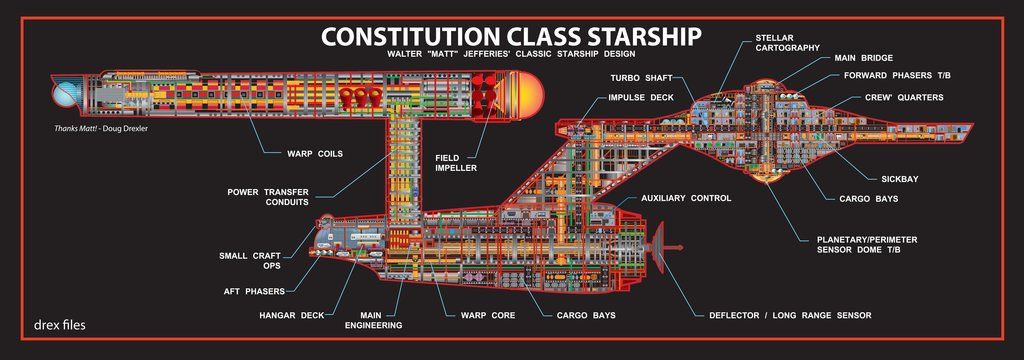
In any case, MSD artwork shows TNG era starships with obvious pressure vessels (cylinders with domed ends) here and there, except for the E-D herself (and there a more elegant shape matching the Tech Manual description is found on top of the engineering hull). Since the only TOS era "MSD" is the one from "In a Mirror, Darkly" (reproduction of Drexler's "Captain's Chair" CD-ROM art), we might try and decipher that one for clues - but there aren't many...

http://www.shawcomputing.net/racerx/trek_stuff/mirror_darkly_display.jpg

Timo Saloniemi
 
That diagram, while very pretty, has way too many horizontal and vertical lines in it. Making it very cluttered.
I think a lot of tankage could be gained by using the empty spaces in the nacelle pylons. and possibly the dorsal pylon. And you could possibly have a giant ring-shaped tank behind the deflector dish.
 
When your display is just a center-line cutaway profile you are going to miss a lot of stuff.
Even though we never saw it done. I'd like to think that those displays were interactive and you could touch a button on screen and switch to an overhead view of each deck. And be able to display each deck as wished.
And could that picture be any smaller?
 
MWg8sz0.gif
 
Trekcore has screencaps which are slightly larger

...I think Rob was referring to your picture of Drexler's original art? ;)

Either version of Drexler's design retains the "original" deck count of a thousand-footish "Matt Jeffries /TMoST" ship, which isn't a bad thing considering how tall (indeed ceilingless) the TOS decks in studio actuality were. But it decidedly creates a rift between this ship and the ST:TMP one, as the dimensions of the latter can be more exactly divined from docking ports and the like. Then again, we never saw those two ships side by side...

Timo Saloniemi
 
Well, the 7368 pixel wide version of Drexler's cutaway is strangely hard to find since his site went down...

However, since you seem so keen I have hosted it on my Photo Bucket. Be warned - it is HUGE!
Tos_cutaway_drexler_2%20length%201420.5%20feet_zpsv9lxlyiz.jpg~original


Either version of Drexler's design retains the "original" deck count of a thousand-footish "Matt Jeffries /TMoST" ship, which isn't a bad thing considering how tall (indeed ceilingless) the TOS decks in studio actuality were. But it decidedly creates a rift between this ship and the ST:TMP one, as the dimensions of the latter can be more exactly divined from docking ports and the like. Then again, we never saw those two ships side by side..
The TOS sets do show ceilings on a couple of occasions and even through they are just sheets of plywood laid on top of the set walls, they do at least confirm the 10' ceiling height - which is the same deck division height seen in the TMP Rec Deck, so not too much of a difference.
The big issue is, as always, trying to cram 11 full height decks into the saucer! Shaw's research, MJ's original cutaway and his subsequent Phase II sketches clearly show that the deck count is more like 8 or 9 (plus crawlways here and there). Crank the deck number up to 11 and you have to grow the size of the ship accordingly.
 
Last edited:
My that's a pretty picture.
I remember reading Doug's blog and seeing that diagram. I went back later to grab it and he had taken his blog down. Thanks for reposting the full-sized picture.
Some of those deck heights do look a bit off. I would think that a ship would have varying deck heights depending on the need. Specially the hangar bay flight deck would need to be twelve or fifteen feet high. And I don't like to go by what the sets look like. None of the sets had an actual ceiling. Unless the shot called for one. I would think that the crew berthing decks would only have eight to nine foot ceilings. Anything higher is wasted space. And can we assume that the actual deck structure is only four to six inches thick. A sandwich of a structural deck plate that serves as the painted or carpeted floor above. With a ceiling panel for below . With gravity plating bonded in between?
Since the Enterprise is designed like a ship, basically a naval warship. I wonder what an actual naval engineer or architect would do with the design?
 
It could also be that, in the TOS/TMP era, impulse engines were simple hydrogen (i.e. proton) fusion reactors, and that using deuterium fusion reactors was only a thing later.

As an aside, deuterium was (to my knowledge) only mentioned as the fuel for the IPS in the TNG Technical Manual, but never on-screen. Given that, and some of the other ways that treknology has differed from what was in that book, it could very well be that the IPS fuel even in the TNG era was just H+.
 
It was never mentioned in TOS because during the original series run, it was considered that (much like an aeroplane) all the reactors and fuel were safely confined to the nacelles; far far away from where the crew hang out!

The Deck 15-16 location was probably thought up by someone retconning the TOS-E based on a cross-section of the E-D
 
If I may weigh in on the deuterium discussion...

IMHO, Allen Rolfes does an excellent job of depicting where 1701 might have stored all that deuterium in his blueprints found on Masao's Star Fleet Museum website:

<starfleet-museum.org>

Indeed, all his work on the innards of Masao's designs are lovely.

The volumes are demonstrably wrong in several cases but you have to get deep into the efficiency of nuclear fusion vs matter/antimatter reactions to even notice. And even then it takes some non-intuitive arguments to get to that conclusion.

None the less, I really appreciate his work and highly recommend it to anyone interested in trying to actually design the insides of a star trek space ship.
 
If you are not already a member then please register an account and join in the discussion!

Sign up / Register


Back
Top