• Welcome! The TrekBBS is the number one place to chat about Star Trek with like-minded fans.
    If you are not already a member then please register an account and join in the discussion!

FACT TREK's Back…& That's A Fact

Though poorly executed, I think the Spock observation to Rand was meant to point out what makes Kirk (or any man) an "attractive" male, not about enjoying sexual assault. Couple the two Spock dialogs together and I think this makes sense:
SPOCK: Judging from my observations, Captain, you're rapidly losing the power of decision.
MCCOY: You have a point, Spock?
SPOCK: Yes, always, Doctor. We have here an unusual opportunity to appraise the human mind, or to examine, in Earth terms, the roles of good and evil in a man. His negative side, which you call hostility, lust, violence, and his positive side, which Earth people express as compassion, love, tenderness.
MCCOY: It's the Captain's guts you're analysing. Are you of that, Spock?
SPOCK: Yes, and what is it that makes one man an exceptional leader? We see indications that it's his negative side which makes him strong, that his evil side, if you will, properly controlled and disciplined, is vital to his strength. Your negative side removed from you, the power of command begins to elude you.
and lastly,
SPOCK: The, er, impostor had some interesting qualities, wouldn't you say, Yeoman?
 
IIRC, Rand's friendship with Spock is mentioned in some document we have, possibly notes on "The Enemy Within," which would explain his WTF teasing..
If true, that'd also tie in with Uhura's song about Spock from CHARLIE X. Rand gave her the go-ahead, figuring Spock would semi-smirk through it.
 
Just posted this article. Been a while since we've had time to finish one of these. This one's fun because of it's about why some pilots sell and why others don't.


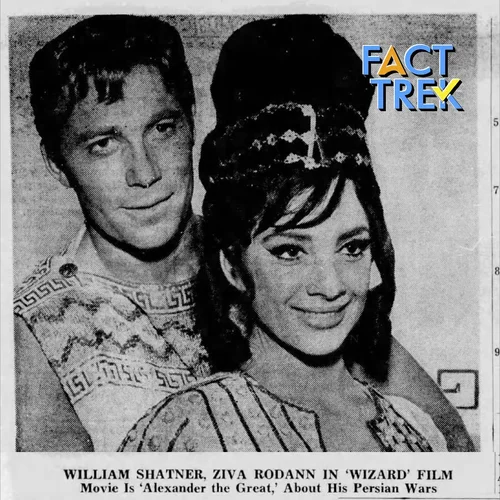
FACT TREK—AlexShatner the Great?

AlexShatner+the+Great+thumbnail.jpg

Nine months before Star Trek debuted on NBC-TV, Batman premiered on ABC-TV. Those series made William Shatner and Adam West into household names and typecast them as spaceman and superhero. But in early 1964, there was a chance they would co-star in a dramatic series for ABC that fall. Had that show sold and run beyond a single season, neither actor would have been available for the roles that defined their careers.

But nothing in television is certain. Even a strong concept with established talent in front of and behind the camera and a sizable budget is no guarantee of reaching the screen.

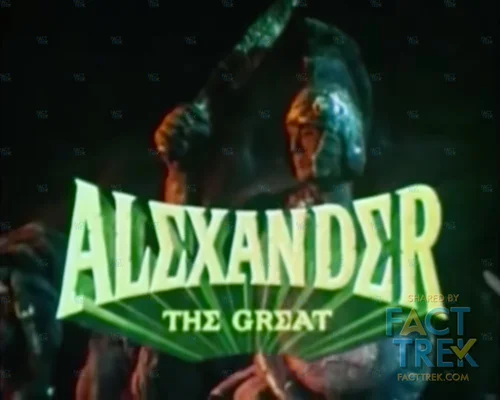
Alexander+title+WM.jpg

Title card for the Alexander the Great pilot (1963)

Such was the case with Alexander the Great, an ambitious and costly hour-long sword-and-sandal stanza produced by ABC’s Selmur Productions and developed by the creator of a well-regarded series. It may have seemed a sure thing.

It wasn’t.

But its failure is an instructive case study in why a series sells, or fails to.


Alexander+1964-03-24+A+March+Look+at+Next+September%27s+TV+Schedule%2C+Variety%2C+Weds%2C+p24+WM.jpg

Alexander the Great was in the running to make ABC’s fall 1964 schedule, and it was considered for a Wednesday 8:30 PM timeslot against CBS comedies and overlapping the end of The Virginian and the start of the Wednesday Night Movies on NBC. Ultimately, it was dropped.

I had yet to figure out that by this time when something hadn’t been done on television, there probably was a good reason it hadn’t been done on television.
—William Shatner​

Direct link:

 
Interesting analysis of why the story choices in the Alexander pilot failed to convey what the focus of the series would've been. It makes me wonder why none of the people involved in the production noticed those script issues before they started filming.

EDIT: The article got me curious about Shatner's For the People, and I found that YouTube has 8 episodes of it. The pilot is a bit cliched but well-written, very naturalistic by '60s standards, and the directing is terrific. (There's an abrupt transition between a suspect being pushed inside a police car and then suddenly being interrogated in the precinct that's so smooth that it looks like a single continuous motion; I would've thought it was a visual effect if the technology had existed for it back then.) Unfortunately, and unexpectedly, Shatner is the weak link. I've generally found his pre-Trek acting to be relatively subtle and naturalistic compared to his hammy reputation; I've tended to assume that the tinnitus he suffered during TOS made it harder for him to modulate his performance and he got broader as a result. But I guess I have to throw out that theory, since Shatner really overacts his way through this role, giving a shouty and strident performance that sometimes edges into "A Piece of the Action" Gangster Kirk mode. It makes his character very hard to like. I'm surprised he didn't do better.
 
Last edited:
Ziva Rodann later starred again with Adam West in the first season King Tut Batman episodes "The Curse of Tut" and "The Pharaoh's in a Rut" where she does some more 'exotic' dancing by joining West in the Batusi.

To view this content we will need your consent to set third party cookies.
For more detailed information, see our cookies page.
 
Ziva Rodann later starred again with Adam West in the first season King Tut Batman episodes "The Curse of Tut" and "The Pharaoh's in a Rut" where she does some more 'exotic' dancing by joining West in the Batusi.

To view this content we will need your consent to set third party cookies.
For more detailed information, see our cookies page.
Ooh, thanks. We missed that. I'll add it!
 
Oh heck. I forgot to include this Adam West quote, which I just added to the article:

[…]one that may well be the worst hour of TV in history: Alexander the Great, an epic dramatization of the Battle of Issus between the Greeks and the Persians in 333 B.C. I costarred as the wine-, women-, and song-loving Cleander to Bill Shatner’s more upright Alexander, and the show was so bad that it sat on a shelf until January 1968, when the two of us were sufficiently well known to guarantee some kind of audience. The script was so thin that we had little to do other than ride our gorgeous Arabian stallions at the head of an army, pop a lot of grapes, and watch heavily made-up belly dancers at what were supposed to be orgies in our command tent. Joseph Cotten costarred as Antigonus, Simon Oakland was Attalos, and John Cassavetes was Karonos. During the nine endless weeks in a desert outside of Saint George, Utah, the wonderfully free-spirited John was also my drinking buddy in the one-bar motel; even then, he was cursing about the ‘‘vandals/sharks/cannibals”’ (it changed from day to day) ‘‘who run things in Hollywood,”’ and was busy making plans to shoot affecting lowbudget movies his own way, which of course he did.[37]

—[37] Adam West with Jeff Rovin, Back to the Batcave, Berkley Books, 1994, p.46. ISBN-10‏: 0425143708 (page 48 in the Titan Books edition).
 
Last edited:
As someone who has tinnitus, the ringing itself doesn't interfere with modulating speech per se; it's the (usual) accompanying loss of hearing that does that.

I wasn't thinking about modulating speech so much as modulating performance style. Reportedly, Shatner's tinnitus was so bad that it caused him considerable stress for years, and I was thinking that might have made it hard to focus mentally on honing his performance, hence playing things more broadly. As I said, though, the fact that he gave such a broad, overplayed performance in a series from early 1965 pretty much disproves that theory. I guess he's always had the ham in him, but sometimes he was, or his directors were, better able to keep it in check than at other times.

It's strange that Shatner gave such a different performance here, less than a year before he got the role of Kirk. True, his character in For the People, assistant DA Dave Koster, was a driven, ambitious hothead obsessed with his job, but then, Kirk was initially written as a somewhat aloof, cool authority figure driven by duty above all, but Shatner did a much better job tempering that and making Kirk approachable and sympathetic. Maybe it's that Kirk had his friendships with Spock & McCoy to showcase his warmer side from the start -- literally, as his very first scene was lighthearted banter with Spock over 3D chess. (Okay, not McCoy from the start, but Kirk's friendship with Mitchell allowed similar character dynamics.) Koster's interactions throughout the pilot are mostly adversarial, and he only softens with his wife (Jessica Walter), but even his scenes with her are largely about how he's so obsessed with his case that he's neglecting her.

Incidentally, according to Wikipedia, there have been three unrelated legal dramas called For the People, the others being a 2002 Lifetime series starring Lea Thompson and a 2018 ensemble-cast series from Shonda Rhimes on ABC. And all three have been short-lived, respectively 13, 18, and 20 episodes (though that was two 10-episode seasons in the last case). Maybe people should stop using that title for legal dramas.
 
My opinion is that Shatner's acting is just Shatner's acting styles. There aren't reasons for everything.

But that's the point -- he doesn't have one style. Sometimes he's more naturalistic, sometimes he's big and hammy. The myth is that he's always hammy, but that's based on mistaking impressionists' comedy caricatures (and Shatner's own self-caricature from Airplane 2 onward) for the real thing. In other roles Shatner did in the 1960s, he was often fairly subtle and naturalistic. But in this role, he was over-the-top to an extent we only saw in his most melodramatic moments in TOS. It's inconsistent with his usual performance style at the time, which is why it's so strange. Hell, even in Roger Corman's The Intruder, where Shatner played a racist demagogue spouting hate speech, he was more nuanced and appealing than he was in For the People, at least in its pilot.

As I said, the issue may be with how the character was written, as driven and angry without much of a softer side on display. Maybe that made him lean too much into the big shouty end of his performance spectrum. Hopefully later episodes gave his character more dimensions.
 
I wasn't thinking about modulating speech so much as modulating performance style. Reportedly, Shatner's tinnitus was so bad that it caused him considerable stress for years, and I was thinking that might have made it hard to focus mentally on honing his performance, hence playing things more broadly. As I said, though, the fact that he gave such a broad, overplayed performance in a series from early 1965 pretty much disproves that theory. I guess he's always had the ham in him, but sometimes he was, or his directors were, better able to keep it in check than at other times.
That makes more sense, actually. What I read about how bad his tinnitus got was that he got so stressed by it he began to consider ending it all. Fortunately a doctor with experience treating it came up with a solution that brought him some much needed peace.
 
Did they do trailers for earlier series? If it's supposed to be a "get excited" flashy highlight reel, what else can they show? Perhaps a two minute preview of a scene from a single episode?
 
If you are not already a member then please register an account and join in the discussion!

Sign up / Register


Back
Top