• Welcome! The TrekBBS is the number one place to chat about Star Trek with like-minded fans.
    If you are not already a member then please register an account and join in the discussion!

The Preservers Versus The Parallel Planet Theory

Spock's Barber

Rear Admiral
Rear Admiral
The Paradise Syndrome…the plot involved an alien entity called The Preservers who rescue human and humanoid races that are in danger of extinction and relocate them around the universe.

Compare that to Hodgkin’s Law of Parallel Planetary Development where, theoretically, similar planets with similar environments naturally evolve similar life forms and societies.

I have never been a huge fan of Hodgkin’s Law. One episode of this was a coincidence; two episodes was redundant; the third time was hysterical.

I prefer the theory involving The Preservers. It’s much more interesting than seeing a simple book that caused an alien planet to imitate 1930’s Chicago or a historian who influences another planet to mimic Nazi Germany, etc.

Your thoughts may differ greatly…
 
Same here, the Preservers has a more poetic, romanticism-induced belief whereas it's just mega-coincidence that so many civilizations all acted like early 20th century societies, if not what are spiritual precursors to episodes of "Sliders", and a lot of that is unintentionally funny right off the bat because we all know the goal was cost cutting. TOS really did parallel dimensions long before that became a thing, since in Startrekland the most we got was "Mirror, Mirror" where it's just the two. Until TNG's "Parallels" but that eppy ends with some out-of-place time travel as an unneeded reset button and we didn't see Riker as Locutus or Wesley in command or any number of other neat twists. The fact DS9 built an easy-to-open door to flit back and forth with Mirrorville is telling in that they didn't want to redo parallelisms to "Parallels".

Plus, the Preservers falls closer in line with the TNG Seeders from "The Chase", even if it doesn't. Unless it does, the Preservers could be the same species as the Seeders, who then hauled human and humanoid heiney across the galaxy after confirming a checklist of preferences. Kinda like sifting through personal ads, only with a grander goal in mind.

A shame we didn't get more Preserver-themed stories, but it too could become rubber-stamped as a plot trope too easily.


As for the "By golly Jim, this world is remarkably similar to Earth, something that's like 1000000000000000000000000000^42 to 1, how unusual is this?" that gets repeated in varying ways every time the trope is trotted out again, a couple of them do appeal:

1. "The Omega Glory". It's both my favorite and my most questionable, rolled into one. While it's stretching things very thin for the big climax with The Ee'd Plebnista and all, it was also a dug-up network pilot meant to sway the studio execs as tv cost a ton back then and sci-fi cost a ton more, now used as episode count filler. That said, there are some interesting twists and the sci-fi angle with the "being turned to crystals" ailment combined with "fountain of youth, it's natural for these inhabitants but impossible for us" was never bettered in Trek at any point in the franchise's lengthy history and even the Ee'd Plebnista subplot is better than watching loosely-sci-fi equivalents of Jerry Springer Show guests duke it out on the big screen over sappy magic radiation that'll be bottled and sold once a collector-with-tropey-tripey-selfdestructbutton is pressed. But back to the infinitely better story, I'd forgotten: that Captain Tracey is played beyond perfection by Morgan Woodward and - even better - that big fight scene between him and Kirk has the stunt double count of... zero... and is genuinely impressive and is the original must-see tv. Overlook the reveal of Ee'd Plotc'ntr'v'nce and there's much in this story that still works impressively well. But it's easy to see why it'll never be a 10/10. It's way too big a coincidence that they have the same penned document, though brownie points are given for the consonantal shift for pronunciation of the material as well as the faction names. I'd go so far to say this story is underrated, in fact. But before I really hype it up, I miss complaining so I'll switch tracks back into Whiny Mode, like this:

2. "Miri". The one that started it all and mostly to save costs given the sheer cost of going through the pilots, set redresses, and everything else. A little creepy at times and not just for the ailment that starts to kill the host after said host enters puberty (plus that "Lord of the Flies" influence with kids running the joint and they're not exactly a gaggle of Wesley Crushers (which for once might be a bad thing, but it's really hard to decide what's worse)), it's definitely proto-Sliders with visiting a world that's developed just like Earth up to a point then diverged. I actually rewatch the next two stories a tad more often, but none of the stories felt more "taking it completely serious" than this one.

3. "Bread and Circuses". Dated, sure, but this story - which feels like it'd fit into "Sliders" season one with ease, still has a neat message or two and is even worth watching for Ian Wolfe's performance (as with "All Our Yesterdays", another spiritual precursor of "Sliders"). Not much else to say, apart from the actors (typical for TOS, somehow playing it with sincerity and making more out of what could easily be risible material. Indeed, there are some themes that are considerable for 1960s television.)

4. "Patterns of Force". Yup, John Gill leads to a giggle what with the musician from a couple decades later and all, but - and where the misunderstanding occurred about organization and power became conflated with WW2 is bizarre yet feels more authentic than the next story coming up - ensures that this copycat of the following is the better of the two: Plus, Malakon himself is played by no other than Skip Homeier, who brings some needed relish to his performance to this wiener of a plot. Both, if you include "The Way to Eden" made a year later.

5. "A Piece of the Action". Forgetting the Fizzbin that is presented in a way more akin to eating a pound of broccoli without any antacids and then letting 'er rip an hour later, everyone on this Earthwannabeplanet playing 1920s gangsters takes the most to swallow, even if the guest cast are playing it with utter sincerity as to try to make it all easier to suspend disbelief over. But ramping up the comedy just wasn't my thing, though I can see why the comedy helps others love it while not being able to stand the serious-tone stories. I don't exactly hate this story, but it's not one I often rewatch and I do wonder how the Federation has to deal with returning every few years to collect on the action piece, which begs far more questions...

I can't count "The Alternative Factor". Not because it's mostly crap, but because both universes shown explore... nothing except a guy with a bandaid and goatee on screaming about keeping the other out and is the goatee guy good or evil while worrying about nonexistence blinking in and out because the galaxy lost is magnetic thingy and is no longer to attract a mate. Or something. /anotherCornyHumorAttempt

 
Reasons for Earth-like civilizations:

* Different version of same planet (an Earth for every reality)
* Different planet, similar conditions (follow the recipe to make your own Earth)
* Interference leading to partial/corrupted adaption of Earth mores, good and bad (wings of a butterfly/stomp on one bug, change the world)
* Transplanting a small group of people to a new planet with or without their knowledge

What am I missing?
 
Last edited:
Not exactly "civilizations," but more in-universe justifications for using the backlot and/or existing wardrobe and props:

* Alien illusion, test, scenario (Shore Leave, Spectre of the Gun, Catspaw, The Savage Curtain, Errand of Mercy)
* Colonists intentionally making their own version exactly the way they want it (Plato's Stepchildren, This Side of Paradise; well, and I guess Requiem for Methuselah as far as the furnishings go)

The Squire of Gothos is kind of a mix of my "alien scenario" and your "corrupted adaptation."

Mudd's Women could maybe also be a case of colonist intentionality, but honestly there's just no good excuse for clothes and furnishings on a lithium mining colony to look like Temu Bonanza. It's hard to imagine that anyone loaded up centuries-old rustic (and heavy) furniture into spacecraft and flew it across the galaxy to Rigel XII or Omicron Ceti III, or that they set up woodworking shops on their planets with tools, plans, and materials from three centuries past. Surely a small supply of lightweight, indestructible, 23rd-century folding tables, chairs, and beds would have been far more space- and cost-effective, while letting the colonists focus on their actual jobs instead of spending months on end felling, sawing, and planing trees, forging nails, brewing glues and varnishes, etc.
 
Last edited:
There's a lot more reasons than there seems at first glance and many of them are due to the influence of Earth people, those who know about them, or those who supposedly spawned humans and those other peoples.
 
Hmm yeah, I guess maybe that's the first major split in the taxonomy: Earth Influence vs. Completely Independent.

Edit: Or maybe three main categories...
  • Influenced by agents of Earth: Ekos/John Gill, Sigma Iotia II/Horizon
  • Copied/Taken from Earth by Outsiders: "Amerind"/Providers, Gothos/Trelane
  • Completely Independent Development: Miri's planet, 892-IV (in spite of Merik/Beagle*)
These distinctions boil down to who has the most agency in the parallelism:
  • Earthlings
  • Aliens
  • Destiny/God/Chance
* While it seems at first that Bread and Circuses is Earth-agent influence, the culture of gladiators and Son-of-God worshippers was already well established before the arrival of the S.S. Beagle. So I would have to say that Merik's contamination, while certainly significant and a Prime Directive violation, was not actually a causal element in the parallelism.
 
Last edited:
3; Earth vs common non-Earth influence (same alien guiding Earth and the other planet) vs independently developed (no acknowledged/known unifying factor beyond existing in the same reality (aside from God, of course - I meant no mortal alien species/person in common who shaped both)
 
Same here, the Preservers has a more poetic, romanticism-induced belief whereas it's just mega-coincidence that so many civilizations all acted like early 20th century societies, if not what are spiritual precursors to episodes of "Sliders", and a lot of that is unintentionally funny right off the bat because we all know the goal was cost cutting. TOS really did parallel dimensions long before that became a thing, since in Startrekland the most we got was "Mirror, Mirror" where it's just the two. Until TNG's "Parallels" but that eppy ends with some out-of-place time travel as an unneeded reset button and we didn't see Riker as Locutus or Wesley in command or any number of other neat twists. The fact DS9 built an easy-to-open door to flit back and forth with Mirrorville is telling in that they didn't want to redo parallelisms to "Parallels".

Plus, the Preservers falls closer in line with the TNG Seeders from "The Chase", even if it doesn't. Unless it does, the Preservers could be the same species as the Seeders, who then hauled human and humanoid heiney across the galaxy after confirming a checklist of preferences. Kinda like sifting through personal ads, only with a grander goal in mind.

A shame we didn't get more Preserver-themed stories, but it too could become rubber-stamped as a plot trope too easily.


As for the "By golly Jim, this world is remarkably similar to Earth, something that's like 1000000000000000000000000000^42 to 1, how unusual is this?" that gets repeated in varying ways every time the trope is trotted out again, a couple of them do appeal:

1. "The Omega Glory". It's both my favorite and my most questionable, rolled into one. While it's stretching things very thin for the big climax with The Ee'd Plebnista and all, it was also a dug-up network pilot meant to sway the studio execs as tv cost a ton back then and sci-fi cost a ton more, now used as episode count filler. That said, there are some interesting twists and the sci-fi angle with the "being turned to crystals" ailment combined with "fountain of youth, it's natural for these inhabitants but impossible for us" was never bettered in Trek at any point in the franchise's lengthy history and even the Ee'd Plebnista subplot is better than watching loosely-sci-fi equivalents of Jerry Springer Show guests duke it out on the big screen over sappy magic radiation that'll be bottled and sold once a collector-with-tropey-tripey-selfdestructbutton is pressed. But back to the infinitely better story, I'd forgotten: that Captain Tracey is played beyond perfection by Morgan Woodward and - even better - that big fight scene between him and Kirk has the stunt double count of... zero... and is genuinely impressive and is the original must-see tv. Overlook the reveal of Ee'd Plotc'ntr'v'nce and there's much in this story that still works impressively well. But it's easy to see why it'll never be a 10/10. It's way too big a coincidence that they have the same penned document, though brownie points are given for the consonantal shift for pronunciation of the material as well as the faction names. I'd go so far to say this story is underrated, in fact. But before I really hype it up, I miss complaining so I'll switch tracks back into Whiny Mode, like this:

2. "Miri". The one that started it all and mostly to save costs given the sheer cost of going through the pilots, set redresses, and everything else. A little creepy at times and not just for the ailment that starts to kill the host after said host enters puberty (plus that "Lord of the Flies" influence with kids running the joint and they're not exactly a gaggle of Wesley Crushers (which for once might be a bad thing, but it's really hard to decide what's worse)), it's definitely proto-Sliders with visiting a world that's developed just like Earth up to a point then diverged. I actually rewatch the next two stories a tad more often, but none of the stories felt more "taking it completely serious" than this one.

3. "Bread and Circuses". Dated, sure, but this story - which feels like it'd fit into "Sliders" season one with ease, still has a neat message or two and is even worth watching for Ian Wolfe's performance (as with "All Our Yesterdays", another spiritual precursor of "Sliders"). Not much else to say, apart from the actors (typical for TOS, somehow playing it with sincerity and making more out of what could easily be risible material. Indeed, there are some themes that are considerable for 1960s television.)

4. "Patterns of Force". Yup, John Gill leads to a giggle what with the musician from a couple decades later and all, but - and where the misunderstanding occurred about organization and power became conflated with WW2 is bizarre yet feels more authentic than the next story coming up - ensures that this copycat of the following is the better of the two: Plus, Malakon himself is played by no other than Skip Homeier, who brings some needed relish to his performance to this wiener of a plot. Both, if you include "The Way to Eden" made a year later.

5. "A Piece of the Action". Forgetting the Fizzbin that is presented in a way more akin to eating a pound of broccoli without any antacids and then letting 'er rip an hour later, everyone on this Earthwannabeplanet playing 1920s gangsters takes the most to swallow, even if the guest cast are playing it with utter sincerity as to try to make it all easier to suspend disbelief over. But ramping up the comedy just wasn't my thing, though I can see why the comedy helps others love it while not being able to stand the serious-tone stories. I don't exactly hate this story, but it's not one I often rewatch and I do wonder how the Federation has to deal with returning every few years to collect on the action piece, which begs far more questions...

I can't count "The Alternative Factor". Not because it's mostly crap, but because both universes shown explore... nothing except a guy with a bandaid and goatee on screaming about keeping the other out and is the goatee guy good or evil while worrying about nonexistence blinking in and out because the galaxy lost is magnetic thingy and is no longer to attract a mate. Or something. /anotherCornyHumorAttempt

Excellent analysis! :techman:
 
The Preservers explain the humanoids throughout the galaxy (biology), and I like the way they were discovered and introduced in that nice scene in "The Paradise Syndrome" between Spock and McCoy, which was lampshading but didn't come off as such.

Hodgkin's Law (sociology) gets casually mentioned in a Kirk log entry about halfway through "Bread and Circuses," is inherently incredible, and the writers treated it as such. I will concede, however, that the idea of an Earth where Rome never fell is interesting. I think they might have tried another (better) idea, though, to get those props and costumes in.
 
I think they might have tried another (better) idea, though, to get those props and costumes in.

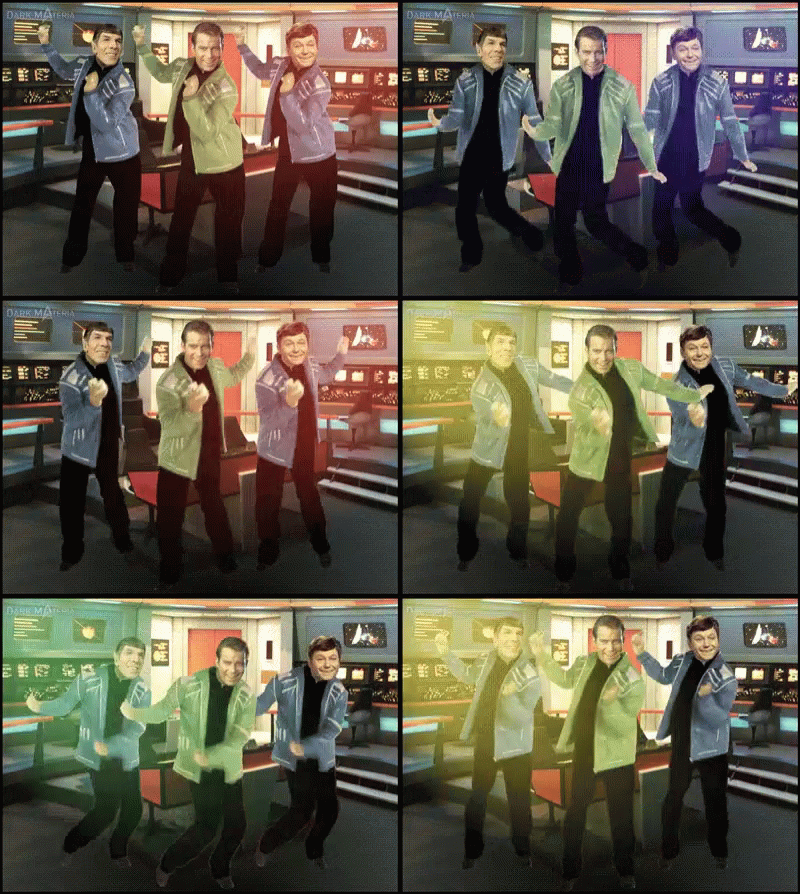
I was patiently waiting for a parallel planet episode where the boys get to beam down to the Disco Planet, but alas Season 4 never arrived…

star-trek-funny.gif
 
It would have been something if TOS lasted through the 70s.
Maybe if it had a run of seven years like TNG. But if TOS had gone only five years as Roddenberry had initially hoped (his 5-year mission) it would have ended its run in ‘71, some years before disco became a thing in the mid ‘70s. Either way we would have thankfully dodged that bullet.
 
Last edited:
Mudd's Women could maybe also be a case of colonist intentionality, but honestly there's just no good excuse for clothes and furnishings on a lithium mining colony to look like Temu Bonanza. It's hard to imagine that anyone loaded up centuries-old rustic (and heavy) furniture into spacecraft and flew it across the galaxy to Rigel XII or Omicron Ceti III, or that they set up woodworking shops on their planets with tools, plans, and materials from three centuries past.

You assume the future was wood. Perhaps it was made from a space age polymer that is much lighter weight and more durable than wood.

Here is how Firefly justified looking like a western complete with horses:

When you’re scratching food out of moon rock without many credits in the bank (if there is a bank), you tend to figure out what’s important pretty quick. Why waste the money on a power-driven tool when an ordinary hammer will do the job? Why worry that your fancy grav-car will break down on you and you can’t get the spare parts, when you can raise your own horses?

Technology is around some, but it’s a lot scarcer and harder to fix. Even broken Cortex datapads or a train’s console can spell disaster if ’n you rely on that tech to get by. Truth be told, that’s why horses are the most common (and cheapest) form of transportation.

Same principle in this case. In-universe these Star Trek settlements are away from the resources of larger Federation worlds. TOS did not depict the Federation as a post-scarcity society with easy access to replicators.
 
Some people just plain like doing things the old-fashioned way. It makes them feel closer to their ancestors, perhaps carry on a timeworn tradition. It's slow and deliberate in the otherwise instant and hectic future. It brings them pleasure to craft something with their own two hands.

Call it LARPing, an alternative lifestyle, being practical, tradition, etc. It'll never disappear completely.
 
Yeah, I understand the old-fashioned preference. I've been married 40 years and our house is largely furnished by antiques, going back to some stuff my parents gave us very early on. It's not for the so-called "investment," it's for emotional comfort and practicality. We like the connection to old things, and how they endure. Antiques rarely break down or go out of style, and they don't report your preferences and habits to algorithms in the cloud.

That said, it's pretty hard to see this as the explanation for flying three- to four-hundred-year-old furniture across the galaxy. Especially when we all know that Sandoval's colony exists as a rustic, 1900s farm on Earth because that's what the production could afford (and what was already available for free at the shooting location).

I guess it would have felt less odd if they had at least mentioned it. Now that I think about it, a good (and easy) lampshading opportunity in TSoP would have been when Sulu and Kelowitz opened the barn to find there were no animals. The issue could have been explained, and the suspense built up even more, with a couple more lines of dialog:

KELOWITZ: [opening the barn door] Hey.
SULU: What is it?
KELOWITZ: No cows. This barn isn't even built for them, just for storage and woodworking.
SULU: Come to think of it, we haven't seen any animals. No horses, no pigs, not even a dog. Nothing. Instead they built this workshop for making... antique chairs and tables? Why?
KELOWITZ: Yeah... And where's all the science gear and collapsible furnishings they would've brought with them?


Of course this approach wouldn't really have made much sense in Mudd's Women. On the other hand, the other approach of seeing colonists bringing their own rustic belongings could have been a pretty easy sale in, say, The Way to Eden. It could've made in-story sense as an intentional plot point like it did in TNG's Up the Long Ladder.

Anyway, I just accept it all as a production reality, like I accept how several planets have Arabic trappings. It's just what they could do with what they had.
 
Last edited:
I know Star Trek looks quite skeptically at any religion, but if God does exist and created Earth and humans, then wouldn't it make sense that He might do the same elsewhere in the galaxy? It still doesn't tell us what He needs with a starship, though.

(Not trying to start a religious debate here; just saying it would be one possible explanation.)
 
If you are not already a member then please register an account and join in the discussion!

Sign up / Register


Back
Top